Moissanite 101 · Shape vs Shape
Moissanite Round vs Pear Cut: Classic Circle or Teardrop?
A pear is a round with a point added. Here is what that point gives you — and what it asks for in return.
Written by the Mapple Gems workshop, Surat · Updated 25 September 2026
Short answer
Choose a round moissanite for the most fire, no points to protect and an easy straight wedding band. Choose a pear for a longer, more distinctive stone — about 8.0 × 5.5 mm at 1 ct DEW against a round's 6.5 mm — with nearly the same sparkle, a V-prong on its point, and a contour band.
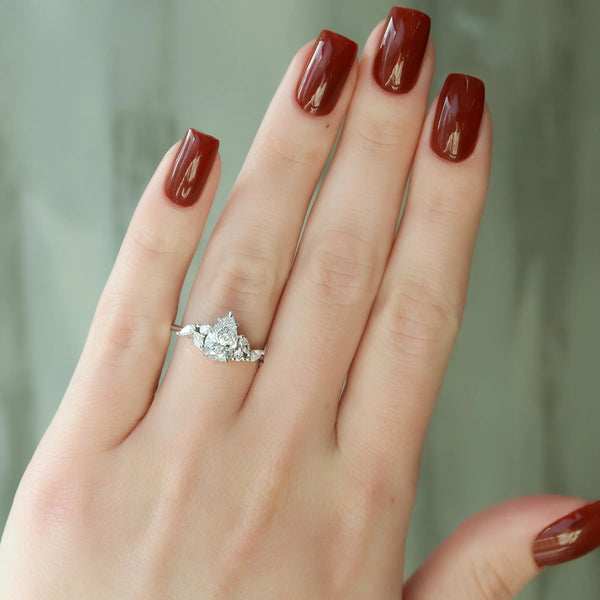
A pear cut is rounded at one end and pointed at the other, like a teardrop. Its round end behaves much like a round brilliant, so it keeps most of the round's sparkle. The point stretches the stone along the finger, which makes it look larger and the hand look longer. Everything else in this comparison follows from that one point.
For all ten moissanite shapes compared, see our moissanite shape comparison.
Round vs pear moissanite at a glance
| Round | Pear | |
|---|---|---|
| Face-up at 1 ct DEW | 6.5 mm | 8.0 × 5.5 mm |
| Face-up at 2 ct DEW | 8.0 mm | about 10 × 6.5 mm |
| Fire | Most of any shape | High, one step below |
| Bow-tie | None | Some, across the widest part |
| Must protect | Nothing | One point — V-prong |
| Symmetry to check | Round outline | Shoulders, point on axis, belly |
| Wedding band | Straight usually fits | Contour |
| Effect on the finger | Balanced | Lengthens |
DEW = diamond equivalent weight. See the moissanite size chart for every size.
Size and sparkle
At 1 ct DEW a pear runs about 8 mm long against a round's 6.5 mm, so it looks noticeably larger from above and makes the finger look slimmer. The round, meanwhile, keeps the top spot for fire: its perfectly symmetrical facets split moissanite's light (dispersion 0.104, more than twice diamond's 0.044) into the most colour of any shape. The pear is close behind, and its point adds a bright flash where the facets converge.
The pear also brings a mild bow-tie — a darker band across its widest part, caused by the stone reflecting what is above it. In a well-cut stone it breaks up as the hand moves. A round has none. Judge a pear on a moving video in ordinary light, never a still photograph.
The point, the V-prong and three symmetry checks
A point is the most exposed part of any stone, so a pear's tip needs a V-prong: a cup of metal shaped around the point. Moissanite has no cleavage planes, which makes it tougher at that tip than a diamond would be, but the point still needs cover. Over the years it is the V-prong, not the stone, that wears — a quick bench check every couple of years keeps it healthy.
A round needs one symmetry check: is it round? A pear needs three. Are the two shoulders even? Does the point sit exactly on the stone's long axis? Is the rounded belly full rather than flat? A pear that fails any of these looks slightly crooked on the hand for as long as it is worn.
From the workshop: the round is the choice you never have to explain.
A round moissanite has nothing to judge except its sparkle: no ratio, no bow-tie, no point, no orientation. It takes any setting, almost always sits flush with a straight band, and has never gone out of fashion. That simplicity is worth something, especially when you are buying without seeing the stone in person.
A pear asks for a few more decisions — which way the point faces, a V-prong, a contour band, a careful look at symmetry — and rewards them with a stone that looks larger and more individual. Neither is the better ring. The question is whether you want the shape that decides everything for you, or the one you decide on.
The wedding band
A round solitaire almost always takes a straight band flush beside it. A pear extends along the finger, so it nearly always needs a contour band shaped around its point, or a gap between the two rings. The point's direction — toward the fingertip or the wrist — must be settled before either ring is made, because the band is shaped to it.
How to decide
- Want maximum sparkle with nothing to judge? Round.
- Want more visible size and a longer finger? Pear.
- Want something more individual? Pear.
- Want a straight band later? Round.
- Choosing pear? V-prong on the point, and check shoulders, point and belly.
- Either way: ask for a moving video — no laboratory grades moissanite.
Keep reading
Frequently asked questions
Does a pear or round moissanite look bigger?
The pear. At 1 ct diamond equivalent weight it measures about 8.0 × 5.5 mm against a round's 6.5 mm, and it runs along the finger, which makes it read larger.
Does a round or pear moissanite sparkle more?
The round shows the most fire of any moissanite shape. A pear is close behind, since its rounded end behaves much like a round brilliant. The difference is small at 1 ct.
Is a pear moissanite less durable than a round?
The stone is equally hard, Mohs 9.25, but a pear's point is exposed and needs a V-prong. A round has no points. With a V-prong, a pear moissanite is fully suited to daily wear.
What should I check on a pear moissanite?
Even shoulders on both sides, a point sitting exactly on the long axis, and a full, rounded belly. Then watch a moving video to check that the bow-tie breaks up as the stone turns.
Will a straight band fit a pear moissanite ring?
Rarely flush. A pear extends along the finger, so it usually needs a contour band shaped around its point. A round solitaire normally takes a straight band.
Circle or teardrop?
Every ring is made to order in our Surat workshop. Ask for a video of the stone before it is set.
Leave a comment