Ring construction
V-Prongs: The Part That Is Meant to Wear Out
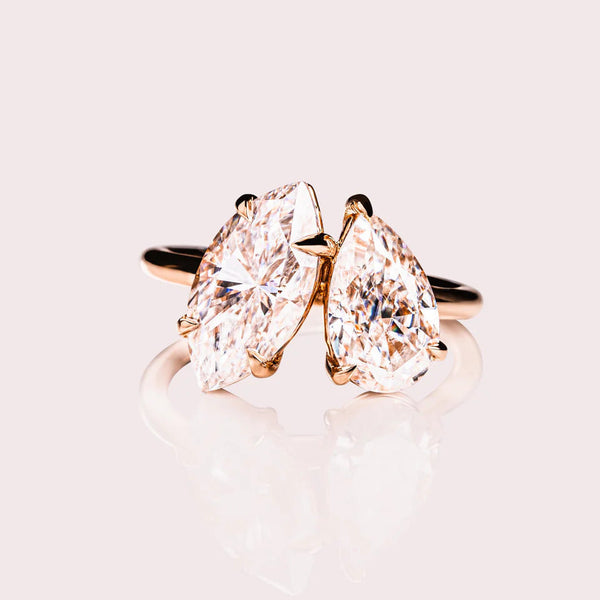
On a marquise, pear or princess, one small piece of metal is the difference between a ring you keep and a stone you replace.
Written by the Mapple Gems workshop, Surat · Updated 23 August 2026
Short answer
A V-prong is a prong shaped to cup a stone's point from two sides rather than gripping it from one. On any pointed shape — marquise, pear, princess, some radiants — it is structural, not decorative. It is also designed to take wear itself: what fails on a marquise is almost always the V-prong, not the stone, and re-tipping it is quick and cheap if caught early.
Hardness and toughness are different properties. Diamond sits at Mohs 10 and moissanite at 9.25, and both numbers describe resistance to scratching. Neither says anything about resistance to a knock. What decides that is where material is thin — and on a pointed stone, the thinnest, most exposed material in the entire gem is the tip.
A standard prong sitting near a point does not solve this. It presses on one face and leaves the tip itself standing proud. A V-prong wraps the point from both sides and forms a metal cap over it, so anything the hand strikes hits gold rather than the stone.
Which shapes need one
| Shape | Points to protect | V-prong needed? |
|---|---|---|
| Marquise | Two, at opposite ends | Yes — on both |
| Pear | One | Yes |
| Princess | Four sharp corners | Yes — on all four |
| Heart | One, plus the cleft | Yes at the point |
| Radiant, emerald, Asscher | Cropped corners — blunt, not sharp | No — but a prong per corner |
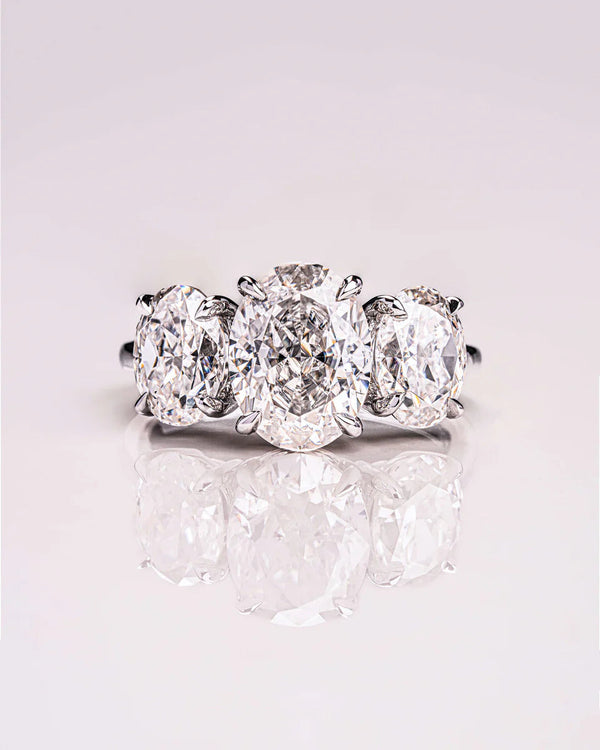
| Oval, round, cushion | None — rounded outline | No |
The marquise is the demanding case because it has two of them, they sit at the extreme ends of a long outline, and the shape is already the most fragile in cutting. A marquise ring offered without V-prongs is not a style variant. It is a build that should be modified before it is made.
How a V-prong is actually made
Setting is not gripping. A setter cuts a seat — a small notch — into the metal, and the stone's girdle sits inside it, supported from below and retained from above. On a V-prong, that seat is cut into two converging faces so the point nests between them, and the metal is then worked over the top to close the cap.
Two consequences follow from that. First, a V-prong holds more securely than a round prong at the same point, because contact is along two surfaces rather than one. Second, the seats survive wear even when the outer metal thins — which is why re-tipping is fast bench work rather than a rebuild.
The part designed to be sacrificed
Prongs do not usually break. They thin, gradually, over years, and a V-prong doing its job on a marquise thins faster than the others because it is the highest and most exposed metal on the ring.
That is the design working. The V-prong is a consumable component protecting an irreplaceable one, in the same way a head can be replaced decades later while the shank, engraving and hallmarks stay. What matters is catching it in time.
Under a 10× loupe, a healthy prong tip is a rounded, clearly defined lip curling over the stone. A worn one looks flattened or squared off, as though the lip has been filed away. That difference is visible years before a stone is at risk, and looking for it takes ten seconds at a two-yearly bench check.
From our bench in Surat
Almost every pointed-stone repair that reaches us is the same job: a V-prong worn thin, caught late. And when we ask, the owner nearly always says the ring has never been checked, because nothing looked wrong. Nothing does look wrong — that is the point of a component that fails slowly.
So the concession is against our own interest, since re-tipping is small work and stone replacement is not: a marquise or pear ring should go on a bench every two years, and we would rather you took it to a good local jeweller than posted it to Surat and back. The reason to return to a maker is information — the CAD file, the exact alloy, the melee spec — not skill. Routine prong work is routine anywhere competent.
V-prongs and the hidden halo
This combination is worth thinking about specifically, because it is the most requested marquise build of the moment.
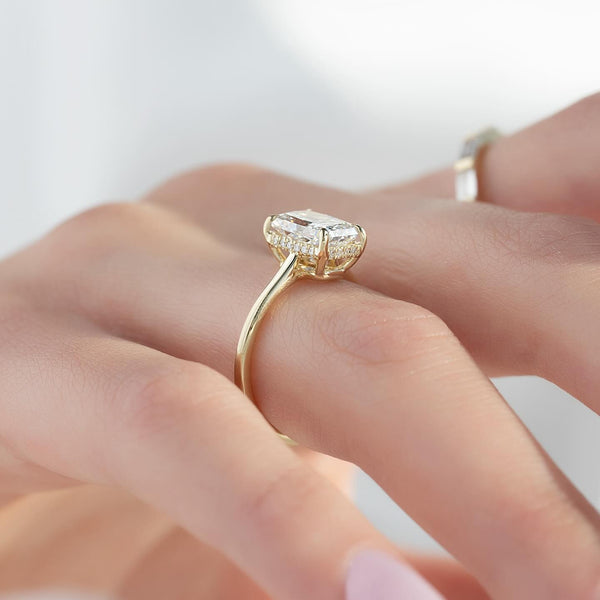
A hidden halo sits beneath the girdle and raises the stone by roughly one to two millimetres. On a rounded shape that is a comfort question. On a marquise it is a leverage question: lifting the stone lengthens the lever arm acting on the two points, so the same knock delivers more force at the tips.
The fix is not to abandon the look. It is to ask for a low-profile hidden halo — halo stones tucked tight under the girdle with the basket shortened to compensate — combined with proper V-prongs at both ends. That is a CAD edit rather than a listed product, so it exists only if you request it.
What to specify
- V-prongs on every point — both ends of a marquise, all four corners of a princess.
- A low-profile head rather than the standard build, if a hidden halo is involved.
- Profile height in millimetres on the side elevation.
- Shank at least 1.8mm at the base; euro shank if worn daily.
- A bench check every two years, diarised, not remembered.
- Tell any jeweller what the stone is before they apply heat.
Keep reading
Frequently asked questions
What is a V-prong?
A prong shaped to cup a stone's point from two converging sides, forming a metal cap over it. On pointed shapes such as marquise, pear and princess it is structural rather than decorative, because the tip is the thinnest and most exposed material in the stone.
Does a marquise ring need V-prongs on both ends?
Yes. A marquise has two points at opposite ends of a long outline, and both are equally exposed. A build that protects only one has left half the problem unsolved.
How do I know if a V-prong is worn?
Under a 10× loupe, a healthy tip is a rounded, clearly defined lip curling over the stone. A worn one looks flattened or squared off. This is visible years before the stone is at risk, which is why a bench check every two years is the whole answer.
Can a worn V-prong be repaired?
Yes. Re-tipping adds metal back to the prong and is quick, because the seats cut into the metal survive even as the outer tip thins. It is routine work for any competent bench and far cheaper than replacing a chipped stone.
Do emerald and radiant cuts need V-prongs?
No, because their corners are cropped rather than sharp. They still need a prong on every corner, since that is where a step cut is thinnest, but a standard prong is sufficient there.
Ask for V-prongs by name
Every piece is made to order in our own workshop in Surat, so prong type, head height and shank thickness are all decided before casting.
Leave a comment