Moissanite 101 · Shape vs Shape
Moissanite Round vs Oval: Fire, Size and Everyday Wear
The two most popular moissanite shapes, compared on the things that actually change once the ring is on your hand.
Written by the Mapple Gems workshop, Surat · Updated 24 September 2026
Short answer
Choose a round moissanite for the most fire, no bow-tie and the easiest wedding-band fit. Choose an oval moissanite if you want the stone to look larger and lengthen the finger: at 1 ct DEW an oval faces up about 7.5 × 5.5 mm against a round's 6.5 mm. Neither has points, so both are equally durable for everyday wear.
Round and oval are the two shapes most people shortlist, and they are closer relatives than they look. An oval is essentially a round brilliant stretched along one axis, so it keeps most of the round's sparkle while gaining length. What changes is how much fire you see, how large the stone reads, one optical quirk the round does not have, and which wedding band will sit beside it.
Moissanite adds a twist that diamond comparisons miss. With a dispersion of 0.104 — more than twice diamond's 0.044 — moissanite shows far more coloured fire, and the shape you choose decides how much of it you get. For every other shape, see our complete moissanite shape comparison.
Round vs oval moissanite at a glance
| Round | Oval | |
|---|---|---|
| Face-up at 1 ct DEW | 6.5 mm | 7.5 × 5.5 mm |
| Face-up at 2 ct DEW | 8.0 mm | about 9 × 7 mm |
| Face-up at 3 ct DEW | 9.0 mm | about 10 × 8 mm |
| Fire | Highest of any shape | Very high, one step below |
| Bow-tie | None | Always present to some degree |
| Ratio to choose | None — always 1.00 | 1.35–1.45 is the classic default |
| Points to protect | None | None |
| Wedding band | Straight usually fits | Often needs a contour |
| Effect on the finger | Neutral, balanced | Lengthens and slims |
DEW = diamond equivalent weight. Moissanite is sold by the millimetre size a diamond of that carat would be. See the moissanite size chart for every size.
Size: the oval looks larger for the same weight
At the same diamond-equivalent weight, an oval spreads across more of the finger. A 1 ct oval is a full millimetre longer than a 1 ct round is wide, and the gap grows with size. Because the oval runs along the finger, it also makes the hand look longer and slimmer — which is why ovals are so often chosen by people with shorter fingers.
One caution: a longer ratio buys length by giving up width. A very elongated oval (1.55 and above) can actually cover less of the finger than a classic 1.40 oval of the same weight. If you want the stone to look big, stay near 1.35–1.45.
Fire and the bow-tie
The round brilliant is the most fiery shape a moissanite can be cut into. Its 57–58 facets are arranged symmetrically around a single centre, so white light is split into colour evenly across the whole stone. An oval uses the same facet idea but stretches it, so its fire is very slightly less even and very slightly calmer.
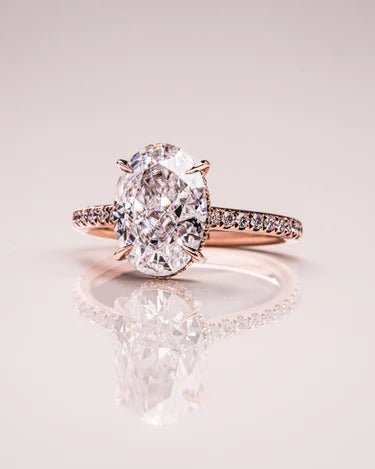
The oval's one quirk is the bow-tie: a darker band across the middle of the stone. It is not a flaw inside the stone — it is the pavilion facets under the waist reflecting whatever is above them, usually your own head. Every oval has one to some degree. A good one breaks up and flickers as the ring moves; a poorly cut one stays as a solid grey band. You can only judge this on a handheld video in an ordinary room, because studio lightboxes hide it on every oval.
A round has no bow-tie at all. If the idea of judging one makes you uneasy, that alone is a good reason to choose round.
From the workshop: with moissanite, size changes the answer.
Moissanite's fire needs depth to develop, so it grows with the size of the stone. At 1 ct the difference between a round and an oval is small. At 3 ct a round moissanite is one of the most colourful rings you can wear — lovely if you want that, conspicuous if you don't. An oval of the same weight spreads its light over a longer table and reads a little calmer, and setting it in yellow or rose gold calms it further, because warm metal reflects into the stone and competes with the coloured flashes.
Our honest advice: if someone tells us they want the most sparkle possible, round is the answer. If they want the stone to look large but not flashy, an oval in warm metal usually gets closer.
Everyday wear and the wedding band
Both shapes are equally tough. At Mohs 9.25, moissanite shrugs off almost everything that touches it, and neither a round nor an oval has a point or corner where chips tend to start. Four prongs are fine to about 2 ct; above that, six prongs on a round, or four prongs placed at the oval's shoulders rather than its tips, hold the stone more securely.
The practical difference shows up when the wedding band arrives. A round solitaire almost always lets a straight band sit flush beside it. An oval extends along the finger, so in many settings the band leaves a gap unless it is contoured or the oval is set higher. Check before the ring is made: hold a straight edge against the side view of the design. Visible daylight means you will want a contour band — and ordering it with the engagement ring is cheaper and fits better than commissioning one later.
How to decide
- Want maximum fire and a classic that never dates? Round.
- Want more visible size for the same budget? Oval, at a 1.35–1.45 ratio.
- Want a longer-looking finger? Oval.
- Want a straight wedding band later? Round, or an oval in a low setting checked at the design stage.
- Going above 3 ct and want it calmer? Oval in yellow or rose gold.
- Either way: ask for a rotating video in ordinary light. No laboratory grades moissanite, so the video is the grading.
Keep reading
Frequently asked questions
Does a round or oval moissanite sparkle more?
A round moissanite shows the most fire of any shape. An oval is very close behind because it uses the same brilliant faceting, stretched along one axis. The difference is small at 1 ct and more noticeable at 3 ct and above.
Does an oval moissanite look bigger than a round?
Yes. At 1 ct diamond equivalent weight an oval measures about 7.5 × 5.5 mm against a round's 6.5 mm, and it runs along the finger, which makes it read larger. Very elongated ovals above a 1.55 ratio lose width, so 1.35–1.45 gives the biggest look.
Do oval moissanites have a bow-tie?
Every oval, moissanite or diamond, has some bow-tie: a darker band across the middle caused by the pavilion reflecting what is above it. A well-cut oval's bow-tie breaks up as the ring moves. Judge it on a handheld video in ordinary light, never a still photograph.
Which is more durable, round or oval moissanite?
They are equally durable. Both are Mohs 9.25 and neither shape has points or corners where chips start. The setting matters more than the shape: a shank at least 1.8 mm thick and six prongs above about 2 ct.
Will a straight wedding band fit an oval moissanite ring?
Often not flush. An oval extends along the finger, so many oval settings need a contour band or a slightly higher head. A round solitaire usually takes a straight band. Check with a straight edge against the side of the design before the ring is made.
Still between round and oval?
Every ring is made to order in our Surat workshop. Tell us the size you're considering and we'll send the exact millimetres for both shapes.
Leave a comment