Moissanite 101
Moissanite Shapes Compared: Every Cut, Side by Side
Round, oval, pear, marquise, heart, cushion, radiant, princess, Asscher and emerald — compared on the same eight measures, with the millimetres, ratios and trade-offs that decide which one belongs on your hand.
Written by the Mapple Gems workshop, Surat · Updated 23 September 2026
Short answer
There is no single best moissanite shape — every shape trades face-up size, fire and durability against each other. Round shows the most fire. Marquise, pear and oval look largest for their weight. Emerald and Asscher show the least rainbow and read calmest. Pointed shapes need metal over every tip. And because no lab grades moissanite, compare shapes in millimetres, never carats.
Moissanite is silicon carbide (SiC), a stone first identified by the chemist Henri Moissan in 1893 in fragments of the Canyon Diablo meteorite in Arizona. Every moissanite in jewellery today is grown in a laboratory. It is not a diamond — it is harder than almost everything else you own, it throws far more coloured fire than a diamond, and it behaves differently in each shape. That last point is the reason this guide exists.
Shape is the most visible decision in a ring, and it quietly sets four other things at once: how large the stone looks, how much rainbow it shows, which parts of it need protecting, and whether a straight wedding band will ever sit flush against it. Below, all ten common moissanite shapes are compared on the same measures, from the bench where we set them in Surat, Gujarat.
All ten moissanite shapes at a glance
| Shape | Face-up at 1 ct DEW | Classic L:W ratio | Fire (1 = most) | Must protect | Wedding band |
|---|---|---|---|---|---|
| Round | 6.5 mm | 1.00 | 1 | Nothing — no points | Straight usually fits |
| Cushion (crushed ice) | 6.0 × 6.0 mm | 1.00–1.05 | 1 | Corners | Straight usually fits |
| Oval | 7.5 × 5.5 mm | 1.35–1.45 | 2 | Nothing — no points | Often contour |
| Pear | 8.0 × 5.5 mm | 1.50–1.70 | 2 | V-prong on the tip | Contour |
| Marquise | 10.0 × 5.0 mm | 1.90–2.00 | 2 | V-prongs on both points | Contour (hardest fit) |
| Heart | about 6.5 × 6.5 mm | 0.90–1.10 | 2 | V-prong on the point | Depends on setting |
| Radiant | 6.5 × 5.0 mm | 1.20–1.35 | 3 | Each cropped corner | Depends on setting |
| Princess | 5.5 × 5.5 mm | 1.00–1.05 | 4 | Four sharp corners | Depends on setting |
| Cushion (chunky) | 6.0 × 6.0 mm | 1.00–1.05 | 5 | Corners | Straight usually fits |
| Asscher | 5.5 × 5.5 mm | 1.00–1.05 | 6 | Each cropped corner | Depends on setting |
| Emerald | 7.0 × 5.0 mm | 1.40–1.50 | 7 (least) | Each cropped corner | Often contour |
DEW = diamond equivalent weight. Moissanite is sold by the size a diamond of that carat would be, so the millimetres are the real specification. Fire rank is relative within moissanite; shapes sharing a number perform alike. Full size tables for 0.5–5 ct are in our moissanite size chart.
The three trade-offs every shape makes
1. Face-up size per carat
The same diamond-equivalent weight is a 10 mm stone or a 5.5 mm one depending only on shape. Elongated shapes — marquise, pear, oval — spread their weight across the face, where you see it. Square step cuts — Asscher and princess — carry more of it in the depth, where you don't. If visible size is your priority, choosing the shape matters more than any other decision you will make. See which shapes look biggest for the carat.
2. Fire — the coloured flashes
Moissanite's dispersion is 0.104, against 0.044 for diamond — more than twice as much white light is split into colour. Many small, steep facets scatter that colour everywhere (round, crushed-ice cushion); a few long, flat facets restrain it (emerald, Asscher). That gives moissanite buyers a control no diamond buyer has: you choose how much rainbow you want by choosing the shape. The full ranking is in moissanite shapes ranked by fire.
3. Durability — points and corners
At Mohs 9.25 moissanite resists scratching from nearly everything, including the quartz in household dust (Mohs 7). But hardness is not toughness. Chips happen at points and thin corners, so pear, marquise and heart need a V-prong over every tip, and princess, radiant, Asscher and emerald need a prong on each corner — never only on the flat sides. Round and oval have no points at all, which is a genuine practical advantage that most shape guides leave out. More in V-prongs: the part that is meant to wear out.
From the workshop: shape and size multiply each other — and that runs the opposite way to how most people shop.
Dispersion needs depth to develop. Below roughly 3 mm there is barely enough stone for colour to separate, so a small moissanite reads almost exactly like a diamond — which is why tennis bracelets, eternity bands and pavé are where moissanite is hardest to tell apart. Above roughly 7 mm the rainbow becomes unmistakable. So a large round moissanite is the most colourful combination you can buy, and a large emerald cut is the calmest.
One more number worth knowing: moissanite is about 15% less dense than diamond (specific gravity 3.21 against 3.52). A 6.5 mm "1 ct" round moissanite actually weighs around 0.88 ct. That is why we quote and compare every shape in millimetres — the carat figure on a moissanite listing is a size statement, not a weight.
Moissanite vs diamond: how the comparison changes by shape
People often search for "moissanite diamond shapes" as though the two were the same stone. They are not, and the differences show more in some shapes than others.
| Property | Moissanite | Diamond (mined or lab grown) |
|---|---|---|
| Composition | Silicon carbide (SiC) | Carbon (C) |
| Hardness (Mohs) | 9.25 | 10 |
| Refractive index | 2.65–2.69 | 2.42 |
| Dispersion (fire) | 0.104 | 0.044 |
| Specific gravity | 3.21 | 3.52 |
| Refraction | Doubly refractive | Singly refractive |
| Cleavage planes | None | Yes — can split along them |
| Cut grade from a lab | None, on any shape | Round brilliants only (GIA, IGI) |
Brilliant shapes widen the gap. On a large round, oval, pear or marquise, moissanite's extra fire is the first thing a trained eye notices. Step cuts narrow it. An emerald or Asscher moissanite shows far less colour, so it is the shape to choose if you want a calmer, more diamond-like presence at a larger size. Pointed shapes favour moissanite on toughness: it has no cleavage planes, so the tip of a pear or marquise is less prone to splitting than the same point on a diamond — though it still needs its V-prong. For the full stone-versus-stone picture, read our honest moissanite vs diamond comparison.
Shape by shape: what to know before you order
Round
The most fire of any shape and the only one with no ratio to judge, no points and no bow-tie. It suits every setting and almost always takes a straight wedding band. The trade-off is that it faces up smallest among the brilliants for its weight, and at large sizes its colour is at its most obvious. Round moissanite rings.
Oval
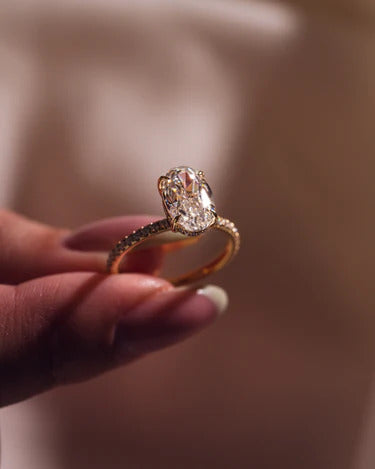
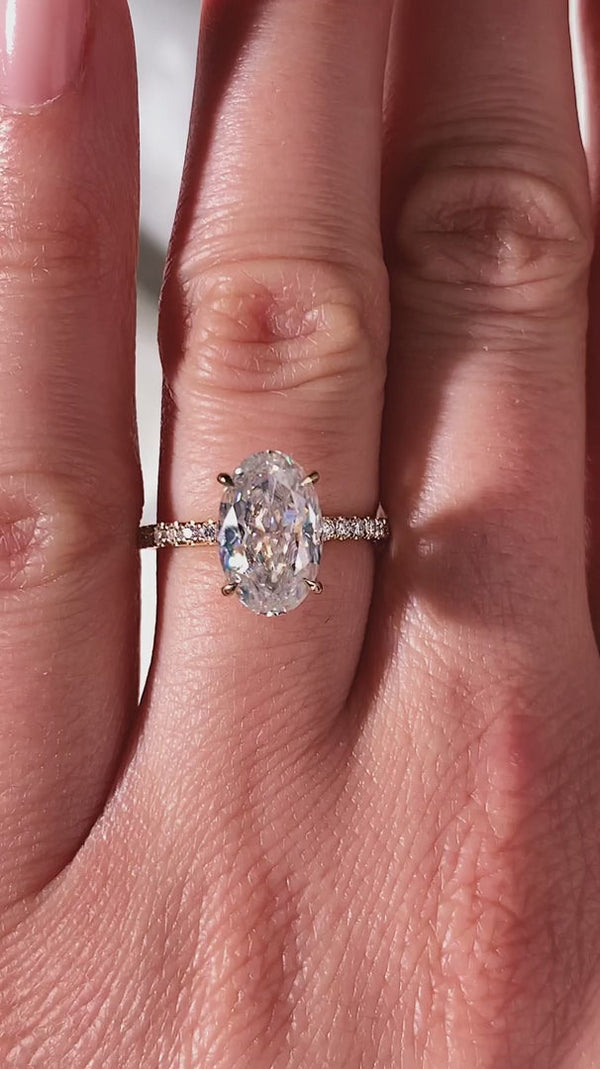
Nearly round-level sparkle with about 15% more face-up length, no points to protect, and a flattering line along the finger. Its one quirk is the bow-tie — a dark band across the middle that is really your own reflection — so judge any oval on a handheld video in an ordinary room, never a still photograph. A 1.35–1.45 ratio is the safe default. Oval moissanite rings.
Pear
A round at one end and a point at the other, facing up slightly larger than an oval of the same weight. The point is the most exposed feature of any brilliant, so a V-prong is structural rather than decorative. Check that both shoulders match and that the point sits exactly on the long axis. Pear moissanite rings.
Marquise
The most face-up size per carat of any shape — roughly 10 × 5 mm at 1 ct — and the strongest lengthening effect on the finger. It has the narrowest good ratio window (1.90–2.00), two points needing V-prongs, and the hardest wedding-band fit in jewellery. Above about 3 ct, measure the flat span between your knuckle joints first: a long marquise can overhang it. Marquise moissanite rings.
Heart
A statement shape rather than an everyday one. The cleft and the point both need good cutting, and the outline only reads clearly at larger sizes — small hearts tend to look like slightly odd rounds. Protect the point with a V-prong. Best suited to right-hand rings and pendants.
Cushion
A square or slightly rectangular stone with softly rounded corners. The decisive variable appears on no listing: crushed ice faceting (many small facets, a glittering shimmer, among the most fiery shapes) versus chunky or antique faceting (fewer, larger flashes, a calmer vintage look). Two cushions with identical specifications can look nothing alike, so ask which one you are getting — see crushed ice or chunky. Cushion moissanite rings.
Radiant
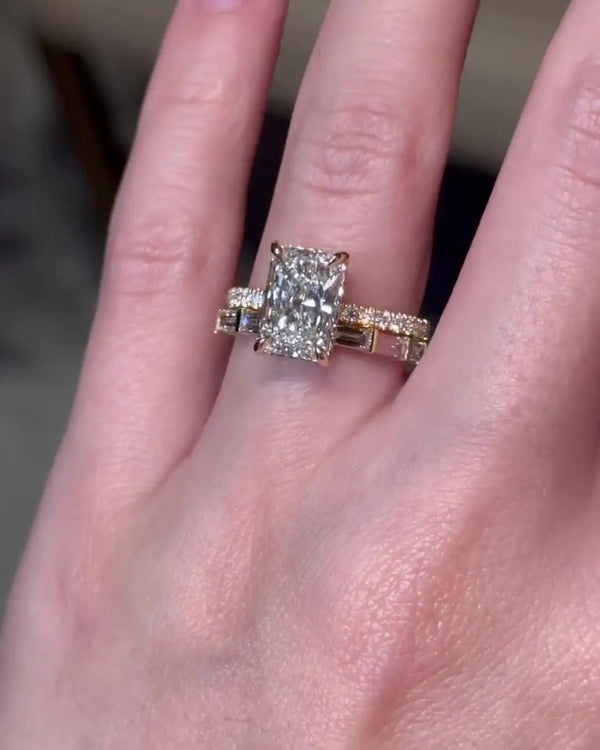
A rectangle or square with cropped corners and brilliant faceting — an emerald's outline with much of a round's sparkle. It sits in the middle of the fire ranking, which makes it a good compromise for anyone who wants a geometric shape without the calm of a step cut. A prong on each cropped corner. Radiant moissanite rings.
Princess
A crisp modern square with pointed corners. It faces up small for its weight and those four sharp corners are its chip risk, so a prong must sit over each one. A clean choice for minimal, architectural designs. Princess moissanite rings.
Asscher
A square step cut with deeply cropped corners and a hall-of-mirrors look from above. It shows very little rainbow, which makes it one of the most diamond-like moissanite shapes at larger sizes. Step cuts are a window rather than a mirror, so cutting quality shows plainly — judge it on a straight-down video with the facet lines parallel. Asscher moissanite rings.
Emerald
A long rectangular step cut: length and presence with the least fire of any moissanite shape. For a large stone that reads calm rather than colourful, it is the strongest choice we know of. It usually needs a contour band, and every corner needs a prong. Emerald moissanite rings.
Which shape suits which hand?
Apparent size is a ratio between stone and finger, so the same stone reads very differently on different hands — a 5.8 mm stone on a size 4 finger looks about as large as a 7 mm stone on a size 7. Elongated shapes (oval, pear, marquise, emerald) make shorter or wider fingers look longer. Rounder shapes (round, cushion, Asscher) balance long, slim fingers. For very active hands, a round or oval in a low setting — or a bezel — removes both the points and the height that catch.
Choosing your shape in six steps
- Decide how much fire you want. Maximum colour: round or crushed-ice cushion. Calm and diamond-like: emerald or Asscher. Everything else sits in between.
- Decide the face-up size in millimetres, not carats. Cut a paper shape to the stated measurements and hold it on your finger — it prevents most size disappointments.
- Check what needs protecting. V-prongs on every point; a prong on every corner; or a bezel if you would rather not think about it again.
- Choose the metal alongside the shape. Yellow and rose gold reflect warmth into the stone and visibly calm its fire; white gold and platinum let it show fully.
- Plan the wedding band now. Hold a straight edge against the side of the ring or its CAD side view. Daylight underneath means you will need a contour band — cheaper and better fitted if ordered with the ring.
- Ask for a rotating video in ordinary light. No lab grades moissanite cut on any shape, so the video is the grading. Our guide to moissanite cut quality explains what to look for.
Keep reading
Frequently asked questions
Which moissanite shape sparkles the most?
Round brilliant, closely followed by crushed-ice cushion. Their many small, steep facets split light into the most colour. Oval, pear, marquise and heart come next, then radiant and princess. Emerald and Asscher step cuts show the least fire of any moissanite shape.
Which moissanite shape looks biggest?
Marquise, at about 10 × 5 mm for 1 ct diamond equivalent weight, followed by pear (8 × 5.5 mm) and oval (7.5 × 5.5 mm). A round is 6.5 mm, while princess and Asscher are about 5.5 mm. Elongated shapes carry their weight in the face, where it is seen.
Which moissanite shape looks most like a diamond?
At larger sizes, emerald and Asscher step cuts, because their long flat facets restrain moissanite's fire. At small sizes, under about 3 mm, every shape reads very close to diamond because there is too little depth for colour to separate. Moissanite is still not a diamond, and a loupe shows its double refraction.
Which moissanite shape is most durable?
Round and oval, because they have no points or corners, which is where chips happen. Every moissanite shape is Mohs 9.25 and scratch-resistant, and moissanite has no cleavage planes. Pointed shapes are perfectly wearable when each point is covered by a V-prong or bezel.
Is moissanite graded for cut on any shape?
No. Laboratories such as GIA and IGI do not grade moissanite for cut, colour or clarity, on any shape. A seller's grade is their own assessment. Compare stones by measured millimetres and depth, and judge cutting on a rotating video in ordinary indoor light.
Tell us the shape. We'll give you the millimetres.
Every moissanite ring is made to order in our Surat workshop. Send us the shape and size you are considering, and we'll tell you its exact measurements, what it needs protecting, and which band will sit against it.
Leave a comment