Moissanite 101
Moissanite Size Chart: Millimetres by Shape
The reference table to buy from — because the carat figure on a moissanite listing is a size statement, not a weight.
Written by the Mapple Gems workshop, Surat · Updated 13 September 2026
Short answer
Moissanite is about 15% less dense than diamond, so it is quoted in diamond equivalent weight — the weight a diamond of those dimensions would have. A “1 ct” round moissanite is 6.5 mm across and actually weighs nearer 0.88 ct. Nothing is hidden by this; it is a size statement written in weight language. Buy by millimetres, which mean the same thing in every material and every country.
This is the single most useful page to keep open while shopping. Every shape below is given by its face-up dimensions, because that is what you see on a hand — and it is the only figure that compares fairly between moissanite, lab grown diamond and mined diamond.
Round brilliant
| Diameter | Sold as (DEW) | True moissanite weight |
|---|---|---|
| 4.0 mm | 0.25 ct | ~0.22 ct |
| 5.0 mm | 0.50 ct | ~0.44 ct |
| 5.8 mm | 0.75 ct | ~0.66 ct |
| 6.2 mm | 0.90 ct | ~0.79 ct |
| 6.5 mm | 1.00 ct | ~0.88 ct |
| 7.4 mm | 1.50 ct | ~1.32 ct |
| 8.1 mm | 2.00 ct | ~1.76 ct |
| 9.3 mm | 3.00 ct | ~2.64 ct |
Approximate, and dependent on cut proportions. Always ask for the actual measured dimensions.
Doubling the carat figure does not double the size — and this is the most useful thing on this page. Going from 0.50 to 1.00 ct takes the diameter from 5.0 mm to 6.5 mm: about 30% wider, not twice as big. Weight scales with volume while the visible face scales with area, so most of what you pay for in a bigger stone is depth you never see. That is the arithmetic behind two practical recommendations: buy just under the round numbers (0.90 measures 6.2 mm against 6.5 mm for 1.00 — three tenths of a millimetre nobody detects, at a substantially lower price), and spend the difference on construction, which is what decides whether the ring survives twenty years.
Fancy shapes at 1 ct DEW
| Shape | Typical mm at 1 ct DEW | Common ratio |
|---|---|---|
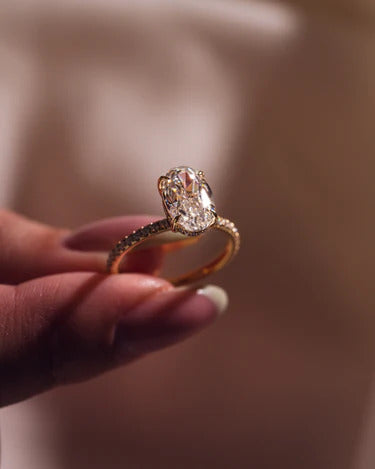
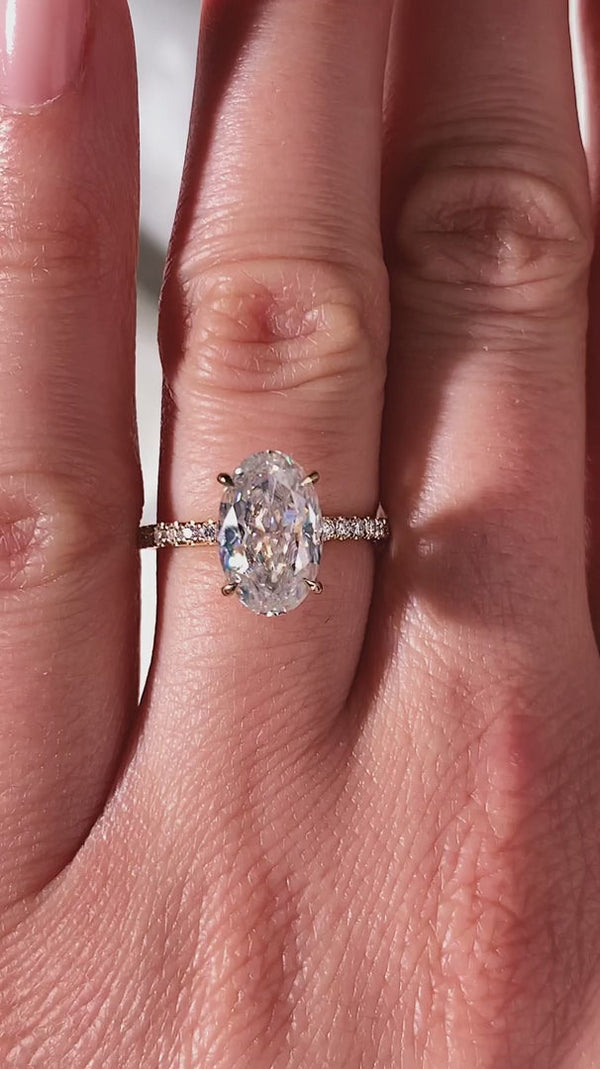
| Oval | 7.5 × 5.5 | 1.35 – 1.45 |
| Pear | 8.0 × 5.5 | 1.45 – 1.55 |
| Marquise | 10.0 × 5.0 | 1.90 – 2.10 |
| Emerald | 7.0 × 5.0 | 1.35 – 1.50 |
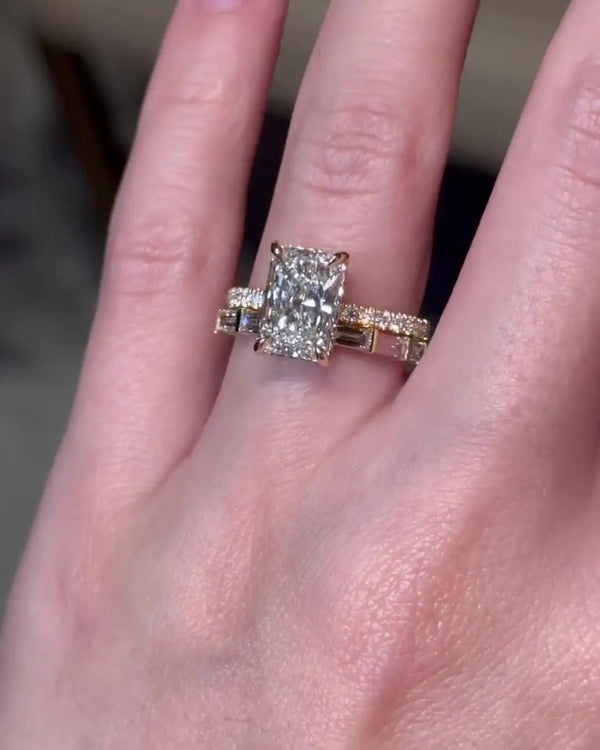
| Radiant | 6.5 × 5.0 | 1.20 – 1.40 |
| Cushion | 6.0 × 6.0 | 1.00 – 1.20 |
| Princess | 5.5 × 5.5 | 1.00 |
| Asscher | 5.5 × 5.5 | 1.00 |
Note how differently the same nominal weight presents: a marquise at 1 ct spans 10 mm along the finger while an Asscher spans 5.5 mm. Elongated shapes carry more of their weight in the face and therefore look larger; square shapes hide more of it in depth.
Small sizes, for accents and studs
The sizes that matter for pavé, side stones, hoops and earrings — and where moissanite is at its strongest, since there is too little depth for the extra dispersion to build.
- 1.0–1.5 mm — pavé and micropavé accents.
- 1.5–2.0 mm — a typical pavé band or halo row.
- 2.5–3.0 mm — tennis bracelet stones.
- 3.0–4.0 mm — everyday studs, second and third piercings.
- 5.0 mm — a 0.5 ct DEW stud, which is what “1 ct studs” usually means per ear.
How to use this when buying
- Ask for the measured millimetres, not the carat figure. Length, width and depth for a fancy shape.
- Check them against this table. A stone measuring noticeably larger than standard for its DEW has been cut shallow to spread — more face, less life.
- Cut a paper circle at the stated size and put it on the actual finger. It is cruder than any render and far more informative.
- Ask for the ratio on elongated shapes — the same weight looks quite different at 1.35 and 1.55.
- Compare like with like. When comparing across sellers or materials, compare millimetres only.
Keep reading
Frequently asked questions
How big is a 1 carat moissanite in millimetres?
A round “1 ct” moissanite measures about 6.5 mm across — the same face-up size as a 1 ct diamond — and actually weighs nearer 0.88 ct, because moissanite is roughly 15% less dense. The carat figure is a size statement written in weight language, so buy by millimetres.
Does doubling the carat weight double the size?
No. Going from 0.50 to 1.00 ct takes a round from 5.0 mm to 6.5 mm — about 30% wider. Weight scales with volume while the visible face scales with area, so most of the extra weight is depth you never see. Buying just under a round number gives nearly the same visible size for meaningfully less.
Why do shapes of the same carat look different sizes?
Because elongated shapes carry more of their weight in the face while square shapes hide more in depth. At 1 ct DEW a marquise spans about 10 mm along the finger while an Asscher spans about 5.5 mm — the same nominal weight, very different presence.
What if a stone measures bigger than the chart says?
Treat it as a warning rather than a bonus. A stone measuring noticeably larger than standard for its stated weight has usually been cut shallow to spread the face — more surface area, less light returned. Ask for video in ordinary light and check for permanently dark zones.
Ask us for the measured millimetres.
Length, width and depth — and we will tell you if a stone is spread shallow for its weight.
Leave a comment