Moissanite 101
Moissanite vs Diamond: The Honest Comparison
Including the parts that do not favour us.
Written by the Mapple Gems workshop, Surat · Updated 17 August 2026
Short answer
Moissanite is silicon carbide (SiC). Diamond is crystalline carbon. They are different minerals, and moissanite is never a diamond. Moissanite is slightly softer (Mohs 9.25 vs 10), noticeably more dispersive (0.104 vs 0.044, so more coloured fire), about 15% less dense, and costs a fraction of the price. Diamond wins on resale, on absolute hardness, and on being unquestionably a diamond.
Almost every comparison of these two stones is written by someone who sells one of them. We sell moissanite, so treat this the way you would treat any seller’s comparison: check the numbers, and pay attention to the parts where we concede.
The numbers, side by side
| Property | Moissanite | Diamond |
|---|---|---|
| Composition | Silicon carbide (SiC) | Carbon (C) |
| Mohs hardness | 9.25 | 10 |
| Refractive index | 2.65 – 2.69 | 2.42 |
| Dispersion (fire) | 0.104 | 0.044 |
| Specific gravity | 3.21 | 3.52 |
| Refraction | Doubly refractive | Singly refractive |
| Origin | Lab grown (natural SiC is meteoric and unusably rare) | Mined or lab grown |
| Graded on D–Z / FL–I3 | No | Yes (mined); lab grown changed in Oct 2025 |
| Typical price, 6.5 mm round | Low hundreds | Thousands (mined), high hundreds to ~$1,500 (lab grown) |
Hardness: the difference is smaller than it reads
Mohs 9.25 against Mohs 10 looks like a near miss. It is not a linear scale, so that reading is misleading in both directions. Diamond is genuinely far harder than moissanite in absolute terms — the jump from 9 to 10 is the largest step on the entire scale.
But hardness only matters relative to what a stone actually meets. Ordinary household dust contains quartz at Mohs 7. That is what abrades jewellery day to day. Both stones are comfortably above it, which is why neither goes dull with wear, and why cubic zirconia at 8.5 does. For everyday durability, 9.25 and 10 are functionally the same answer.
Toughness is a separate property from hardness. Diamond has perfect cleavage in four directions; moissanite does not. In practice both chip at exposed points and girdles if you hit them hard enough.
Fire: the real visual difference, and it scales
Dispersion is how strongly a stone splits white light into spectrum colours. Moissanite’s 0.104 against diamond’s 0.044 means roughly 2.4 times the coloured flash.
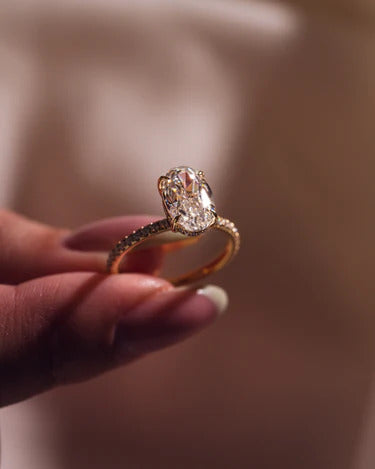
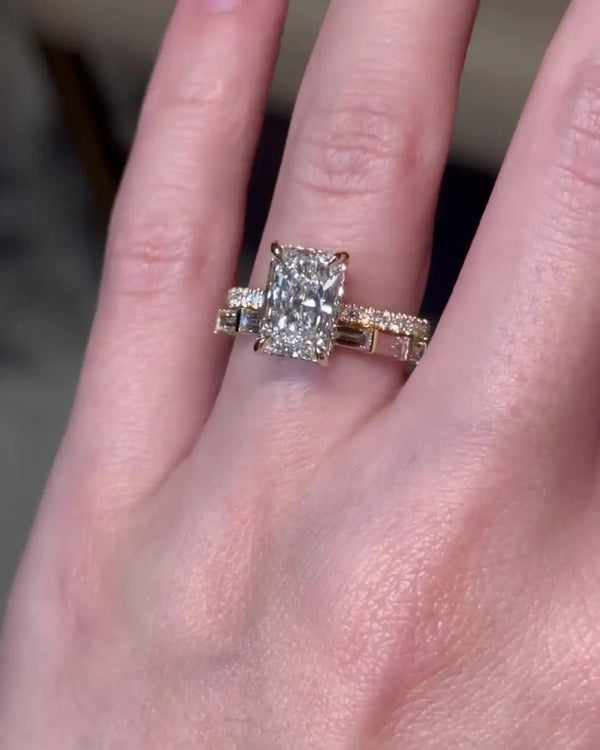
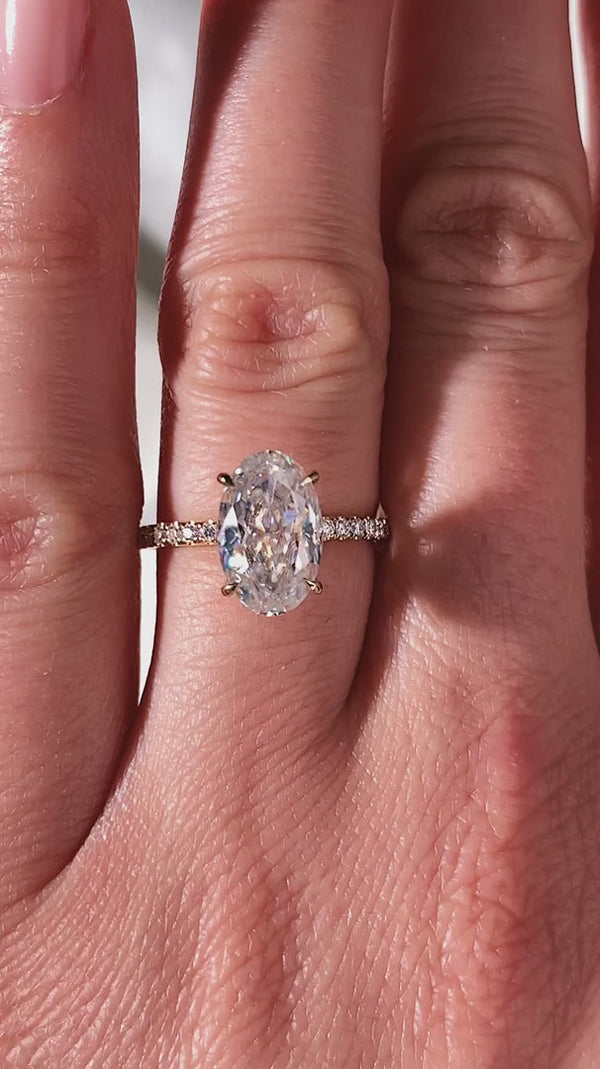
Here is the part that matters and that most comparisons leave out: the effect scales with the size of the stone. In a 4 mm stud, nobody on earth is going to notice. In a 9 mm centre stone under a restaurant spotlight, the rainbow flash is visible and it does not look like diamond. So the bigger the moissanite, the less it passes — which is the exact opposite of what people assume when they size up.
Whether that is a fault depends entirely on what you want. Plenty of people choose moissanite for the fire, not despite it.
Where diamond genuinely wins. Resale. A mined diamond has a decades-old second-hand market and a predictable, if unflattering, floor. Moissanite has almost none. Neither does lab grown diamond, now that new-stone prices have fallen so far that an older stone competes against cheaper current production. If you are buying partly as a store of value, moissanite is the wrong purchase and we will tell you so. Buy it to wear.
Can anyone tell them apart?
By eye, at small sizes, no. At larger sizes, a person who knows what to look for can often pick it out from the fire alone.
Under magnification it is straightforward. Moissanite is doubly refractive, so looking through the table at an angle, a jeweller sees the back facet edges appear doubled. Diamond, being singly refractive, never does this. A basic thermal diamond tester will read moissanite as diamond because both conduct heat well; a combination thermal-and-electrical tester separates them immediately.
We say this plainly on every product page: moissanite is moissanite. We never describe it as a diamond, and any seller who does is telling you something about themselves.
The third option: lab grown diamond
The comparison is no longer two-way. Lab grown diamond is chemically and optically diamond, and its price fell steeply between 2020 and 2024 before flattening near production cost. A well-cut certified 1 ct round now sits somewhere between the high hundreds and about $1,500 at a fairly priced seller — and often 40–60% more than that at legacy retailers who never repriced.
That narrowed the gap to moissanite from roughly five-to-one down to closer to two-to-one. If “it must actually be a diamond” matters to you at all, that gap is now small enough to be worth crossing. If size-for-money is the goal, moissanite is still ahead.
One thing changed in October 2025 that affects how you read certificates: GIA stopped issuing D–Z colour and FL–I3 clarity grades for lab grown diamonds, replacing them with a broader “Premium” or “Standard” assessment. IGI still issues the granular numbers, and grades most lab grown production. Reports issued before that date keep their letter grades.
So which should you buy?
- Choose moissanite if you want the largest, brightest stone your budget allows, you are comfortable telling people what it is, and you are buying something to wear rather than to hold.
- Choose lab grown diamond if the word “diamond” matters, you want a granular certificate, or you want the classic look at a large size without the mined price.
- Choose a mined diamond if resale value, geological origin, or an heirloom framing genuinely matters to you. Those are real reasons and we are not going to argue you out of them.
Keep reading
- Round brilliant moissanite engagement rings — why the stone is sold in millimetres
- Lab Grown Diamonds — certificates, pricing and cutting
- Shop moissanite engagement rings
Frequently asked questions
Is moissanite a diamond?
No. Moissanite is silicon carbide and diamond is crystalline carbon — two different minerals with different optical and physical properties. Moissanite is a diamond alternative, not a type of diamond, and should never be described as one.
Does moissanite pass a diamond tester?
A basic thermal tester will read moissanite as diamond, because silicon carbide conducts heat similarly. A combination thermal-and-electrical tester distinguishes them, because moissanite conducts electricity and diamond does not. Most jewellers now use the combination type.
Is moissanite cheaper than lab grown diamond?
Yes, but the gap has narrowed sharply. Lab grown diamond prices fell steeply between 2020 and 2024 and have since flattened near production cost, taking the ratio from roughly five-to-one down to closer to two-to-one for comparable sizes.
Does moissanite hold its value?
No, and neither does lab grown diamond. There is no established second-hand market for either, and falling new-stone prices mean an older stone competes with cheaper current production. The gold in a piece has a predictable scrap floor by weight and karat; the stone is where the loss sits. Buy a moissanite because you want to wear it, not as a store of value.
Which sparkles more, moissanite or diamond?
Moissanite produces more coloured fire, because its dispersion of 0.104 is roughly 2.4 times diamond’s 0.044. Diamond produces a whiter, more restrained brilliance. Neither is objectively better — but the difference becomes more visible as the stone gets larger, so a big moissanite reads less like a diamond than a small one does.
We make both, in our own workshop in Surat.
Moissanite and IGI-certified lab grown diamond, cut and set to order. Ask us which suits what you actually want — we will tell you straight.
Leave a comment