Moissanite 101
Moissanite Cut Quality: The Thing No Certificate Will Tell You
Nobody grades moissanite for cut. So the difference between a good stone and a poor one is entirely on you to see.
Written by the Mapple Gems workshop, Surat · Updated 31 August 2026
Short answer
No major laboratory issues a cut grade for moissanite — cut grading systems were built for diamond. So two stones sold as “1 ct DEW, D-E-F” can perform completely differently, and nothing on paper distinguishes them. Judge by video, moving, in ordinary light, looking for four things: even facet junctions, no permanently dark zones, a symmetrical outline, and a table that is not oversized. Cut is the single largest factor in how a moissanite looks, and it is the one nobody quotes.
Colour grades get quoted constantly for moissanite, even though no laboratory assigns them. Cut — which affects appearance far more — gets quoted almost never. That is worth reversing, because it is where the actual difference between two stones lives.
Why there is no grade to rely on
Cut grading, as GIA and others apply it, is a diamond system. It assesses proportions against how diamond behaves optically — its refractive index, its dispersion, the way light travels through it.
Moissanite has a refractive index of roughly 2.65–2.69 against diamond’s 2.42, and dispersion of 0.104 against 0.044. Light behaves differently inside it, and proportions optimal for diamond are not necessarily optimal here. Applying a diamond cut grade would be measuring against the wrong target.
The practical consequence: you are the cut grader. That sounds daunting and is not — the four checks below take about a minute each.
The four checks
- Facet junctions should meet cleanly. Look at where facets meet along the crown. In a well-cut stone the lines are crisp and the points converge; in a poorly cut one the junctions are slightly offset and the pattern looks blurred rather than sharp. This is the single most reliable indicator of careful cutting.
- No zone should stay dark through a full rotation. Flashing on and off is correct. A patch that remains dark as the stone turns means light is leaking out of the bottom — usually a pavilion cut too deep or too shallow.
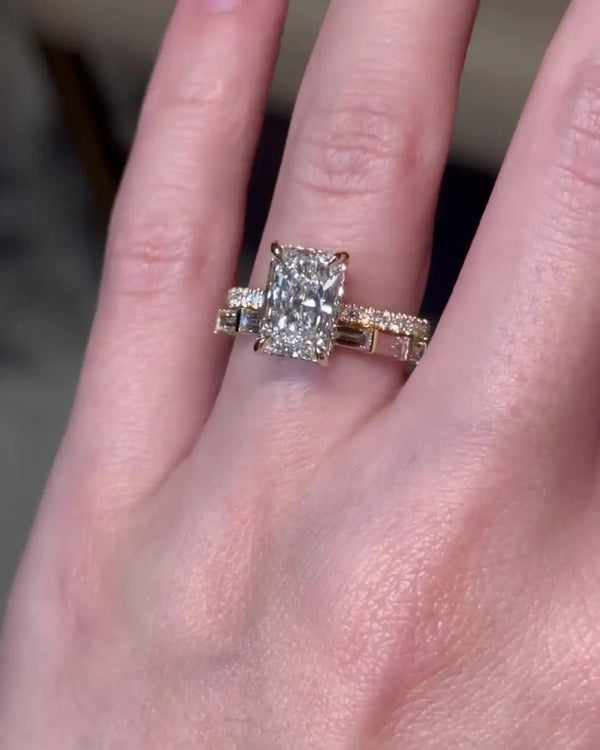
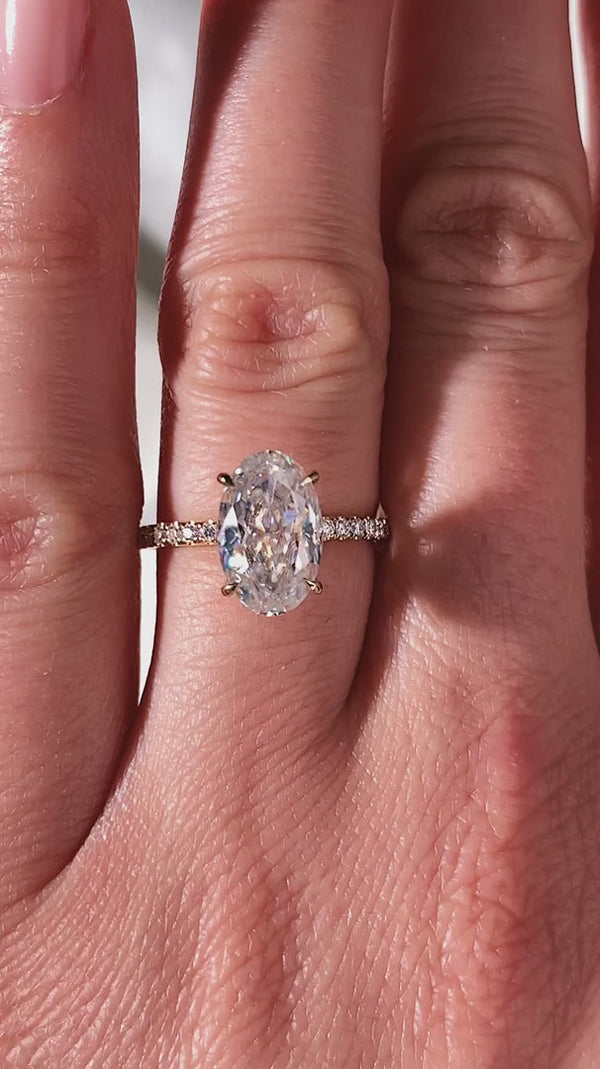
- The outline should be symmetrical. Halve it mentally: both sides should mirror each other. On elongated shapes especially, uneven shoulders make a correctly set stone look tilted on the finger.
- The table should not dominate. An oversized flat top spreads the stone wider for its weight — which sounds like a bargain and produces a glassy, lifeless look with less fire. If a stone measures noticeably larger than the standard millimetre figure for its DEW, that is why.
The trap: a moissanite that measures bigger than it should. Because moissanite is sold by diamond equivalent weight, some stones are cut shallow to spread wider — so a “1 ct DEW” stone measures 6.8 mm instead of 6.5 mm. It looks like free size. It is not: a shallow stone leaks light through its base and reads flat and glassy, and the extra 0.3 mm is not visible to anyone while the loss of life is. Check the millimetre figure against the standard for that DEW. Slightly under is a good sign. Noticeably over is a warning.
Faceting style is a separate question
Do not confuse cut quality with cut style. A crushed-ice cushion and a chunky antique cushion can both be beautifully cut; they simply do different things with light.
What varies with style, for moissanite specifically:
- Many small facets — brilliant rounds, crushed ice cushions, ovals. Maximum scattered rainbow fire. The most obviously moissanite look.
- Few large facets — emerald, Asscher, chunky antique cushions. Broad restrained flashes. The most diamond-like look.
- Hearts-and-arrows style faceting — precision-cut rounds showing a symmetrical pattern under a scope. In moissanite this is a mark of careful cutting rather than a graded standard, so treat it as evidence of care, not as a certified claim.
What to ask a seller
- Video of the actual stone, rotating, in ordinary indoor light — not a lightbox, which flatters everything equally.
- The millimetre dimensions, so you can check them against the standard for that DEW.
- Whether the faceting is brilliant-style or step-style, and on a cushion, crushed ice or chunky.
- A straight-on photograph of the stone alone, to judge outline symmetry without a setting distracting you.
- Whether they will let you see it before it is set. Once a stone is in a setting, several of these checks become much harder.
A seller who can answer all five is describing a stone they have handled. One who can answer none is listing a catalogue image.
Why this matters more than colour
A near-colourless moissanite in a well-cut stone will outperform a “D-E-F” stone that is cut poorly, every time and in every light. Colour affects the stone’s body tint; cut affects whether light comes back to your eye at all.
And since colour grades for moissanite are seller assessments rather than laboratory grades, they are not even reliably comparable between sellers — whereas a video is a video.
So if you have to choose where to be fussy: be fussy about cut.
Keep reading
Frequently asked questions
Is moissanite graded for cut?
No major laboratory issues a cut grade for moissanite. Cut grading systems were built around how diamond behaves optically, and moissanite has a different refractive index and far higher dispersion, so diamond proportions are not the right target. That means the buyer has to judge cut by eye, from video.
How can I tell if a moissanite is well cut?
Watch a video of it rotating in ordinary light and check four things: facet junctions meeting cleanly rather than blurred, no zone staying dark through a full rotation, a symmetrical outline, and a table that does not dominate the crown. Those four take about a minute and tell you more than any quoted grade.
Is a moissanite that measures larger than expected a good deal?
Usually not. A stone cut shallow spreads wider for its weight, so a 1 ct DEW stone might measure 6.8 mm rather than 6.5 mm — but shallow stones leak light through the base and look flat and glassy. The extra fraction of a millimetre is invisible; the loss of life is not.
Does cut matter more than colour for moissanite?
Yes. Colour affects body tint; cut determines whether light returns to your eye at all, so a well-cut near-colourless stone outperforms a poorly cut top-colour one in any light. Moissanite colour grades are also seller assessments rather than laboratory grades, so they are not reliably comparable between sellers.
Ask to see the stone before it is set.
Straight on, rotating, in ordinary light. Several of these checks get much harder once it is in a setting.
Leave a comment