Moissanite 101
Turning Down the Fire
Six levers that change how much rainbow a large moissanite throws — without changing the stone.
Written by the Mapple Gems workshop, Surat · Updated 23 August 2026
Short answer
Moissanite's fire comes from dispersion of 0.104 and needs depth to show, so it scales with stone size. You cannot remove it, but six choices control it: shape, size, metal colour, setting style, halo or no halo, and lighting. Warm metal and a step cut are the two strongest levers, and both are decided before casting.
Someone orders a large moissanite because it looks like the photographs. It arrives, and in the kitchen at 8am it throws coloured flashes across the wall. Nothing has gone wrong — the stone is doing exactly what silicon carbide does — but nobody explained the physics before the order.
Fire is not a fault, and for many buyers it is the whole point. But it is controllable, and every control is exercised at the design stage rather than afterwards.
Why size is the master variable
Dispersion is the splitting of white light into its component colours as it passes through a material. Moissanite disperses at 0.104; diamond at 0.044. That is not a small difference — it is more than double.
But the effect needs distance. Light has to travel far enough through the stone for the colours to visibly separate, and the distance available is the depth of the pavilion. Below roughly 3mm there is barely two millimetres of pavilion, the colours never fully separate, and moissanite reads essentially identical to a diamond. Above about 7mm the separation is complete and the fire is unmistakable.
This produces the rule that surprises everyone: a large moissanite is a less convincing diamond lookalike than a small one. It is also why moissanite's strongest commercial case is not a big solitaire at all — it is tennis bracelets, eternity bands, pavé and studs, where every stone sits below the visibility threshold and the saving multiplies across forty or sixty of them.
The six levers, ranked
| Lever | Effect on fire | Decided when? |
|---|---|---|
| Stone size | Strongest of all — fire scales with depth | At order |
| Shape | Round and crushed-ice cushion highest; emerald and Asscher lowest | At order |
| Metal colour | Warm metal competes with dispersed colour and calms it | At order |
| Setting style | Bezel transfers most warmth; peg head least | At CAD |
| Halo or none | A full halo multiplies it — 25–45 more dispersing stones | At CAD |
| Lighting | Directional light maximises it; diffuse light nearly removes it | Every day, not a choice |
Shape, ranked by fire
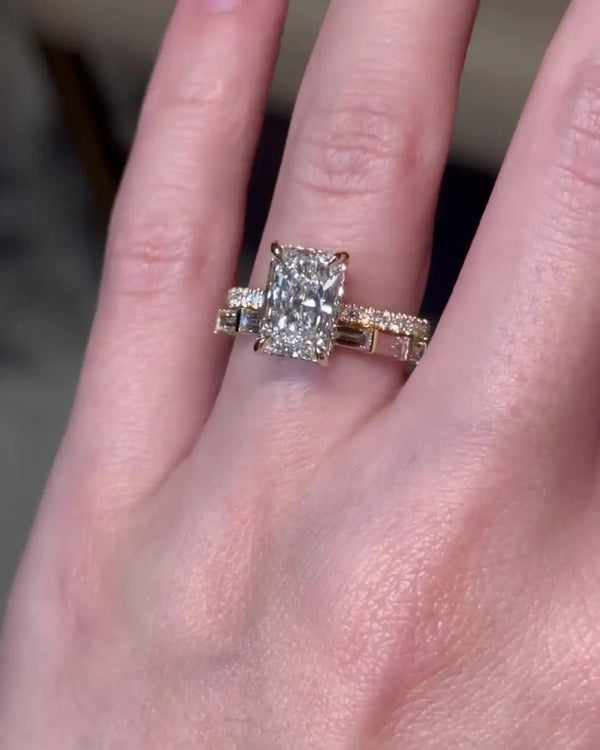
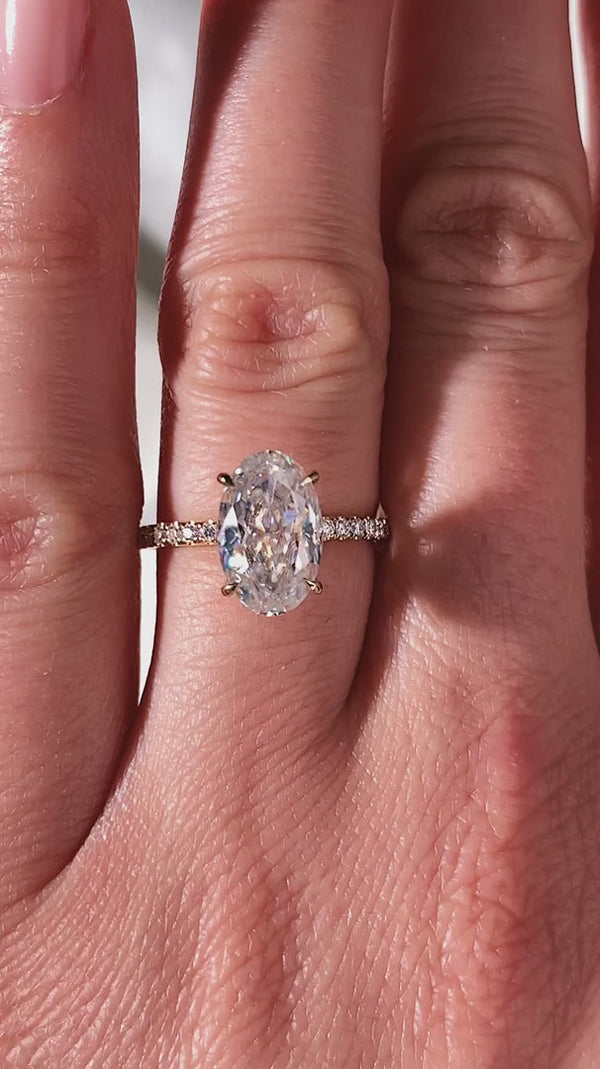
Most fire to least: round and crushed-ice cushion → oval, pear, marquise and heart → radiant → princess → chunky antique cushion → Asscher → emerald.
Shape and size multiply. A 4ct round moissanite is at the top of both scales and is about as much fire as the material produces. A 4ct emerald cut is the same weight with a fraction of the visual noise, because step cuts use fewer, larger facets that separate less dispersion at once.
If somebody wants the scale of a large moissanite but not the rainbow, the emerald or Asscher cut is the single most effective answer — more effective than any setting choice.
Warm metal is the underrated lever
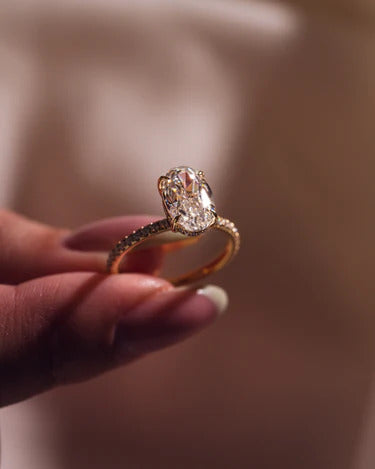
A yellow or rose gold setting reflects its own colour up into the pavilion. That warm light competes with the dispersed colour the stone is producing, and the result is that the same stone reads calmer and richer in 14K yellow than in white gold or platinum.
This is the only lever that changes a moissanite's character without changing the stone itself, and it costs nothing extra. How much warmth transfers depends on how much metal touches the stone: a bezel wraps the whole girdle and transfers the most, a cathedral or heavy basket a moderate amount, a peg head with an open gallery the least.
So the calmest possible build for a large moissanite is a step cut, bezel-set, in 14K yellow gold. The loudest is a round brilliant on a peg head in platinum with a full halo. Same material, entirely different object.
From our bench in Surat
There is a category of message we get every few weeks: the stone looks grey or dull, not fiery at all — the opposite complaint. Four causes, and only one is the stone. Commonest by far is film on the pavilion from sunscreen or hand cream, which clears in two minutes with a soak and a soft brush from underneath. Second is cool white LED lighting, which pulls any colourless stone grey. Third is a shallow cut leaking light, the tell being that the stone measures larger than standard for its stated equivalent weight. Only fourth is genuine residual tint.
Diagnostic: gradual dulling over months = film. Fine in daylight, grey indoors = lighting. A dull patch that stays put through rotation = cut. An even cast everywhere = tint. Three of those four are not the stone's fault, and the first one is free to fix.
The one category where you should turn it up
All of the above assumes you want less fire. For a cocktail or right-hand ring, the advice reverses completely.
There, size up, choose the most dispersive shapes, use white metal, and let the material do what it does. Six prongs above roughly 8mm and a euro shank, because a heavy head spins on the finger. The one caution is that cut faults amplify at this size — including the off-optic-axis softness that is invisible at 4mm — so the stone still has to be judged on video.
Deciding before you order
- Decide whether fire is the point or the problem, and say so out loud.
- Choose the shape for that answer before choosing the size.
- Warm metal to calm; white metal to amplify.
- Bezel to calm further; peg head with open gallery to amplify.
- Skip the full halo if fire is already the concern.
- Ask for video in ordinary room light, not a lightbox spin.
Frequently asked questions
Can you reduce the rainbow effect in a moissanite?
You cannot remove it, since dispersion of 0.104 is a property of the material, but you can control how much shows. The strongest levers are a step-cut shape, a smaller stone, and a warm-metal bezel setting. All three are decided before casting.
Why does a bigger moissanite show more fire?
Dispersion needs depth to become visible — light must travel far enough through the stone for colours to separate. Below about 3mm there is too little pavilion for that; above roughly 7mm the separation is complete. So fire scales with size rather than being fixed.
Does yellow gold really calm a moissanite?
Yes. The setting reflects warm light into the pavilion, which competes with the dispersed colour the stone produces, so the same stone reads calmer in yellow than in white gold or platinum. A bezel transfers the most warmth; a peg head the least.
Which moissanite shape has the least fire?
Emerald, then Asscher. Step cuts use fewer, larger facets that separate less dispersion at once. The ranking from most to least runs round and crushed-ice cushion, then oval, pear, marquise and heart, then radiant, princess, chunky cushion, Asscher and emerald.
My moissanite looks grey rather than fiery. Why?
Usually film on the pavilion from sunscreen or hand cream, which clears with a warm soak and a soft brush from underneath. Cool white LED lighting is the second cause, a shallow cut the third, and genuine tint only the fourth. Gradual dulling points to film; a dull patch that stays put through rotation points to cut.
Fire is a specification, not a surprise
Made to order in our Surat workshop — tell us whether you want it loud or quiet and we will build to that.
Leave a comment