Moissanite 101
Moissanite Shapes Ranked by How Much Fire They Show
If you want the rainbow, choose one end of this list. If you want restraint, choose the other.
Written by the Mapple Gems workshop, Surat · Updated 3 September 2026
Short answer
Fire is scattered by many small facets and restrained by few large ones. Most to least, roughly: round brilliant and crushed-ice cushion, then oval, pear and marquise, then radiant and princess, then chunky antique cushion, and least of all emerald and Asscher. Size amplifies all of it — a 5 mm round shows less fire than an 9 mm emerald. Choose the shape and the size together, not separately.
Moissanite disperses light about 2.4 times more strongly than diamond — 0.104 against 0.044. That is a property of the material and cannot be changed. What can be chosen is how much of it reaches your eye, and that is almost entirely a question of faceting.
Why faceting decides it
Dispersion splits white light into spectrum colours. A facet acts as a small window: the more windows a stone has, and the smaller each one is, the more separate coloured flashes are thrown in different directions at once. That is what reads as rainbow fire.
A step cut has a handful of large parallel facets instead. Light enters and exits in broad sheets, so you get wide clean flashes of white light with the colour effect much less separated out.
So two moissanites of identical material and size can look genuinely different, and nothing on any document tells you which is which.
The ranking
| Shape | Fire shown | Choose it if |
|---|---|---|
| Round brilliant | Highest | You want maximum sparkle and do not mind the colour |
| Crushed-ice cushion | Highest | You like a busy, glittering effect |
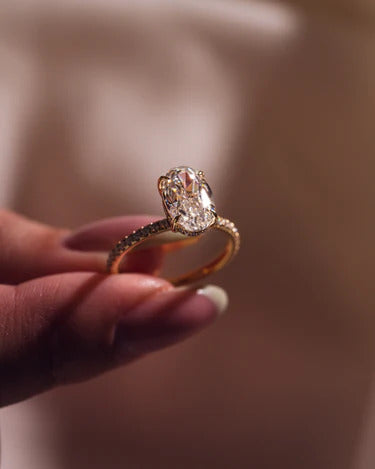
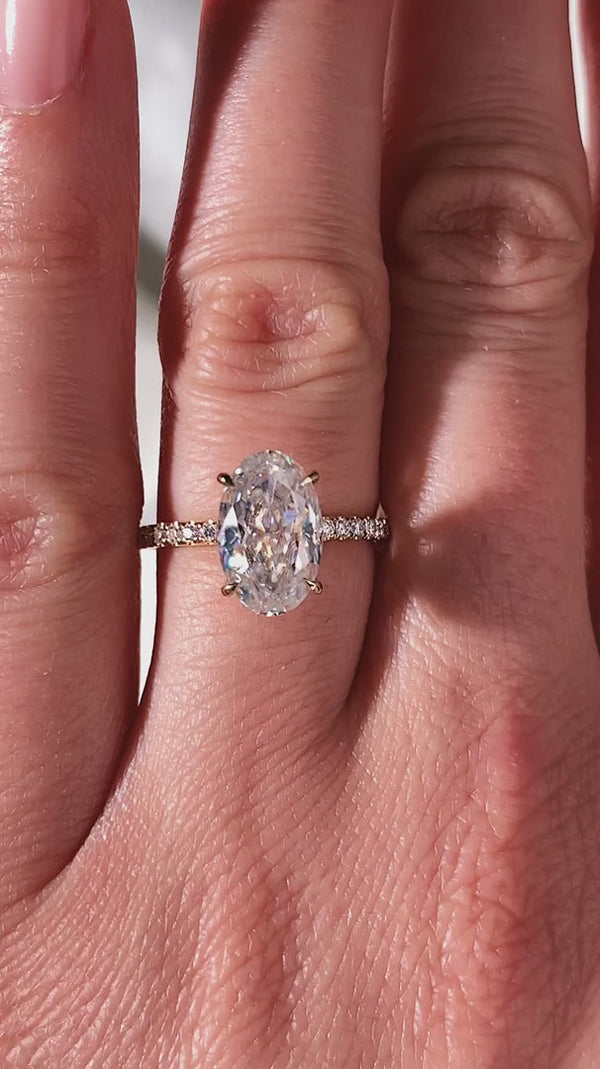
| Oval / pear / marquise | High | You want elongation and accept the fire |
| Heart | High | Brilliant faceting, same as above |
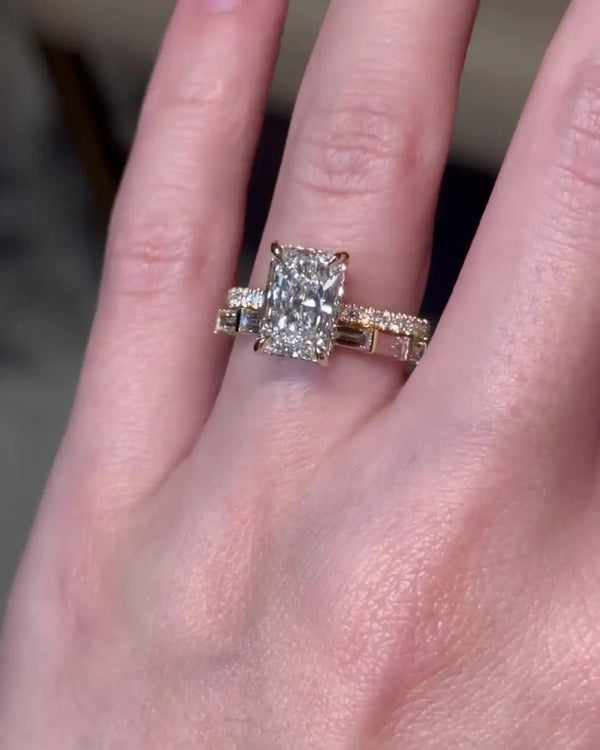
| Radiant | Moderate–high | You want a step outline with brilliant sparkle |
| Princess | Moderate | You want a square outline, less scatter than a round |
| Chunky antique cushion | Moderate–low | You want broad flashes and vintage character |
| Asscher | Low | You want restraint and a square outline |
| Emerald | Lowest | You want the most diamond-like moissanite there is |
Shape and size interact, and this is where people go wrong. Dispersion also scales with the depth of stone light travels through — so a small round shows less fire than a large emerald, even though round is top of the list and emerald is bottom. The two levers multiply. If you want the most discreet possible moissanite, take a step cut AND keep it under about 7 mm. If you want maximum effect, take a brilliant cut at 8.5 mm and up. Choosing one lever and ignoring the other is why people end up surprised by what arrives.
Lighting changes the answer
Worth knowing, because it explains why a stone looks different in a shop, in the office and outdoors.
- Direct point sources — spotlights, LEDs, sunlight, candles. These maximise fire in any stone, and dramatically so in moissanite.
- Diffuse light — an overcast day, a north-facing room, most offices. Fire almost disappears and the stone reads as clean white sparkle.
- Jewellery shop lighting is deliberately directional, which is why everything looks its most spectacular there and slightly quieter at home.
So ask for video under an ordinary ceiling light rather than a lightbox — that is the lighting the ring will actually live in.
Setting choices that raise or lower the effect
- A halo raises it. Dozens of small faceted stones around the centre all disperse light too, so a halo amplifies exactly the characteristic that makes moissanite identifiable.
- A plain solitaire lowers it. One stone, one source of fire, nothing echoing it.
- A bezel lowers it slightly, by reducing light entering from the sides.
- A high, open setting raises it, by letting more light in from below and around.
Where high fire is an advantage
This article reads as though restraint is the goal, and for engagement rings many people do want that. But the fire is also the reason a lot of people choose moissanite deliberately, and there are places it is simply better.
Small stones — studs, tennis bracelets, pavé, hoop accents — have too little depth for the effect to build, so it never becomes an issue there. And on an occasion piece meant to be noticed under evening lighting, the extra fire is the point rather than the compromise.
Frequently asked questions
Which moissanite shape has the least rainbow fire?
Emerald, followed by Asscher and chunky antique cushions. These are step cuts with few large facets, so light enters and exits in broad sheets rather than being scattered into separate coloured flashes. Round brilliants and crushed-ice cushions show the most.
Does a smaller moissanite show less fire?
Yes — dispersion scales with the depth of stone light travels through, so size and shape multiply. A small round can show less fire than a large emerald despite round being the more dispersive shape. For maximum discretion choose a step cut and keep it under about 7 mm.
Does a halo make moissanite look more obviously like moissanite?
It can. A halo surrounds the centre with dozens of small faceted stones that disperse light too, amplifying the characteristic that identifies moissanite. A plain solitaire gives one source of fire with nothing echoing it, and a bezel reduces the effect slightly by limiting side light.
Why does my moissanite look different in different rooms?
Because fire depends on the light source. Direct point sources — spotlights, LEDs, sunlight, candles — maximise it, while diffuse light such as an overcast day or a typical office almost removes it, leaving clean white sparkle. Jewellery shop lighting is deliberately directional, which is why stones look most dramatic there.
Tell us which end of the list you want.
Restraint or fire — we will pick the shape and the size together, and send video under ordinary light.
Leave a comment