Emerald cut
Which Material, in a Step Cut
We sell both, in this shape, and we would not give you the same answer for both. A step cut is the one format where the two materials genuinely part company.
Written by the Mapple Gems workshop, Surat · Updated 27 August 2026
Short answer
In a brilliant shape the two are hard to tell apart on a hand. In a step cut they are not, for one specific reason: moissanite is doubly refractive, and a large flat table gives you a clear view of the doubled facet edges underneath. It is subtle at a carat and increasingly visible above two. If you want a large emerald cut and the calm, still look is the point, lab grown diamond is the safer choice. If you want the shape at a size that is otherwise out of reach, moissanite does that and nothing else does.
Most comparisons of these two materials are written about round brilliants, where the honest conclusion is that almost nobody can tell. We have said as much ourselves about the same choice in an oval. Sparkle covers a great deal, and at typical sizes the practical difference between the two in a brilliant cut is small enough that price should decide it.
A step cut removes the sparkle. Everything that a brilliant hid is now available for inspection, and that applies to the material as much as it applies to inclusions.
The property that matters here
Moissanite is doubly refractive. Light entering the stone splits into two rays, which means facet junctions seen through the stone appear very slightly doubled — a faint second edge alongside the first. Diamond is singly refractive and does not do this at all.
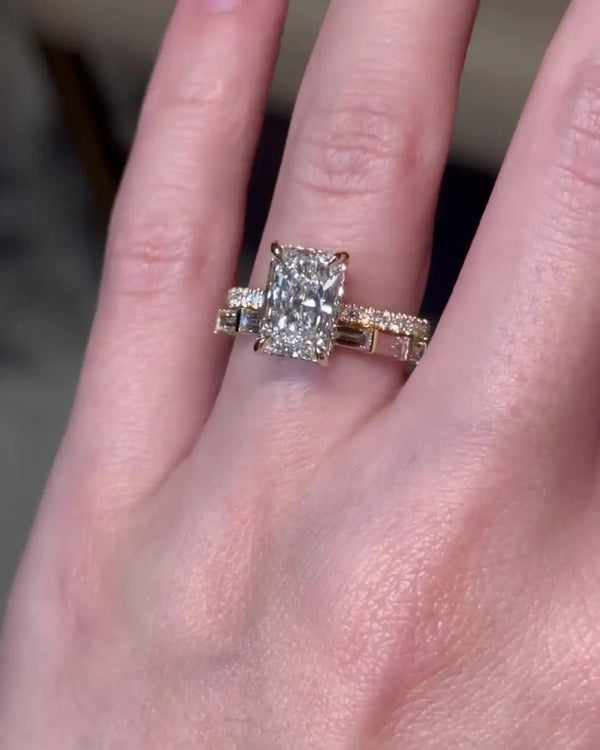
On a round brilliant this is close to invisible, because you are never looking through a large calm area; the facets are small and the scintillation is constant. On an emerald cut you are looking straight down through a big flat window at the long parallel pavilion facets below. That is exactly the viewing condition under which doubling becomes noticeable, and it is why gemmologists check for it through the table.
How much it shows depends on size and on how the stone is cut. At half a carat, nothing. At one carat, visible if you go looking. At three or four carats, it is one of the things people mean when they say a large moissanite "looks like moissanite" without being able to say why. It is not a defect — it is what the material is — but it is fair to know about before buying the shape that displays it best.
Side by side, in a step cut
| Moissanite | Lab grown diamond | |
|---|---|---|
| Doubling through the table | Present; grows with size | None |
| Fire in the flashes | Strong, coloured — broad rainbow flashes | Restrained, mostly white |
| Clarity concern | Rare; grown very clean | Real — VS1 minimum on a step cut |
| Colour concern | Grey or green cast in lower grades | Warmth in lower grades; predictable |
| Hardness | 9.25 Mohs — excellent for daily wear | 10 Mohs |
| Sold by | Millimetres and DEW (diamond equivalent weight) | True carat weight |
| Certificate | Usually none of substance | IGI or GIA report |
| Cost at a large size | A fraction | Rises steeply with weight |
The weight thing that trips people up
Moissanite is less dense than diamond, so it is sold by millimetre size with a diamond equivalent weight attached rather than by true carat. A moissanite described as "2 carat" in an emerald cut means it measures like a two carat diamond — roughly 8.8 × 6.0mm — while actually weighing appreciably less.
That is not deceptive, it is the industry convention, and it is the sensible one since you buy a stone for how big it looks. But it does mean that comparing a moissanite listing to a diamond listing by the carat figure alone compares two different measurements. Compare millimetres. It is the only figure that means the same thing on both sides.
From our bench in Surat
We set a great deal of moissanite and we are not going to pretend the doubling is not there. In a step cut above about two carats, in good light, at reading distance, it is findable. Most people never look for it and never notice. Some people, once told, cannot stop seeing it. We would rather you were in the first group by choice than the second by surprise.
What we will also say plainly: a five carat emerald cut in lab grown diamond is a serious sum of money, and in moissanite it is not. If the size is the thing you actually want — and for a lot of people it genuinely is — then moissanite is the only material that delivers it, and the trade-off is one visual property that most observers will never register. The wrong answer is buying a small moissanite to save money on a shape where a small lab grown diamond was affordable anyway.
Colour, which is the other step cut problem
The open table that reveals doubling also reveals body colour. In moissanite the risk is not warmth but a grey or green cast in lower-grade material, and a step cut presents it across a large calm area with nothing to distract from it. Buy colourless grade moissanite for this shape specifically — it matters more here than in any brilliant. The grading conventions are set out in moissanite colour grades explained.
On the lab grown diamond side the equivalent rule is G or better in white metal, H in yellow or rose. Both materials are less forgiving here than they would be in a round.
What to specify
- Millimetre measurements on both sides of the comparison, never carat against DEW.
- For moissanite: colourless grade, and a video through the table at an angle rather than straight down.
- For lab grown diamond: VS1 minimum, G+ in white metal, IGI or GIA report.
- Video in ordinary indoor light for either, because a lightbox flatters both.
- The same ring quoted in both materials at the same millimetre size, so the real difference is a number.
- Corner prongs seated into the girdle regardless of material.
Keep reading
Can a jeweller tell moissanite from diamond?
Emerald cut clarity: the one shape where the grade really matters
Frequently asked questions
Can you tell moissanite from diamond in an emerald cut?
More easily than in a brilliant shape. Moissanite is doubly refractive, so facet edges seen through the large flat table appear faintly doubled. It is hard to spot at a carat and increasingly noticeable above two. Most people never look for it, but a step cut is the shape that displays it best.
Is moissanite a bad choice for an emerald cut?
No — it is the only way most people can own a large emerald cut at all, and at four or five carats the difference in cost is enormous. The caution is about size and expectation: buy colourless grade, and understand that the shape shows the material more than a round would.
Why is a 2 carat moissanite not the same as a 2 carat diamond?
Moissanite is less dense, so it is sold by millimetre size with a diamond equivalent weight. A "2 carat" moissanite measures like a two carat diamond but weighs less. Compare the millimetre measurements between listings, because that is the only figure that means the same thing for both materials.
Does moissanite have more fire in a step cut?
Yes, noticeably. Moissanite disperses light more strongly than diamond, and a step cut returns light in broad flashes rather than small sparks, so those flashes carry visible colour. Whether that is a feature or a giveaway is a matter of taste — it is the opposite of the restrained look many emerald cut buyers are after.
Which is more durable in this shape?
Both are excellent. Diamond is 10 on the Mohs scale and moissanite 9.25, and both are well beyond what daily wear requires. On a step cut the durability question is really about the four cropped corners and how well the prongs are seated, which is a setting issue rather than a material one.
Same ring, both materials
Tell us the millimetre size you want and we will quote it in both, with video in ordinary light so you can decide with your own eyes.
Leave a comment