Moissanite 101
Moissanite Colour Grades Explained
Borrowed letters from a diamond scale, applied to a different mineral. Here is what they actually mean.
Written by the Mapple Gems workshop, Surat · Updated 23 August 2026
Short answer
Moissanite is usually sold in three colour bands borrowed from diamond’s D–Z scale: D-E-F (colourless), G-H-I (near colourless) and occasionally warmer J-K. These are seller descriptions, not independent grades — no major laboratory grades moissanite on the D–Z scale, because that scale was built for diamond. In practice the difference between D-E-F and G-H-I is barely visible on the hand, and completely invisible once the stone is set in yellow or rose gold.
Almost every moissanite listing quotes a colour grade, and almost none explain that the grade did not come from a laboratory. That is not usually dishonest — it is the trade using familiar vocabulary because buyers already understand it. But it means the number deserves less weight than you would give it on a diamond.
Why moissanite is not really graded
The D–Z scale is a diamond system. It measures how far a diamond departs from colourless, under controlled lighting, against a set of physical master stones. It is calibrated to diamond’s specific optical behaviour.
Moissanite is silicon carbide, a different mineral with a different refractive index and roughly 2.4 times diamond’s dispersion. Applying a diamond colour scale to it is an approximation by analogy. Major laboratories therefore do not issue D–Z colour grades for moissanite — so when a listing says “D colour”, that is the supplier’s own assessment.
Which means grades are not directly comparable between sellers. One seller’s D-E-F may be another’s G-H-I, and there is no referee.
| Band | Described as | Visible on the hand? |
|---|---|---|
| D – E – F | Colourless | Reads bright white in any metal |
| G – H – I | Near colourless | Faintly warmer; invisible in yellow or rose gold |
| J – K | Faint warmth | Noticeable in white metal, pleasant in yellow gold |
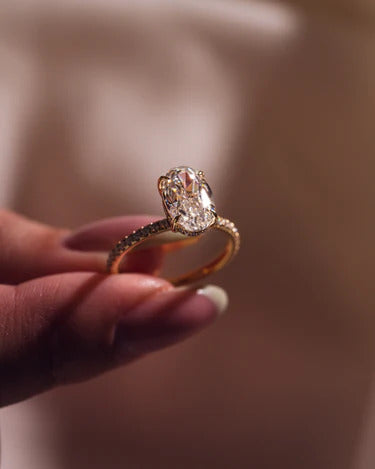
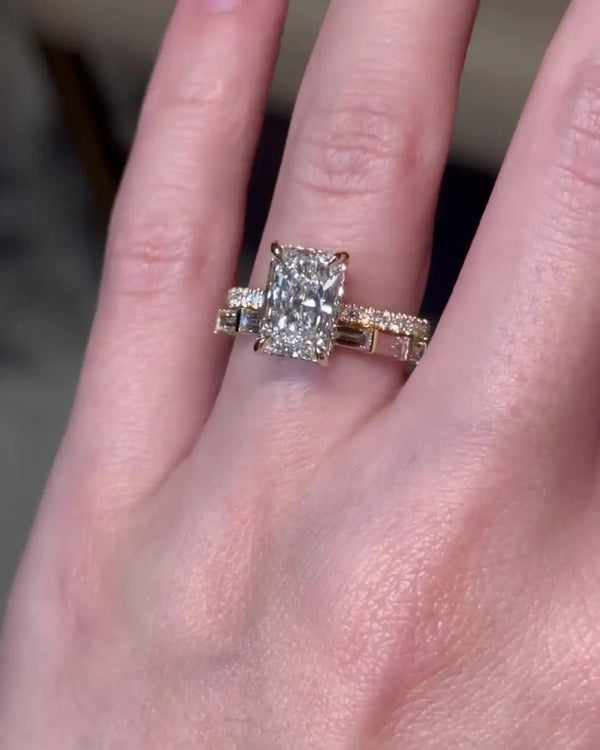
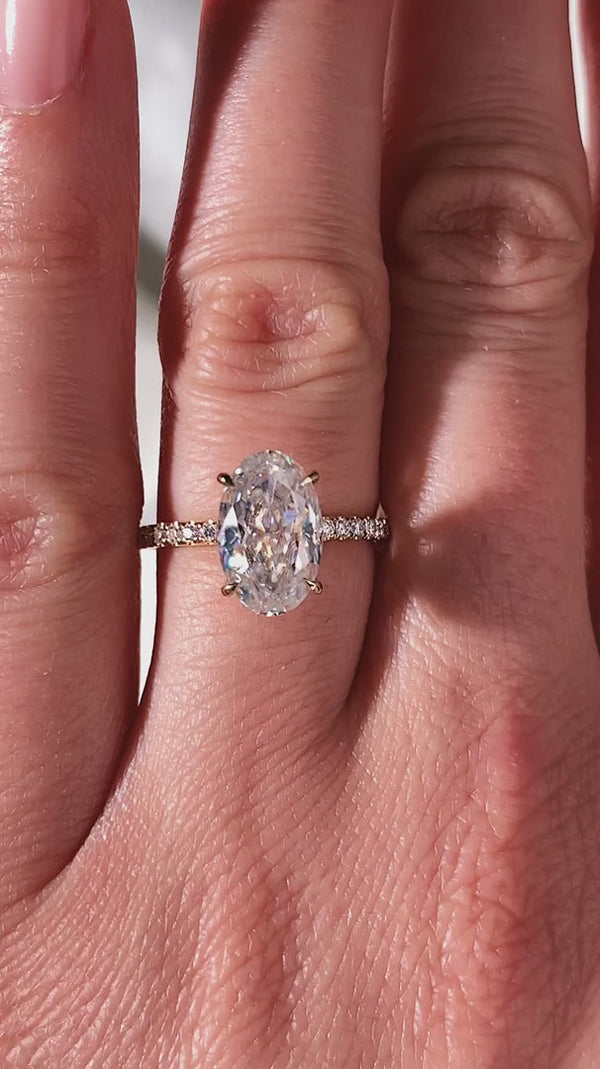
The thing that affects perceived colour far more than the grade. The metal touching the stone. A near-colourless moissanite set in a white head reads white; the same stone in a yellow gold basket picks up warmth from the metal reflecting up through the pavilion. So the colour decision and the metal decision are the same decision. If you want a warm band, ask for a white head and keep the shank whatever colour you like — you get both, and you can stop paying for the top colour band entirely. We build rings this way as standard above 7 mm.
Does colour matter more as the stone gets bigger?
Yes, and this is the one place the grade genuinely earns its price.
Colour is a function of how much material light passes through. A 4 mm stone has very little depth for a tint to accumulate in; a 9.5 mm stone has a great deal. So a faint warmth invisible in a stud can be perceptible in a large centre stone, particularly viewed from the side.
A practical rule: below about 6.5 mm, buy the cheaper band without hesitation. Above about 8 mm, the step up to colourless is worth considering — especially if the setting is platinum or white gold, which gives the eye a white reference to compare against.
Colour is not the same as fire
A common confusion. People see rainbow flashes from a moissanite and assume the stone is “coloured” or poorly graded. It is neither.
Those flashes are dispersion — white light being split into spectrum colours as it exits the stone. Moissanite’s dispersion of 0.104 against diamond’s 0.044 means it does this far more strongly. It is a property of the mineral, present in every moissanite regardless of colour grade, and it scales with size.
So a D colour moissanite still throws rainbows. Buying a higher colour grade will not reduce them. If the fire is the thing you dislike, moissanite is the wrong stone rather than the wrong grade — a lab grown diamond is the answer.
How to buy sensibly
- Decide the metal first. It changes the colour question more than the grade does.
- In yellow or rose gold, near colourless is enough at almost any size. The metal is warmer than the stone.
- In white metal above 8 mm, consider the colourless band — this is where it shows.
- Ask for video under ordinary indoor light, not studio lighting. Studio setups neutralise colour differences by design.
- Do not compare grades between sellers as though they are equivalent. Compare the videos.
Keep reading
Frequently asked questions
What are moissanite colour grades?
Moissanite is usually sold in bands borrowed from diamond’s D–Z scale: D-E-F for colourless, G-H-I for near colourless, and sometimes warmer J-K. These are seller descriptions rather than independent laboratory grades, because the D–Z scale was built for diamond and no major lab grades moissanite on it.
Is D-E-F moissanite worth the extra money?
Below about 6.5 mm, rarely — there is too little depth for a tint to be visible. Above about 8 mm in a white metal setting, it becomes worth considering. In yellow or rose gold at any size, near colourless is enough, because the metal is warmer than the stone anyway.
Why does my colourless moissanite show rainbow colours?
That is dispersion, not body colour. Moissanite splits white light into spectrum colours about 2.4 times more strongly than diamond does, and this happens in every moissanite regardless of colour grade. Buying a higher grade will not reduce it. If you dislike the effect, a lab grown diamond is the answer rather than a different moissanite.
Can moissanite be certified?
It can be identified and described by a gemmological laboratory, but it is not graded on the diamond D–Z colour and FL–I3 clarity scales, because those were built for diamond. So a document confirming a stone is moissanite is meaningful; one presenting diamond-style grades for it is the seller’s own assessment presented in borrowed language.
Ask for video, not a grade.
Ordinary indoor light, the actual stone, in the metal you have chosen. That tells you more than any letter.
Leave a comment