Emerald cut
Clarity, With Nowhere to Hide
On every other shape, clarity is one variable among four. On a step cut it is the variable that decides whether the stone works — and the grade on the report is only half of the answer.
Written by the Mapple Gems workshop, Surat · Updated 27 August 2026
Short answer
Buy VS1 or better on an emerald cut, and confirm it eye-clean on a rotating video before committing. A step cut returns light in broad flashes from a few large planes rather than scattering it across dozens of small facets, so there is no visual noise for an inclusion to disappear into. The grade alone will not tell you enough — position matters as much as grade, and a well-placed SI1 can outperform a badly placed VS2.
Clarity grading describes what a trained grader sees at ten times magnification. It says nothing about what you will see at arm's length, and the gap between those two things varies enormously by shape. On a round brilliant the gap is generous: light bounces off fifty-seven facets in every direction, and a small feather sitting under all that activity is genuinely hard to find. That is why so much buying advice tells you to drop to SI1 and spend the difference elsewhere.
That advice is sound, and it does not apply here.
A window, not a mirror
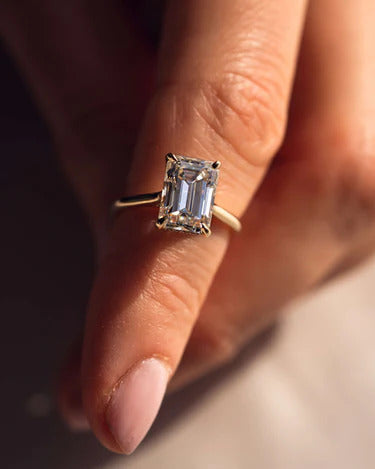
An emerald cut is a step cut: a large flat table with a small number of long, parallel facets descending in steps around it. It does not scatter light. It returns it in wide, slow flashes as the stone moves, and between those flashes you are looking straight down through the table into the body of the stone.
That is the whole appeal. It is also the whole problem. There is no sparkle to hide anything in, and there is no busy pattern for the eye to lose an inclusion inside. Whatever is in there is on display, in ordinary light, from the top, all the time.
The same property is why the shape rewards a good stone so heavily. A clean emerald cut has a depth and calm no brilliant can produce. The distance between a good one and a poor one is simply wider than it is on other shapes, in both directions. The related point about brightness rather than inclusions is covered in oval vs emerald cut: a mirror or a window?.
What each grade looks like on a step cut
| Grade | On a round brilliant | On an emerald cut |
|---|---|---|
| VVS1–VVS2 | Invisible; you are paying for the certificate | Invisible, and the safest choice at large sizes |
| VS1 | Invisible | Reliably clean — the practical floor |
| VS2 | Invisible in almost every case | Usually fine, occasionally not. Depends entirely on position |
| SI1 | Often eye-clean; a common value pick | Only with the plot checked and the video seen. Never blind |
| SI2 and below | Visible on inspection | Assume visible. We would not set one |
Note what the table is not saying. It is not saying an SI1 emerald cut is a bad stone. It is saying that the grade stops being a shortcut on this shape, and you have to look.
Position beats grade
Two stones can carry the same clarity grade and behave completely differently, because the grade counts the severity of what is there and not where it sits. On a step cut, where it sits is most of the story.
- Under the table, centre. The worst place. You are looking straight at it through a flat window, every time.
- Near a corner. Better optically, worse structurally — the corners are where the girdle is thinnest and where a setting bears down. A feather reaching a corner is a stone we would decline.
- Under a crown step, off to the side. The most forgiving position. The stepped facets break up the view enough to absorb it.
- Near the girdle edge. Usually coverable by a prong or a bezel rim, which is one of the quiet arguments for a bezel on a step cut.
Type matters too. A white crystal or a cloud reads as a soft spot and is often the least offensive. A dark crystal reads as a full stop on a white page. A feather is the one to take seriously, because it is the only category that is also a structural question.
From our bench in Surat
We reject more step cuts at the bench than any other shape, and it is almost never about the grade on the report. It is about a dark inclusion under the table that the plot showed as a dot and the stone shows as a mark. A plot diagram tells you where something is; it tells you nothing about how dark it is or how it catches the eye. Those are the two things that matter and neither is printed anywhere.
So the honest version: we cannot promise you eye-clean from a grade, and neither can anyone else. What we can do is look at the specific stone and tell you. If a seller will commit to eye-clean on a two carat SI1 emerald without having seen it, they are guessing with your money.
Clarity and colour together
The same open table that shows inclusions also shows body colour. A step cut presents a large, calm area of the stone with no sparkle to distract from a warm tint, so colour behaves the same way clarity does: one grade less forgiving than on a brilliant.
The practical version is that metal decides how far you can go. In platinum or white gold, G or better. In yellow or rose gold, H sits comfortably and I is usually fine, because the metal is warming the stone anyway. Spending on a D colour and then setting it in yellow gold is money spent on something the setting immediately undoes.
What to specify
- VS1 or better as the default; VS2 or SI1 only with the plot and video reviewed.
- The plot diagram for the specific stone, not a sample.
- A rotating video in ordinary indoor light. A lightbox flatters every stone equally and tells you nothing.
- Confirmation that no feather reaches a corner or the girdle edge.
- Colour matched to the metal — G+ for white, H–I for yellow and rose.
- A named grading laboratory. Uncertified stones are a poor bet on the one shape where the grade carries this much weight.
Keep reading
The 2 carat emerald cut: what two carats actually buys you
Frequently asked questions
What clarity grade should I buy for an emerald cut?
VS1 or better as a default, and higher again above two carats. VS2 and SI1 can work, but only when you have seen the plot diagram and a rotating video of that specific stone. A step cut gives an inclusion nowhere to hide, so the usual advice to drop to SI1 for value does not transfer.
Why do emerald cuts show inclusions more?
Because they have very few, very large facets rather than dozens of small ones. Instead of scattering light in all directions, a step cut gives you a clear view down through a flat table into the stone. There is no sparkle for an inclusion to disappear into.
Can an SI1 emerald cut be eye-clean?
Yes, if the inclusion is small, pale, and sitting off to one side under a crown step rather than centrally beneath the table. Position matters more than grade on this shape. What you cannot do is assume it from the grade — you have to see the stone.
Does clarity matter as much on a moissanite emerald cut?
Moissanite is grown to a consistently high clarity, so inclusions are rarely the issue. On moissanite the equivalent concern is colour tint and cut quality — a step cut shows a grey or green cast as plainly as it shows an inclusion.
Is a feather in an emerald cut a problem?
It depends where it sits. A small feather away from the edges is usually cosmetic. One that reaches a cropped corner or the girdle is a structural concern as well, because those are the thinnest points and the places a setting bears on. We would decline to set that stone.
Let us look at the stone first
We will send the plot and a video in ordinary light before anything is set, and tell you honestly what we can see from the bench.
Leave a comment