Moissanite 101
Is Moissanite Tacky?
A question about other people, not about the stone. Here is the honest version of both.
Written by the Mapple Gems workshop, Surat · Updated 27 August 2026
Short answer
No — but what can look cheap is a badly made ring, in any stone. Thin metal, plated bases, sloppy setting and a stone sized far beyond what the piece can carry: those read as cheap, and they read that way with diamonds too. Moissanite’s own risk is different and specific: at very large sizes its extra fire becomes visible, which some people find spectacular and others find obviously not-diamond. Buy a well-made ring at a sensible size and the question disappears.
This question is asked quietly and it deserves a straight answer rather than reassurance. It is really two questions wearing one coat: does this look cheap, and will people judge me. They have different answers.
What actually makes jewellery look cheap
Almost none of it is the stone. In the workshop, the things that make a piece read as inexpensive are consistent, and they apply equally to a mined diamond ring.
| What reads as cheap | Why |
|---|---|
| Plated or hollow metal | Wears through, dents, sounds and feels light |
| A very thin shank under a big head | Looks unbalanced and bends over time |
| Uneven or rough setting | Visible at arm’s length; the giveaway of rushed work |
| A stone far larger than the ring can carry | Proportion is what the eye actually reads |
| Poor polish and finishing | Dull metal makes any stone look worse |
A moissanite in a well-proportioned solid gold ring, cleanly set, does not appear on that list. A diamond in a plated hollow ring does.
The one moissanite-specific risk
Being fair rather than defensive: there is a genuine one, and it is about size.
Moissanite’s dispersion is roughly 2.4 times diamond’s, and the effect scales with how much stone light passes through. Below about 7 mm it is not noticeable. Above roughly 8.5 mm, under directional light, it throws visible coloured flashes that a diamond does not.
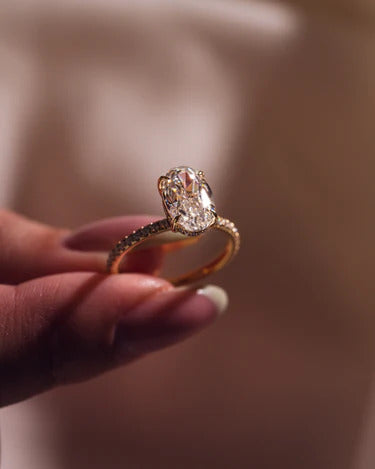
Some people love exactly that. Others feel it announces itself. If your concern is looking understated, the practical answer is not to avoid moissanite — it is to avoid a very large moissanite. A 6.5 mm stone in a beautifully made ring is invisible as anything other than a beautiful ring.
The counter-intuitive rule. With most purchases, spending more buys something more convincing. With moissanite it inverts: the larger the stone, the more obviously it is moissanite. So the person who buys a 3 ct-equivalent because the price allows it ends up with a less discreet ring than the person who bought 1 ct and spent the difference on 18K gold and a properly finished setting. If you are worried about how it reads, put the money into the metal and the workmanship, not into millimetres. That advice costs us larger orders, and it is still the right advice.
The other half: will people judge?
Worth separating from the aesthetics, because it is a social question and it deserves a social answer.
In practice, almost nobody examines someone else’s ring closely enough to form a view about the stone. What people notice is whether the wearer is happy with it. A ring worn with obvious pleasure reads well; a ring worn apologetically reads badly, whatever is in it.
The one situation that genuinely goes wrong is when someone lets others believe it is a diamond and is later corrected. That is not a moissanite problem — it is a problem created by ambiguity. “It’s moissanite” said plainly and cheerfully ends the conversation every time, and most people’s follow-up is a question about price rather than a judgement.
If you want a ring nobody questions
- Keep the centre stone under about 7 mm. This is the single most effective step.
- Buy solid metal. 14K or 18K gold, or platinum. Nothing plated, ever.
- Get the proportions right. A shank of at least 1.8 mm under a substantial head.
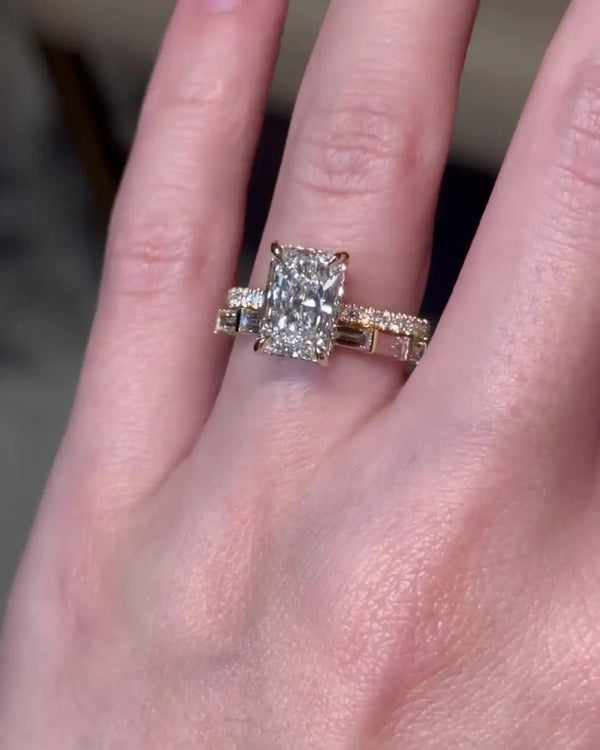
- Consider a step cut. Emerald and Asscher cuts have few, large facets, so the dispersion does not scatter — these are the shapes where moissanite reads least like moissanite.
- Spend on the setting. Clean, even work at arm’s length is what people actually register.
And if none of that matters to you
Plenty of people choose moissanite precisely for the fire, wear it at 3 ct equivalent, tell everyone exactly what it is, and are entirely delighted. That is a completely coherent position and this article is not an argument against it.
The point is only that the two goals — maximum stone, or maximum discretion — pull in opposite directions with this material. Knowing which one you actually want is the whole decision.
Keep reading
- Can a jeweller tell moissanite from diamond?
- Emerald cut engagement rings — the most discreet shape for moissanite
- Moissanite vs diamond: the honest comparison
Frequently asked questions
Does moissanite look cheap?
No. What reads as cheap is poor construction — plated or hollow metal, a thin shank under a heavy head, uneven setting, poor polish, or a stone out of proportion with the ring. Those apply equally to diamond rings. A well-proportioned moissanite in solid gold, cleanly set, does not look cheap.
What size moissanite looks most natural?
Under about 7 mm. Moissanite’s extra dispersion scales with the depth of stone light travels through, so smaller stones show almost none of it. Above roughly 8.5 mm the coloured flashes become visible under directional light — meaning a larger moissanite is less discreet, not more impressive.
Which moissanite shape looks most like a diamond?
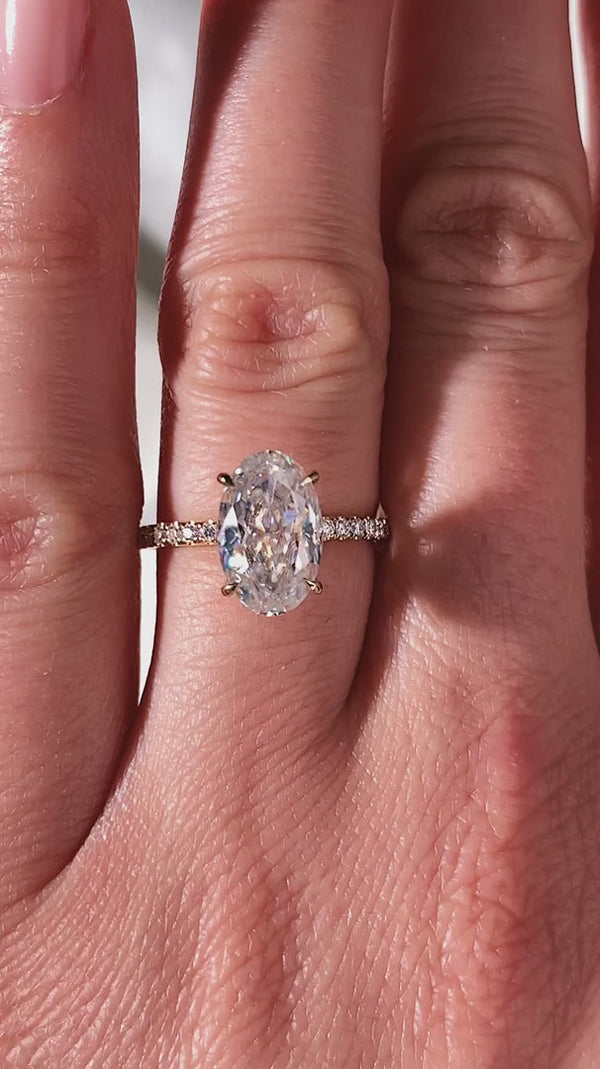
Step cuts — emerald and Asscher. They have few, large facets, so light produces broad clean flashes rather than the scattered rainbow fire you get from a brilliant cut with many small facets. Brilliant shapes such as round, oval and pear display moissanite’s dispersion most.
Should I tell people my ring is moissanite?
It is much easier than the alternative. Almost nobody examines someone else’s ring closely enough to have an opinion about the stone, and the situations that go badly are the ones where people were allowed to assume it was a diamond and later found out. Saying so plainly ends the conversation, and the usual follow-up is curiosity about price rather than judgement.
Put the money into the metal.
Solid gold, a proper shank and clean setting will do more for how your ring reads than another millimetre of stone.
Leave a comment