Moissanite 101
Oval Moissanite or Oval Lab Grown?
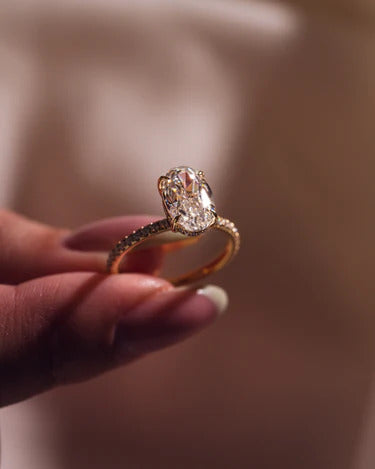
The oval is the shape where this comparison is hardest, because everything that distinguishes the two materials gets amplified by the outline.
Written by the Mapple Gems workshop, Surat · Updated 22 August 2026
Short answer
In small sizes an oval moissanite is very hard to distinguish from a lab grown diamond and the saving is large. At two carats it is not: moissanite disperses light more than twice as strongly, and an oval's depth gives that dispersion room to show. Moissanite is also never graded and sold by diamond equivalent weight, so compare millimetres, never carats.
Moissanite is silicon carbide, not carbon. It is its own gemstone with its own optical properties, and it should never be described as a diamond. A lab grown diamond is carbon, chemically and physically identical to a mined one, graded on the same scales by the same laboratories.
That much is standard. What is less often explained is why the oval, specifically, makes the choice between them sharper than any other shape.
The two numbers that decide everything
Dispersion. Moissanite disperses light at 0.104 against diamond's 0.044 — more than twice as much. Dispersion is what splits white light into visible colour, the rainbow flashes people call fire. That is not a defect; for many buyers it is the appeal.
Density. Moissanite is roughly 15% less dense than diamond, specific gravity around 3.21 against 3.52. So a moissanite that measures the same as a 1ct diamond weighs less — about 0.88ct. This is why moissanite is sold by millimetres plus a diamond equivalent weight, and why comparing carat figures between the two materials tells you nothing useful.
Ask for millimetres. Always. A "2ct oval moissanite" and a 2ct oval lab grown diamond are not the same size stone, and the millimetre line is the only comparison that holds.
Why size changes the answer
Dispersion needs depth to work. Light has to travel far enough through the stone for the colours to separate visibly. Below roughly 3mm there is barely two millimetres of pavilion and moissanite reads essentially identical to a diamond. Above about 7mm, the fire becomes unmistakable.
An oval is a shape people buy large. At 2ct an oval runs close to 10mm long, which is comfortably into the range where moissanite announces itself. The counter-intuitive consequence: a large moissanite is a less convincing diamond substitute than a small one.
Which is why the strongest case for moissanite is almost never a big oval solitaire. It is the pieces built from many small stones — tennis bracelets, eternity bands, pavé, studs — where the visual difference is smallest and the saving multiplies across forty or sixty stones.
Side by side, on an oval
| Oval moissanite | Oval lab grown diamond | |
|---|---|---|
| Material | Silicon carbide (SiC) | Carbon — identical to mined |
| Dispersion (fire) | 0.104 | 0.044 |
| Hardness | Mohs 9.25 | Mohs 10 |
| Cleavage planes | None | Yes — all diamonds have them |
| Sold by | mm + diamond equivalent weight | Actual carat weight |
| Independent grading | None — no lab grades it | IGI or GCAL report; no cut grade on ovals |
| Bow-tie | Yes — any elongated brilliant has one | Yes |
| Best use case | Small stones, many stones, size for money | A single significant centre stone |
Two rows deserve a second look. The cleavage planes row is one of the few places moissanite has the structural advantage: every diamond has planes along which it can split, and moissanite has none. On an oval, where the tapered tips are the exposed feature, that is worth knowing — though hardness is not toughness for either material, and chip risk remains a setting question rather than a material one.
The grading row is the one that changes how you shop. No laboratory grades moissanite for colour, clarity or cut. A seller's "D–E–F, VVS" is an in-house assessment, not a comparable grade, and there is no upper price anchor either — a higher price is not evidence of a better stone. On a lab grown diamond you at least get colour, clarity and measurements from a third party, though still no cut grade on any fancy shape.
From our bench in Surat
We sell far more moissanite than lab grown, so the honest version costs us something. Lab grown diamond prices fell sharply between 2020 and 2024 and have settled near production cost. The gap between the two materials used to be roughly fivefold. On a well-cut certified stone it is now closer to twofold.
At a fivefold gap, a large oval moissanite was an obvious decision. At twofold it is a real one, and for a single significant centre stone many people should now be looking at the lab grown option they would have dismissed three years ago. Where moissanite still wins outright is exactly where we said above: small stones, and lots of them.
If you choose an oval moissanite
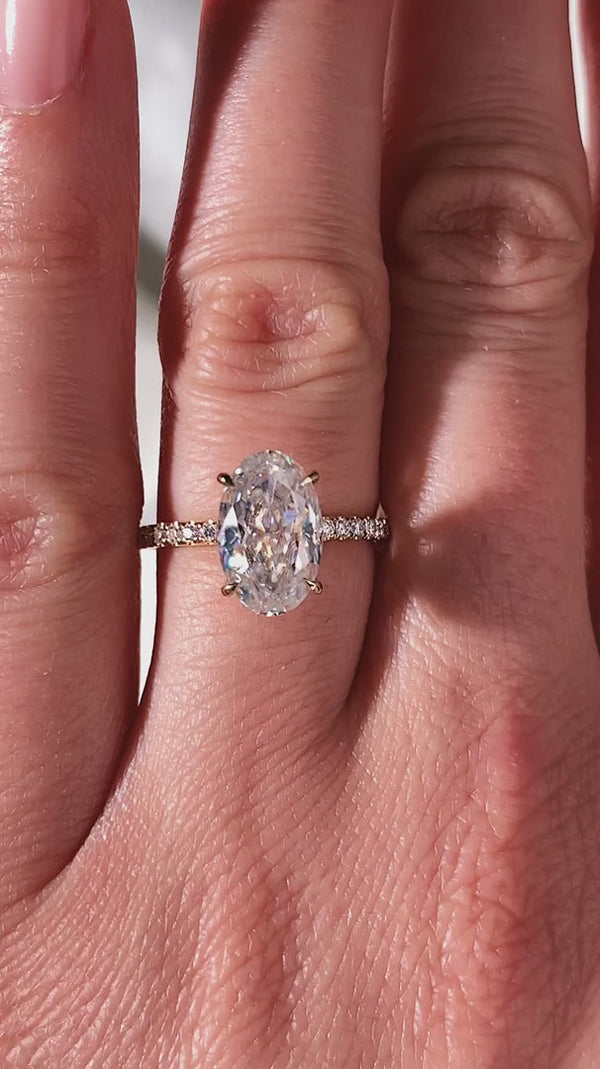
Since nothing is graded, you are the cut grader. Four checks, all done on a rotating handheld video in ordinary room light:
- Clean facet junctions. Crisp meeting points rather than soft, blurred ones. This is the fastest proxy for cutting quality on anything not cut-graded.
- No fixed dark zone. A dull patch that stays put through the whole rotation indicates a shallow cut leaking light, not a bow-tie.
- Measurements against standard. A stone measuring larger than standard for its stated equivalent weight is a shallow-cut warning, not a bonus.
- Symmetrical outline. Moissanite is doubly refractive and has an optic axis; a stone cut off-axis shows a faint softness from the top that no photograph reveals.
One useful lever: warm metal is a fire control. A yellow or rose gold setting reflects into the pavilion and competes with dispersed colour, so the same stone reads noticeably calmer in yellow than in white gold or platinum. A bezel transfers the most warmth, a peg head the least. It is the only way to change a moissanite's character without changing the stone.
Keep reading
Oval cut lab grown diamond engagement rings: the complete buying guide
Frequently asked questions
Can people tell an oval moissanite from an oval lab grown diamond?
It depends almost entirely on size. Below about 3mm the two are very hard to separate by eye. Above roughly 7mm moissanite's stronger dispersion shows as visible rainbow flashes, and an oval bought at two carats sits well into that range.
Why is moissanite sold in diamond equivalent weight?
Because it is about 15% less dense than diamond, so a stone of the same physical size weighs less. A moissanite matching a 1ct diamond's dimensions weighs roughly 0.88ct. Compare millimetres between the two materials, never carat figures.
Is moissanite graded like a diamond?
No laboratory grades moissanite for colour, clarity or cut, so any grade quoted is a seller's own assessment rather than a comparable third-party result. Lab grown diamonds do receive reports from IGI or GCAL, though no laboratory grades cut on a fancy shape such as an oval.
Which is more likely to chip at the tips of an oval?
Diamond has cleavage planes along which it can split and moissanite has none, which is one structural point in moissanite's favour. But hardness is not toughness for either material, and chip risk on an oval is mainly decided by whether the tapered ends are covered by the setting.
Where does moissanite make the most sense?
In pieces built from many small stones — tennis bracelets, eternity bands, pavé and studs — where each stone is below the size at which extra dispersion becomes visible, and the saving multiplies across forty or sixty of them.
Ask for millimetres, not carats
We make both in our own Surat workshop, so we can quote the same oval design in either material and send you video of each.
Leave a comment