Moissanite 101
Can a Jeweller Tell Moissanite From Diamond by Eye?
Sometimes. With a loupe, always. Here is exactly how, and what it means for you.
Written by the Mapple Gems workshop, Surat · Updated 21 August 2026
Short answer
By eye alone, an experienced jeweller can often identify a large moissanite from its excess coloured fire — but frequently not a small one. With a 10× loupe it takes seconds: moissanite is doubly refractive, so tilting it shows doubled back facet edges, which a singly refractive diamond never shows. A basic thermal tester reads moissanite as diamond; a combination thermal-and-electrical tester separates them instantly.
This question is usually asked with a specific worry underneath it: will the person I give this to be embarrassed. So it is worth answering precisely rather than reassuringly.
By eye: it depends almost entirely on size
Moissanite has a dispersion of 0.104 against diamond’s 0.044 — roughly 2.4 times the coloured fire. Dispersion is what splits white light into spectrum colours, so moissanite throws visible rainbow flashes where diamond returns a whiter, more restrained sparkle.
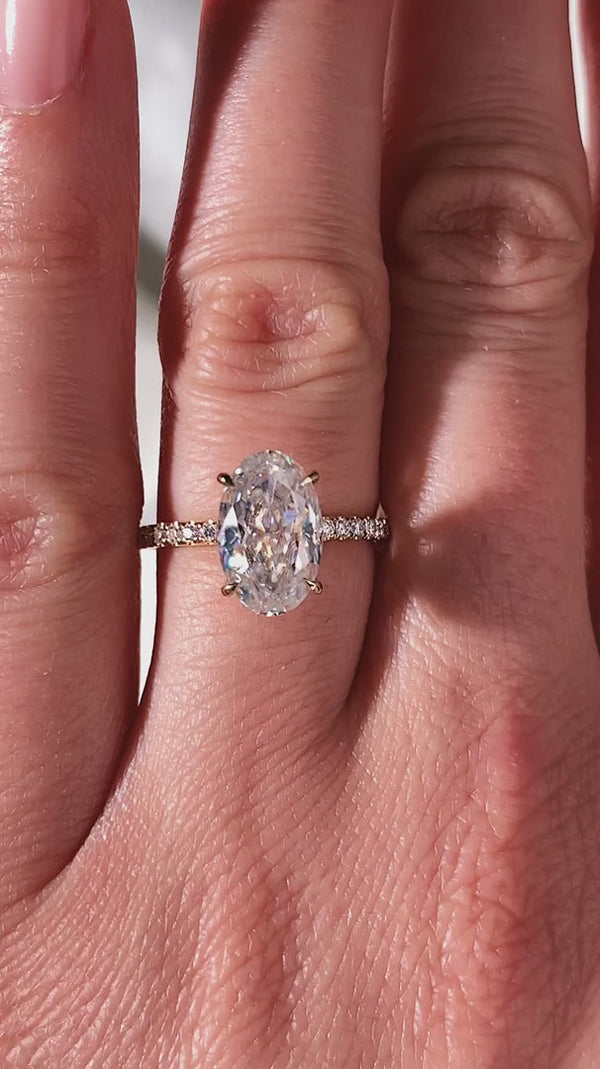
The critical point is that this effect scales with the size of the stone. A 4 mm stud produces so little of it that nobody notices. A 9 mm centre stone under directional light produces flashes a trained eye recognises across a table.
Which produces a conclusion most people find counter-intuitive: the bigger the moissanite, the less it passes. If your goal is a stone nobody questions, sizing up works against you.
| Size | Ordinary person | Experienced jeweller, by eye |
|---|---|---|
| Under 5 mm | No chance | Usually not |
| 5–7 mm | Very unlikely | Sometimes, in the right light |
| 7–8.5 mm | Unlikely | Often |
| Above 8.5 mm | Possibly, if they know the effect | Usually, quickly |
Lighting matters enormously. Diffuse daylight suppresses the difference; spotlights and LEDs amplify it.
With a loupe: it takes about five seconds
This is the definitive test and it requires no equipment beyond a 10× loupe.
Diamond is singly refractive — light entering it travels as one ray. Moissanite is doubly refractive: light splits into two rays travelling at slightly different speeds. Look down through the table at a slight angle and the back facet edges appear doubled, like a printing misregistration. Diamond never does this, at any size, under any lighting.
A jeweller who has done this a hundred times finds it immediately. It is not a subtle judgement call.
Why the honest framing is also the practical one. A stone that is identifiable in five seconds cannot be a secret over a lifetime. Every appraisal, every resize, every prong check puts it under a loupe. So the version of this that works is not concealment — it is owning it. “It’s moissanite” said plainly is a complete answer that nobody argues with, and it costs nothing. We never describe moissanite as a diamond on any page of this site, and we would say the same to a customer planning to.
Why diamond testers get this wrong
A basic diamond tester measures thermal conductivity. Diamond conducts heat exceptionally well, and so does silicon carbide — which is precisely why moissanite is used in industrial heat-management applications. A thermal-only tester therefore reads moissanite as diamond.
This is a real and widely known limitation, not a loophole. Combination testers add an electrical conductivity check: moissanite conducts electricity, diamond does not. Those separate the two immediately, and most working jewellers now use them for exactly this reason.
So “it passes the diamond tester” is a true statement about a specific and outdated instrument. It is not evidence about the stone.
Other tells worth knowing
- Weight. Moissanite is about 15% less dense than diamond, so a stone of identical size weighs less. On a scale this is conclusive — which is why moissanite is sold by millimetre and diamond equivalent weight rather than true carat.
- Inclusions. Moissanite frequently shows fine needle-like inclusions under magnification, quite different in character from diamond’s.
- Faceting style. Some moissanite is cut with facet patterns rarely used on diamond, which a specialist recognises before doing anything else.
- Certification. Diamonds carry IGI, GCAL or GIA reports and often a laser inscription. Moissanite generally is not graded on the D–Z scale at all, so its absence is itself informative.
So what does this mean for buying one?
If your reason for choosing moissanite is that you want a large, bright, hard-wearing stone for a fraction of the price — none of the above is a problem. It is a good reason and the stone delivers on it.
If your reason is that you want people to believe it is a diamond, the practical answer is that it works at small sizes among people who are not looking, and stops working as the stone gets bigger or a professional gets involved. That is a narrower promise than it sounds, and it is worth knowing before you spend money on the assumption.
Keep reading
Frequently asked questions
How does a jeweller identify moissanite?
With a 10× loupe, by looking for doubled back facet edges. Moissanite is doubly refractive, so light splits into two rays and the rear facets appear doubled when the stone is tilted. Diamond is singly refractive and never shows this. A combination thermal-and-electrical tester confirms it in seconds.
Will people know my ring is moissanite?
Ordinary people almost certainly will not, particularly below about 7 mm. Above that, moissanite’s extra coloured fire becomes visible in directional light and someone who knows the effect may notice. Counter-intuitively, a larger moissanite is less convincing than a smaller one.
Why does moissanite pass a diamond tester?
Basic testers measure thermal conductivity, and silicon carbide conducts heat almost as well as diamond — which is why it is used in industrial heat management. Combination testers add an electrical conductivity check, and since moissanite conducts electricity while diamond does not, they distinguish the two immediately.
Can you tell moissanite from diamond by weight?
Yes, conclusively, if the stone is unset. Moissanite has a specific gravity of about 3.21 against diamond’s 3.52, so a stone of the same physical size weighs roughly 15% less. This is exactly why moissanite is sold by millimetre diameter and diamond equivalent weight rather than by true carat.
We call moissanite moissanite.
On every product page, every time. If you want a diamond, we will sell you an IGI-certified lab grown one instead and tell you the difference honestly.
Leave a comment