Oval engagement rings
The Oval Solitaire
The simplest oval ring is the one that keeps every future decision open — and the one where five invisible specifications do all the work.
Written by the Mapple Gems workshop, Surat · Updated 22 August 2026
Short answer
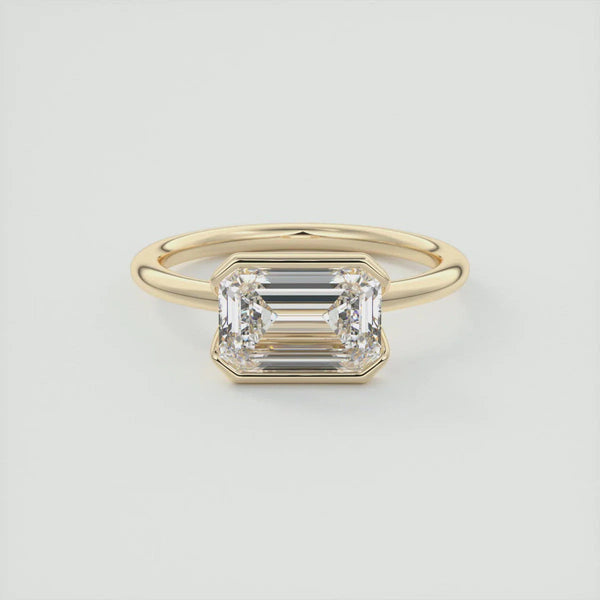
An oval solitaire is a single oval stone on a plain band. It is the only oval build that reliably takes a straight wedding band, allows a centre-stone upgrade later, and has just four to six setting points to maintain. Because there is no decoration to look at, five unlisted specifications decide whether it succeeds: head type, prong shape, shank taper, profile height and gallery.
A solitaire looks like the easy choice. There is nothing to configure, nothing to compare, nothing that can go visibly out of fashion. That is exactly why it is hard: with no halo, no pavé and no detail to carry the design, every quality signal lives in proportions most listings never state.
We have written separately about why a plain solitaire is worth choosing at all. This piece is about the oval version specifically, and about the thing nobody frames as an advantage: optionality.
The optionality argument
Most of what can be changed on a ring later depends on how simple it was to begin with. Look at the difference across a lifetime of ownership.
| Later decision | Oval solitaire | Oval halo or pavé build |
|---|---|---|
| Straight wedding band | Often possible | Rarely |
| Swap the centre stone | Straightforward | Needs a new halo drawn to the new outline |
| Add a halo or side stones | Possible — the upgrade path runs one way | Already spent |
| Replace the head after decades | Routine bench work | A rebuild |
| Settings to check every 2 years | 4–6 | 25–45 |
| Resize | Simple — plain shank | Limited if the band is stone-set |
The pattern is that a solitaire is a starting position and a decorated ring is a finished one. Neither is wrong, but only one of them lets you change your mind in ten years.
The five specifications that carry it
1. Head type. A peg head lets the most light into the pavilion and sits lowest; a basket is more enclosed and more protective; a cathedral lifts the stone on rising shoulders and often helps a straight band fit. On an oval, whichever you choose, the prongs belong at the shoulders rather than on the tapered tips where the girdle runs thin.
2. Prong shape. More important than prong count. A rounded or claw prong presents less to catch than a flat tab, and prongs thin gradually rather than snapping — which is why a bench check every two years is the entire maintenance story on a solitaire.
3. Shank taper. A band that narrows slightly as it approaches the head makes the stone read larger, uses less metal and costs less. It is the only apparent-size lever that improves size, comfort and price at once. Taper the width; never thin the thickness.
4. Profile height. Fixed at casting, invisible in a top-down render, and the specification most people discover only when the ring catches on a jumper. Ask for it in millimetres on the side elevation.
5. Gallery. Ask for it open. Light entering from beneath fills the pavilion, and it is the only way the underside of a low-set oval can actually be cleaned.
From our bench in Surat
A solitaire is the hardest thing in our workshop to sell from a photograph, and we know why. Take two oval solitaires: same stone, same metal, one with a 1.6mm straight shank and one with a 2mm shank tapering to 1.7mm at the head, on a properly finished open gallery. In a catalogue image they are almost identical. On a hand, and in year twelve, they are not the same ring at all.
So here is the concession. Every quality difference in a solitaire is a number, and our product pages do not currently publish those numbers — not gram weight, not shank thickness. Until they do, ask us. A maker who cannot answer either did not make the piece or would rather you could not compare it.
Where the money should go
With no decoration absorbing budget, a solitaire concentrates spend on the stone and the band. Two places it is worth putting money, and two where it is not.
- Worth it: cut quality. No laboratory grades cut on a fancy shape, so a bright, well-proportioned oval with a mild bow-tie is entirely a buying decision — and on a bare solitaire there is nothing else to look at.
- Worth it: shank thickness, 1.8mm minimum at the base. Structural, permanent, and almost never listed.
- Not worth it: a colour grade the metal will hide. H–I in yellow or rose gold; G or better only in white metals.
- Not worth it: a round carat figure. A 1.90ct oval is fractionally shorter than a 2.00ct one and sits below a price threshold.
What to specify
- Head type and prong placement at the shoulders, not the tips.
- Shank 1.8mm+ at the base, tapered in width toward the head.
- Euro shank, so a top-heavy oval does not turn on the finger.
- Open gallery beneath the stone.
- Side elevation with profile height in millimetres.
- Straight-edge test on that elevation, to see whether a straight band will fit.
Frequently asked questions
Is an oval solitaire a good choice for everyday wear?
It is one of the best, because it has only four to six setting points to maintain rather than the twenty-five to forty-five on a halo build. The variables that decide daily comfort are profile height and shank thickness, not the solitaire format itself.
Can I add a halo to an oval solitaire later?
Usually yes, and this is one of the format's advantages — the upgrade path runs from simple to decorated, not the reverse. It generally means a new head built around the existing stone rather than modifying the current one.
Does an oval solitaire look smaller than a halo ring?
A halo adds roughly 2.5mm of apparent width, so yes at the same centre weight. A tapered shank recovers some of that at no cost, and putting the halo budget into a larger or better-cut stone is the alternative worth pricing.
Will a straight wedding band fit an oval solitaire?
Sometimes, and a solitaire is the oval build most likely to allow it. Hold a straight edge against the side of the ring or the CAD side elevation: visible daylight under the stone means a contoured band is needed instead.
How thick should the band be on an oval solitaire?
At least 1.8mm at the base for daily wear, 2mm at two carats and above. Width can taper toward the head to make the stone read larger, but thickness should not — that is what stops the shank going out of round under an oval head.
Ask us for the numbers
Gram weight, shank thickness, profile height. Everything is made to order in our Surat workshop, so all three are still choices before casting.
Leave a comment