Oval engagement rings
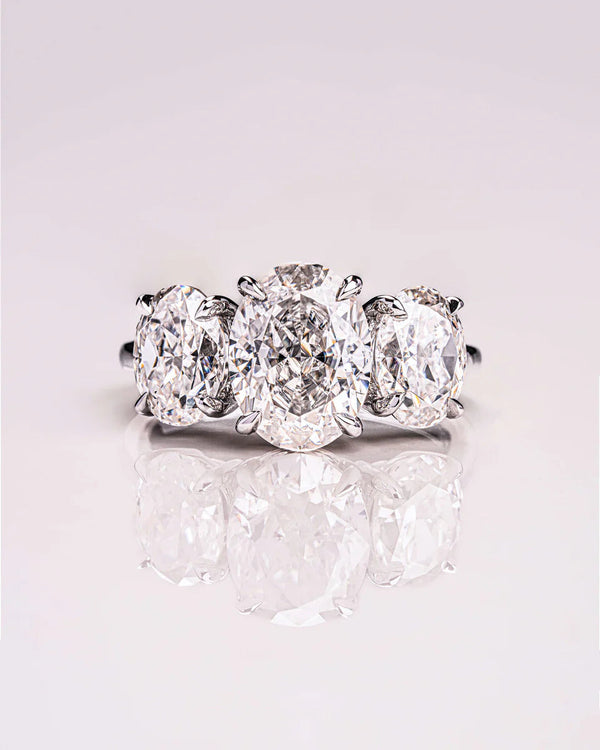
Oval Three-Stone Rings
The one arrangement where matching beats grading — and the mixed-shape version that has taken over the design in 2026.
Written by the Mapple Gems workshop, Surat · Updated 22 August 2026
Short answer
A three-stone ring places an oval centre between two side stones. Because it is the only setting that puts stones directly side by side, colour match matters more than colour grade — three G stones beat a D centre with H sides. Side stones at 15–25% of centre weight frame it; 40–50% make a true trio. A contoured band is almost always required.
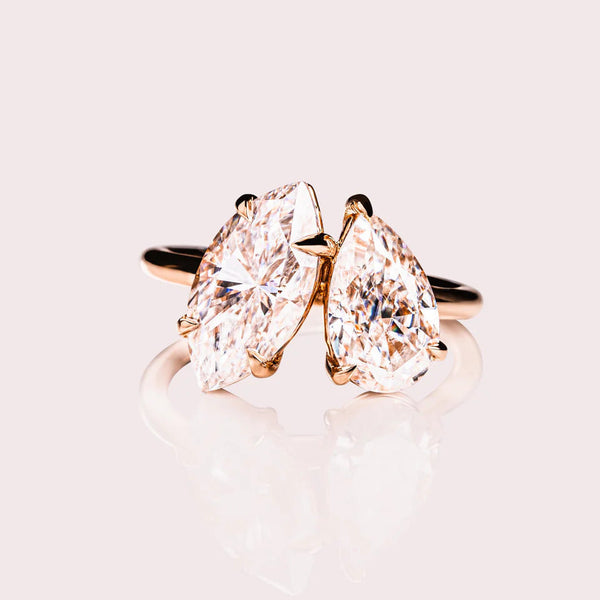
Three-stone rings have come back strongly, and the version people now ask for is not the traditional one. Instead of three matching stones, the current design pairs an oval centre with side stones of a different shape — pears, tapered baguettes, half-moons, trapezoids.
Falling lab grown prices are a large part of why. When side stones of meaningful size stopped being expensive, mixing shapes became affordable, and a design that used to be about symbolism became about composition.
The rule that separates good from bad
Colour is graded in isolation — one stone, face-down, against master stones. A three-stone ring is the only common setting that then places stones directly beside one another, and side-by-side comparison is the single condition under which most people can actually see colour differences at all.
So the arithmetic inverts. A D centre flanked by H sides looks wrong, because the eye has a reference point three millimetres away. Three well-matched G stones look right, cost less, and read as one deliberate object.
Match beats grade. If you take one thing from this page, take that.
Proportion: framing or a true trio
| Side stones as % of centre weight | Effect | Suits |
|---|---|---|
| 10–15% | Accent only; reads as a solitaire with detail | Keeping the oval unambiguously the subject |
| 15–25% | Framing — the classic proportion | Most buyers; adds width without competing |
| 40–50% | A true trio; three stones you read as three | The symbolic version, and a wide statement ring |
| Above 50% | The centre stops being a centre | Rarely what anyone actually wanted |
One number to request that no listing gives you: total width across the setting. A 2ct oval is around 7mm wide; add two meaningful side stones and the ring can occupy 13–15mm of finger. That is a different object from what the top-down render suggests, and it is the figure that determines whether the ring is comfortable next to other fingers.
Choosing the side shapes
Tapered baguettes are step cuts — long, calm parallel facets. They add width and presence with far less fire than a halo or pavé, which is exactly the point: they frame the oval without competing with it. Because a step cut is a window, they want a grade higher on colour and clarity than the centre would need.
Pears point outward along the finger and echo the oval's curve. Each one needs a V-prong over its point; a pear side stone without one is a repair waiting to happen.
Half-moons and trapezoids sit flush against the oval's shoulders and give the cleanest, most architectural line. They are the hardest to source in matching pairs, which is worth knowing before you fall for a render.
Matching ovals remain the traditional answer and are the easiest to get right, because the outline logic is consistent across all three stones.
From our bench in Surat
Side stones under about 0.2ct are never individually certified in any material, so on a three-stone ring you are usually trusting a maker's word on two of the three stones. That is normal across the trade, not a warning about anyone in particular — but it means the useful question is not "are they certified" but "how were they matched".
Ask for the sides to be selected as a pair from one parcel rather than picked individually, ask for a photograph of all three stones together before setting, and ask for a level stone row in the finished piece. That last one is the visible evidence of the setting work: a row that runs true is the single clearest sign the bench took its time.
The band problem is worse here
A three-stone ring is one of the builds most likely to need a contoured wedding band, and for a different reason than a plain oval solitaire. It is not just that the centre sits low — it is that the side stones extend the setting along the finger in both directions, so there is even less room for a straight band to meet the ring.
Run the straight-edge test on the CAD side elevation before approving anything, and order the band from the same file at the same time. And accept the maintenance arithmetic: a three-stone ring has roughly ten to fourteen setting points against a solitaire's four to six, so a bench check every two years matters more.
What to specify at CAD
- Side stones matched as a pair, in the same colour range as the centre.
- Side proportion chosen deliberately: 15–25% to frame, 40–50% for a trio.
- Total width across the setting, in millimetres.
- V-prongs on any pear sides; a prong per corner on any step-cut sides.
- Prongs on the oval at the shoulders, not on the tapered tips.
- Shank 1.8mm or more, and a euro shank — a wide head turns readily.
- Contoured band drawn from the same file, ordered together.
Frequently asked questions
Should the side stones match the centre's colour grade?
They should match each other and the centre closely, and that matters more than the grade itself. A three-stone ring is the only common setting that puts stones side by side, which is the one condition under which colour differences become visible — three matched G stones beat a D centre with H sides.
How big should side stones be next to an oval?
15–25% of the centre's weight each for a framing effect, which suits most buyers. 40–50% produces a true trio where all three stones read equally. Above 50% the centre stops functioning as a centre.
Are baguette side stones a good match for an oval?
Very good, because they are step cuts and add width and presence with much less fire than a halo, so they frame the oval rather than compete with it. Being step cuts, they want a grade higher on colour and clarity than a brilliant side stone would.
Are side stones certified?
Stones under roughly 0.2ct are never individually certified in any material, so most side stones come with a maker's description rather than a report. The useful question is how they were matched — ask for them to be selected as a pair from one parcel.
Can a three-stone oval ring take a straight wedding band?
Almost never. The side stones extend the setting along the finger in both directions, leaving no room for a straight band to meet the ring. Plan for a contoured band and order it from the same CAD file at the same time.
Ask to see all three stones before setting
Made to order in our Surat workshop, so matching, proportion and total width are all decided before anything is cast.
Leave a comment