Engagement Rings
East-West Settings: What They Are, and What They Are Not
A term that gets applied to rings it does not describe. Here is the actual definition.
Written by the Mapple Gems workshop, Surat · Updated 22 August 2026
Short answer
An east-west setting turns an elongated stone sideways, so its long axis runs across the finger rather than along it. It only applies to shapes with a long axis — oval, emerald, marquise, pear, radiant, elongated cushion. A round, cushion, Asscher or princess cannot be east-west, because a symmetrical stone has no orientation to rotate. If a listing calls a round ring east-west, the listing is wrong.
East-west is one of the few genuinely new ideas in ring design in decades, and also one of the most frequently misapplied labels in the trade. Both things are worth knowing, especially if you are shopping by filter.
The definition, precisely
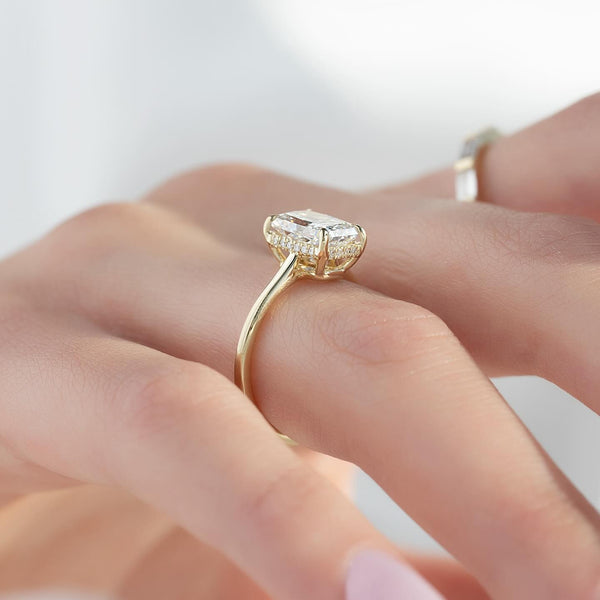
Rings are conventionally set north-south: the long axis of the stone points up the finger, from knuckle toward the hand. It is so standard that most people have never registered it as a choice.
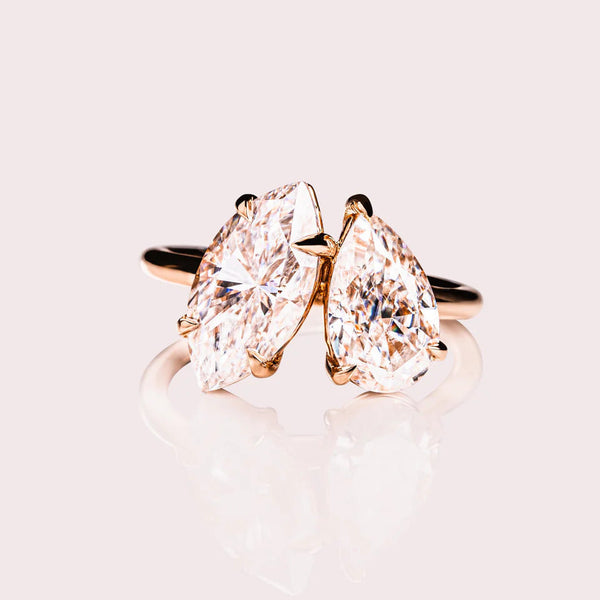
East-west rotates that by 90 degrees. The stone lies across the finger. The stone is unchanged; only its orientation in the setting differs.
Which means the whole idea depends on the stone having a long axis to rotate. Turn a round brilliant 90 degrees and you have a round brilliant. Turn a princess or an Asscher and you have the same square. There is nothing to see.
| Shape | Can be east-west? | Effect |
|---|---|---|
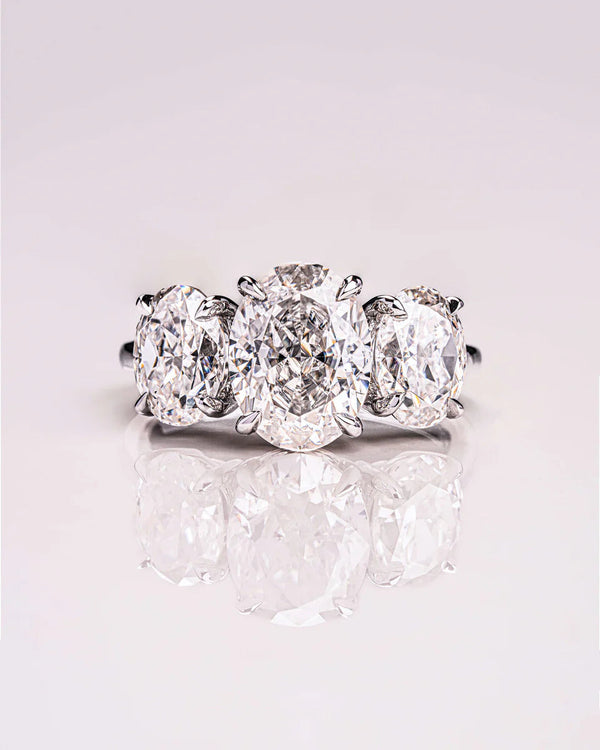
| Oval | Yes | The most common and most flattering version |
| Emerald | Yes | Strong architectural look; very effective |
| Marquise | Yes | Dramatic, and the widest across the finger |
| Pear | Yes | Point sits to one side; polarising but distinctive |
| Radiant / elongated cushion | Yes, if elongated | Only when the ratio is genuinely long |
| Round | No | Symmetrical — no axis to rotate |
| Princess, Asscher, square cushion | No | Rotating a square gives you a square |
Why this matters when you are shopping. “East-west” has become a search term, and search terms get attached to listings that do not deserve them. We have found rings tagged east-west in our own catalogue that were nothing of the sort — round centres, symmetrical cushions, ordinary north-south ovals — and we are fixing them. If you are filtering by east-west anywhere, look at the photograph rather than trusting the label. The test takes one second: does the stone lie across the finger, and does it have a long axis at all?
What it actually does on a hand
- It widens rather than lengthens. A north-south oval draws the eye up the finger and makes it look longer. East-west does the opposite — it emphasises width. This is the single most important consequence and it decides whether the ring suits you.
- It sits lower and flatter. A stone lying across the finger generally has a lower profile than the same stone standing along it, so it catches less and slides under a cuff more easily.
- It reads as deliberate. Because it is unusual, people notice the ring rather than the stone size. That is the appeal for some buyers and the objection for others.
- It changes how the light moves. On an emerald cut especially, turning it sideways changes the direction of the long flashes across the table.
Who it suits
Longer fingers carry east-west comfortably, because they can afford to give up the lengthening effect of a north-south setting.
Shorter fingers are the harder case. East-west emphasises width across a finger that is already short, so it usually works against you — unless the stone is small relative to the finger, in which case it can look neat rather than wide.
Anyone who works with their hands benefits from the low profile. There is genuinely less to catch.
The wedding band question
East-west is generally easier to pair with a band than a north-south equivalent, which surprises people.
A north-south oval or marquise extends down the finger toward where the band sits, which is what creates the gap. Turned sideways, the stone extends outward across the finger instead, leaving the space beside the shank clearer. A straight band often sits flush with no contouring at all.
It is not universal — a low basket or a hidden halo still intrudes regardless of orientation — so ask for the side elevation of the render before assuming. But as a rule, east-west is the friendlier option here.
Fad or fixture?
Honestly: somewhere in between. East-west is not new — sideways settings appear throughout Art Deco design and earlier — so it is a revival rather than an invention, and revivals tend to persist longer than genuine novelties.
What is new is its current volume. A ring that reads as distinctive today because few people have one will read differently when many people do. If that matters to you, that is a real consideration. If you like how it sits on your hand, it is not.
Keep reading
Frequently asked questions
What is an east-west engagement ring?
One where an elongated stone is set sideways, so its long axis runs across the finger instead of along it. The stone itself is unchanged — only its orientation in the setting differs. It applies only to shapes with a long axis, such as oval, emerald, marquise and pear.
Can a round diamond be set east-west?
No. East-west means rotating an elongated stone through 90 degrees, and a round stone is symmetrical, so there is no axis to rotate and no visible difference. The same applies to princess, Asscher and square cushion cuts. A listing describing any of those as east-west is mislabelled.
Do east-west rings make fingers look shorter?
They emphasise width rather than length, so they give up the lengthening effect a north-south elongated stone provides. On longer fingers this is comfortable. On shorter fingers it usually works against you unless the stone is small relative to the finger.
Do east-west rings fit a wedding band?
Usually more easily than the north-south version of the same stone. Turned sideways, the stone extends across the finger rather than down toward where the band sits, so a straight band often sits flush without contouring. A low basket or hidden halo can still intrude, so check the side elevation of the render.
Ask us to show you both orientations.
Same stone, north-south and east-west, on your finger size — before anything is cast.
Leave a comment