Oval engagement rings
The Best Settings for an Oval Diamond
An oval is asymmetric, sits low and wide, and tapers to two vulnerable ends. That combination makes it the shape where the setting decides more than the stone.
Written by the Mapple Gems workshop, Surat · Updated 21 August 2026
Short answer
For an oval, a four-prong solitaire with prongs at the shoulders and a euro shank is the most reliable everyday build. Use six prongs above about 2ct, a bezel for hands-on work, and a full halo if you want to mask a bow-tie. The two specifications that matter most — open gallery and shank thickness — are ones almost nobody asks for.
Most setting advice is written about round diamonds and then applied to everything else. That works reasonably well for cushions and radiants. It works badly for ovals, because an oval breaks three assumptions a round setting is built on: it is not rotationally symmetrical, it does not distribute weight evenly around the finger, and it has two ends where the girdle runs thin.
Here is what to actually specify.
Prongs: count matters less than position
The usual question is four prongs or six. The better question is where they sit.
On a round, prong position is arbitrary because every direction is the same. On an oval it is not. Prongs placed at the two tips look tidy in a drawing and are a poor idea in practice: the tips are where the girdle is thinnest, and a prong sitting on a thin girdle has less material to grip and puts pressure on the most fragile part of the stone.
The standard good build puts four prongs at roughly the ten, two, four and eight o'clock positions — on the shoulders, where the girdle is thickest — leaving both tips visually open. That reads cleaner, grips better, and leaves the outline uninterrupted.
Six prongs add two more at the twelve and six positions. Worth it above roughly 2ct, where the stone is heavy enough that four points of contact start working harder, and worth it for a long ratio where the ends need covering. Below that, six prongs mostly cost you visible outline.
The spin problem nobody warns you about
An oval solitaire is top-heavy along one axis. When the ring turns on the finger — and every ring turns — a round stone still looks like a round stone. An oval turns sideways, and you notice immediately.
The fix is not a tighter ring size. A ring sized tight enough to stop rotating is a ring that will not go over the knuckle in warm weather. The fix is a euro shank: a flattened section on the underside of the band that meets the flat underside of the finger instead of sitting on a curve. It is invisible from above, costs almost nothing at the design stage, requires no maintenance, and it is the single most useful modification we make to oval rings.
Almost nobody is offered it, because it has to be drawn into the CAD before casting. Ask for it by name.
Which setting style suits which life
| Setting | What it does for an oval | Maintenance points | Straight band fits? |
|---|---|---|---|
| Four-prong solitaire | Maximum light in, cleanest outline, easiest to upgrade later | 4 | Sometimes |
| Six-prong solitaire | Covers the tips; sensible above ~2ct or ratio above 1.50 | 6 | Sometimes |
| Full halo | Adds ~2.5mm of apparent width and genuinely masks a bow-tie | 25–45 | Rarely |
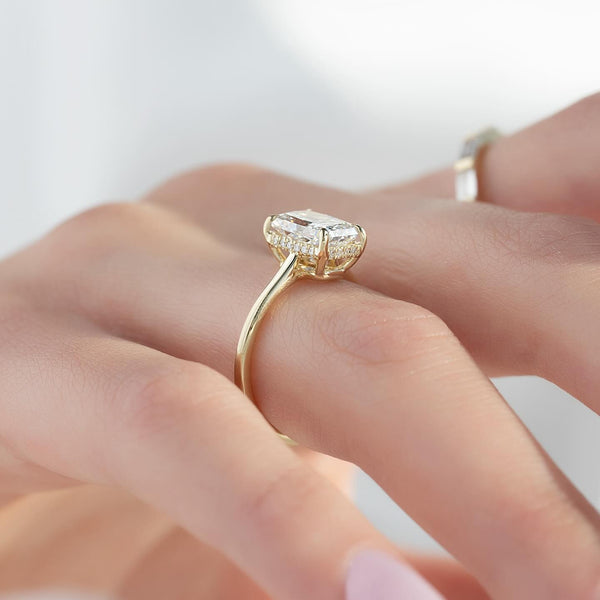
| Hidden halo | Detail from the side only; raises profile height | 20–30 | Rarely |
| Bezel | Protects both tips completely; lowest profile; nothing to catch | 1 | Usually |
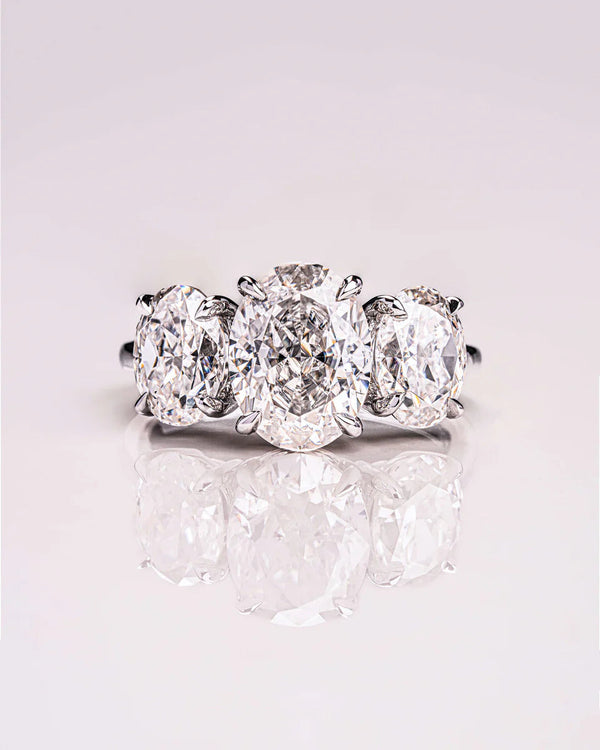
| Three-stone | Adds width across the finger without a halo's fire | 10–14 | Almost never |
The maintenance column is the one people skip and later care about most. Every setting point is a place that can loosen, and a bench check every couple of years is the whole answer regardless of which row you choose — but a solitaire has four things to check and a halo has forty.
From our bench in Surat
The oval repairs that come back to us are almost never about the stone. They are about the shank. An oval head is heavier on one axis than a round head of the same carat, and that weight sits on top of whatever thickness the band was cast at. Under about 1.8mm at the base, a shank carrying an oval starts going out of round within a few years, and once it goes oval the setting above it stops sitting square.
The honest concession: thin, delicate shanks photograph better than thick ones, and that is a large part of why they are so widely sold. We will make one if you want it. We will also tell you it is the specification most likely to bring the ring back to a bench before its tenth birthday.
The two specifications nobody asks for
An open gallery. The gallery is the structure under the stone. On an oval it matters more than on any other shape, for two reasons. Light entering from beneath fills the pavilion and reduces how much you notice the bow-tie. And an open gallery is the only way the underside of a low-set oval can actually be cleaned — with a closed basket, product film builds up on the pavilion where no cloth reaches, and the stone dulls from underneath.
Profile height in millimetres. How far the stone sits above the finger is fixed at casting and cannot be changed afterwards. It is invisible in the top-down render most people approve from. Ask for the side elevation with the height marked before you sign anything off.
What to specify at CAD approval
- Prongs at the shoulders, not on the tips. Six above roughly 2ct.
- Euro shank, if the ring will be worn daily.
- Shank at least 1.8mm at the base.
- Open gallery under the stone.
- Side elevation supplied, with profile height in millimetres.
- Total width across the setting, so you know what the ring occupies on the finger.
- Wedding band decided now, not later — most ovals need a contour.
Keep reading
The bow-tie in an oval diamond, and how to judge it
Frequently asked questions
Four prongs or six for an oval diamond?
Four is enough for most ovals up to about 2ct, placed on the shoulders rather than on the tips where the girdle runs thin. Go to six above 2ct, or when the length-to-width ratio is above roughly 1.50 and the ends need covering.
Why does my oval engagement ring keep spinning?
Because the head is heavier along one axis and the round underside of the band sits on the flat underside of the finger. A euro shank — a flattened section under the band — solves it permanently and invisibly, but it has to be drawn in before casting.
Is a bezel setting a good idea for an oval?
It is the most protective option, because it covers both tapered ends completely and leaves nothing raised to catch. It also gives the lowest profile and is the easiest oval setting to fit a straight wedding band against. The trade-off is slightly less light entering from the sides.
Does a halo hide a bow-tie?
A full halo genuinely helps, because it adds a bright frame at the width where the dark band sits and the eye reads the whole head as one lit object. A hidden halo does not, since it sits below the girdle and contributes nothing at the face of the stone.
How thick should the band be under an oval?
At least 1.8mm at the base for daily wear. Width is cosmetic; thickness is structural, and it is the specification almost no listing states. An oval head puts uneven load on the shank, so a thin band goes out of round faster under one than under a round solitaire.
Made to order means these are still choices
Prong placement, gallery, shank thickness and euro shank are all decided before casting in our Surat workshop — not after.
Leave a comment