Shape Guide
Oval Cut Lab Grown Diamond Engagement Rings
Everything that actually changes the ring on the hand — spread, bow-tie, ratio, certificate, setting.
The short answer: An oval cut lab grown diamond engagement ring pairs the shape that covers the most finger per carat with the stone type that now accounts for the majority of engagement ring purchases. Because an oval is elongated, it presents a noticeably larger face-up surface than a round of identical carat weight, so it reads bigger for the same money. The three things that decide whether a specific oval is a good one are its length-to-width ratio, the severity of its bow-tie, and whether the setting protects the two pointed tips.
Oval has spent the last few years climbing towards the top of the shape charts, and it is now effectively level with round brilliant among engagement ring buyers. Lab-grown has moved even faster: it is no longer the alternative choice, it is the default one. Put the two together and "oval cut lab grown diamond engagement ring" has become one of the single most-searched ring descriptions in the category.
The problem is that most guides stop at "ovals look elegant and elongate the finger." That is true and it is useless when you are looking at forty listings that all claim the same thing. This guide covers the specifications that separate a good oval from a mediocre one at the same price.

Why an oval looks bigger than its carat weight
Carat is a measure of weight, not size. Two stones of the same weight can present very differently depending on where that weight sits. A round brilliant is deep — a meaningful share of its mass is below the girdle, hidden inside the setting. An oval is stretched along one axis, which pushes more of the same mass out into the face-up surface you actually see.
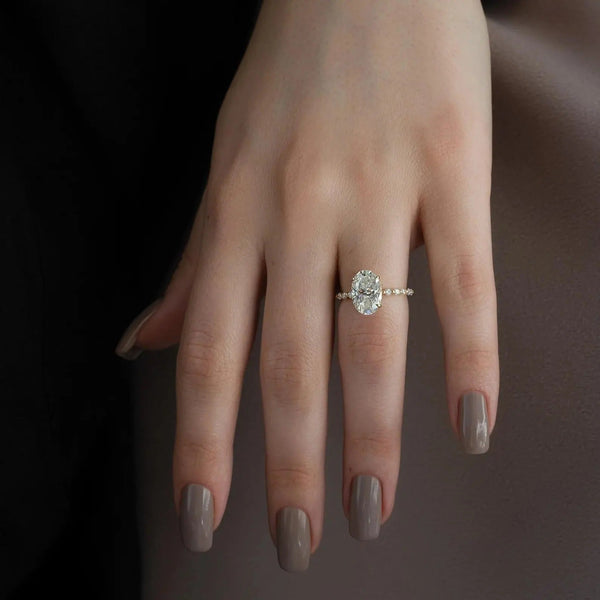
In practice, an oval of a given carat weight presents roughly a tenth more visible surface than a round of the same weight, and because the extra length runs along the finger rather than across it, the perceived difference is larger still. This is why buyers repeatedly report that an oval "wears bigger" than the number on the certificate suggests.
| Shape | Face-up spread at equal carat | Reads as | Main risk to check |
|---|---|---|---|
| Round brilliant | Baseline | Classic, compact, brightest return of light | Paying for depth you cannot see |
| Oval | Largest of the three | Elongating, larger for the weight | Bow-tie and ratio |
| Pear | Similar to oval | Directional, more distinctive | Single vulnerable point |
If your priority is the largest-looking stone within a fixed budget, oval is close to the optimal choice. If you want to compare across shapes properly, our guide to which stone shapes look biggest for the carat sets out the full ranking.
The bow-tie: the flaw nobody mentions in the listing
Look at almost any oval stone straight down and you will see a darker band across the middle, roughly the shape of a bow tie. It is caused by the way the elongated pavilion facets shadow the centre of the stone — light entering the top is obstructed by the viewer's own head and by the facet geometry, and returns dark.
Every oval has a bow-tie. Anyone telling you their ovals have none is describing a photograph, not a stone. What varies is severity: a faint one that only shows at certain angles is normal and arguably adds contrast; a heavy black band that dominates the centre of the stone is a cutting fault, and no certificate grade will flag it.
How to check it before you buy
- Ask for video, not stills. A still can be lit to erase a bow-tie entirely. Movement is what exposes it.
- Watch it under ordinary light. Jewellery lighting is designed to flood a stone from every direction, which is precisely the condition under which a bow-tie disappears.
- Judge it at arm's length, not magnified. The question is how it looks on a hand across a table.
Length-to-width ratio: the specification that decides the look
Ratio is simply the stone's length divided by its width. It is the single number that determines whether an oval reads as a soft, rounded oval or a long, dramatic one — and it is far more visible on the hand than a colour or clarity grade one step apart.
| Ratio | How it reads | Suits |
|---|---|---|
| Around 1.30 | Soft, close to a rounded cushion | Buyers who nearly chose round |
| 1.35 – 1.45 | The classic oval most people picture | Most buyers; the safe default |
| 1.45 – 1.55 | Visibly elongated, more elegant, more finger coverage | Slimmer fingers, buyers wanting drama |
| Above 1.60 | Narrow and stretched; bow-tie usually more visible | A deliberate stylistic choice, not a default |
Decide your ratio band before you start looking. It is the fastest way to cut a long list down, and it prevents the common outcome where someone spends weeks comparing certificates and then dislikes the finished ring for a reason no certificate mentioned.
What certification means for a lab-grown stone in 2026
This changed recently and a lot of published advice has not caught up. As of October 2025, GIA stopped issuing the familiar D–Z colour and Flawless–I3 clarity grades for laboratory-grown diamonds. It now issues a Laboratory-Grown Diamond Quality Assessment, which places a stone in a broad band — a top band for stones with the highest colour, very high clarity and excellent finish, and a wider band below it — or declines to assess if it clears neither. Reports issued before that date keep their letter grades.
IGI, which grades the large majority of lab-grown production, still issues the granular colour and clarity grades buyers are used to. In practice that means:
- Most lab-grown ovals you will see quoted with a specific colour and clarity grade carry an IGI report.
- A GIA report on a recent lab-grown stone will read as a band, not a letter — that is not a downgrade, it is a change in how the report is written.
- At Mapple Gems, lab-grown stones are IGI certified. Moissanite is a different mineral and is not graded on the diamond scale at all.
Where to spend and where not to: on an oval, cut quality and ratio are visible from across a room. Colour and clarity one grade apart are not. If a budget decision has to be made, hold the cut and let the clarity grade drop — the reverse produces a stone that grades well on paper and looks flat on a hand.
What an oval lab grown diamond costs now
Lab-grown prices fell steeply between 2020 and 2024 and have since flattened out close to production cost. A well-cut, certified one-carat stone now sits in a band that would have been unthinkable five years ago, and the same specification can still cost forty to sixty per cent more at retailers who never repriced after the fall.
Two consequences worth planning around:
- Carat is cheap; craftsmanship is not. The stone is now often the smaller share of a finished ring's cost. Setting quality, metal weight and finishing are where the money and the durability sit.
- Buy to wear, not to resell. Falling new-stone prices mean an older lab-grown stone competes against cheaper current production, so resale is limited. Gold has a predictable scrap floor by weight and karat; stones are where value is lost. That is an argument for choosing something you will wear daily, not an argument against buying.
Setting an oval so it survives being worn
An oval has two tips, and tips are where stones chip. The setting is not a styling decision here — it is a structural one.
Prongs
Four prongs at the compass points leave the tips exposed. Prongs positioned to sit over the tips, or six prongs, protect the vulnerable ends and are the more sensible choice for a ring worn every day. Read our guide to 4-prong vs 6-prong settings for the trade-offs.
Hidden halo
A ring of small stones set beneath the centre stone, invisible from above, lifts the oval slightly and adds brightness at the girdle without changing the silhouette. It is currently the most-requested detail on oval engagement rings.
Bezel and half-bezel
A bezel that wraps the tips is the most protective option available and suits anyone who works with their hands. It slightly reduces the light entering from the sides, so it pairs best with a well-cut stone.
Three stone
Tapered side stones on an oval extend the line of the ring along the finger, amplifying the elongating effect the shape already has.
Metal choice for an oval
White metal — 14K or 18K white gold, or 925 sterling silver — keeps a colourless stone reading colourless, because there is no warm metal adjacent to it to reflect into the pavilion. Yellow gold is now the most-chosen setting metal overall, and it does subtly warm the appearance of the stone; on a lab-grown diamond of high colour this is usually a non-issue and often desirable. A frequently used compromise is a white metal head holding the stone on a yellow or rose gold band.
On karat: 14K is harder and more resistant to knocks than 18K, which is richer in colour and slightly softer. For a ring worn daily with an exposed centre stone, 14K is the more practical choice. See gold karats explained for the full comparison.
Keep reading
Frequently asked questions
Are lab grown diamonds real diamonds?
Yes. A lab-grown diamond is carbon in the same crystal structure as a mined diamond, with the same hardness, the same refractive index and the same optical behaviour. The difference is origin, not composition. It is disclosed as laboratory-grown, always.
What is the best length-to-width ratio for an oval engagement ring?
Between about 1.35 and 1.45 gives the classic oval silhouette most buyers picture. Below 1.30 it starts reading like a rounded cushion; above 1.60 it becomes narrow and the bow-tie usually becomes more visible. Choose your band before you start comparing stones.
Does every oval diamond have a bow-tie?
Yes. The bow-tie is a consequence of how light behaves in an elongated pavilion, so every oval has one to some degree. What matters is severity. A faint bow-tie visible only at certain angles is normal; a heavy dark band across the centre is a cutting fault and will not appear on any grading report. Always judge it on video under ordinary light.
Does an oval look bigger than a round diamond of the same carat?
Yes. Carat measures weight, and an oval distributes more of that weight into the face-up surface rather than into depth hidden by the setting. An oval presents roughly a tenth more visible surface than a round of equal weight, and the elongation along the finger makes the perceived difference greater still.
Who certifies lab grown diamonds in 2026?
IGI grades the large majority of laboratory-grown production and still issues granular colour and clarity grades. Since October 2025 GIA no longer issues letter grades for lab-grown stones; it issues a Laboratory-Grown Diamond Quality Assessment placing the stone in a broad quality band instead. Mapple Gems lab-grown stones are IGI certified.
Which setting is safest for an oval engagement ring?
A bezel or half-bezel that wraps the two tips is the most protective, followed by six prongs or four prongs positioned over the tips rather than at the compass points. The tips are the thinnest part of an oval and the place a stone is most likely to chip in daily wear.
Oval lab grown diamond rings, made to order
IGI certified stones, set in 925 sterling silver or solid 10K, 14K and 18K gold. Handcrafted to your specification in Surat.
Shop oval lab grown diamond rings
Leave a comment