Engagement Rings
The Design Mistakes We See Most Often
Seven decisions that look fine on a render and cause problems later. All of them are free to fix beforehand.
Written by the Mapple Gems workshop, Surat · Updated 6 September 2026
Short answer
The seven, in order of how often they come back to us: a shank under 1.8 mm; no prong over a point or corner; a profile height chosen by accident; a full eternity band on a finger whose size will change; the wedding band left until afterwards; a colour grade paid for that the metal hides; and a stone sized past what the finger carries. Every one is decided at the render stage, costs nothing to change there, and cannot be changed once cast.
These are not exotic problems. They are the same handful of decisions, made the same way, by people who had no particular reason to know better — because none of them are visible in a top-down render, which is the image everyone approves from.
1. A shank thinner than 1.8 mm
The most common by a distance, and the most consequential. A thin band looks elegant in a render and reads delicate on the hand — and then flexes under grip pressure until it goes out of round, and stones set into a flexing shank work loose.
1.8 mm is the floor for daily wear. The difference between 1.5 mm and 1.8 mm is invisible on a hand and costs a negligible amount of gold. Ask for the number in writing; almost no listing states it.
2. No prong over a point or a corner
On a pear, marquise or heart, the point is the only genuinely fragile part of the stone, and it needs a V-prong wrapping it from both sides. On an emerald or Asscher, each of the four cut corners needs a prong over it.
Renders frequently show prongs on the long sides with the point or corners exposed, because it looks cleaner. That ring will eventually be damaged, and it cannot be corrected afterwards without unsetting the stone.
3. Profile height chosen by accident — and the render that hides it. Nearly every design is approved from a top-down view, which is the one angle where height does not exist. So people discover the ring’s height when it arrives: it catches on gloves, it rolls, it will not sit flush with a straight band. Height is fixed the moment the ring is cast — resizing, repolishing and resetting are all possible later, but lowering the profile means remaking the piece. Ask for the side elevation and the height in millimetres before approving anything. If a maker only ever sends top-down images, that is worth noticing on its own.
4. A full eternity band on a finger that will change
Full eternity bands cannot be resized — there is no plain metal to cut and nowhere safe to apply heat. That is fine if your size is settled and you know it.
It is not fine if pregnancy, weight change, joint changes or a hot climate are in the picture, and it is a very poor choice for a ring intended to be worn every day for forty years. A three-quarter eternity looks identical on the hand, because the bare section sits under the finger, and it resizes.
5. Leaving the wedding band until afterwards
Whether a straight band sits flush is decided entirely by the engagement ring’s profile near the shank. Designed together, the band is cut to the actual ring while it is still unfinished, and the fitting is simply part of making it.
Fitted afterwards, it is bench work — measuring or physically having the ring, cutting a wax to profile, checking and adjusting. That is charged as skilled labour, frequently more than the metal in the band.
Three stone and pear rings almost always need a contour or chevron. If either is your design, deciding the band later is a guaranteed extra cost.
6. Paying for a colour grade the metal hides
A near-colourless stone set in yellow or rose gold reads white, because the metal is warmer than the stone. Buying up the colour scale for a warm-metal setting is money spent on something nobody will see, including you.
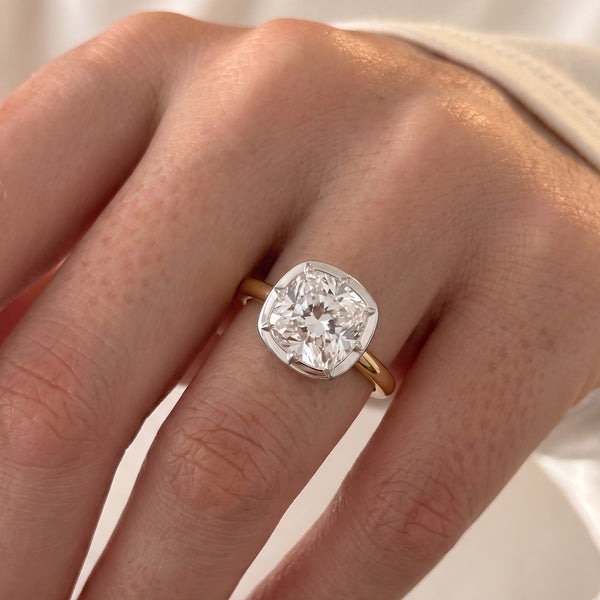
Where it does matter: white gold and platinum, which give the eye a neutral reference, and larger stones, where tint accumulates with depth. The efficient answer is often a white head on a coloured band — the stone sits in white metal and stays neutral, the shank is whatever colour you want, and the colour grade you need drops.
7. A stone sized past what the finger carries
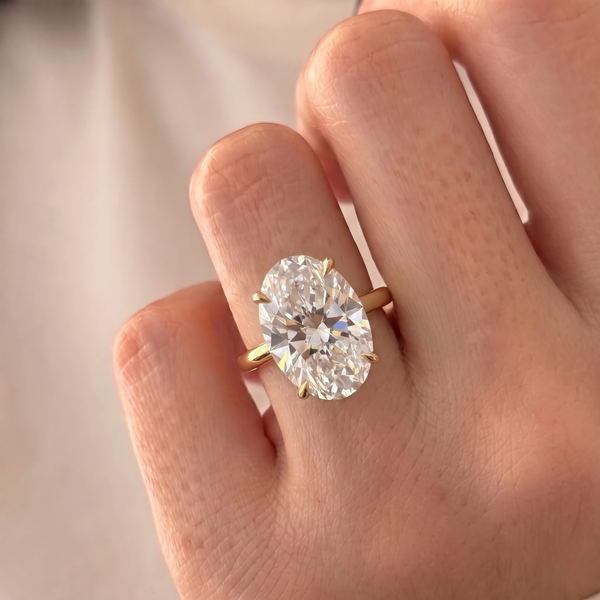
Apparent size is a ratio of stone width to finger width. On a size 4–5 hand, a stone reads roughly one step larger than the same stone on a size 7 — so people frequently buy a size larger than they needed, and end up with a ring that overhangs the finger’s edges and sits high.
With moissanite there is a second reason for restraint: dispersion scales with depth, so a larger moissanite is less discreet, not more impressive. If the goal is a ring that reads as a beautiful ring rather than as a large stone, moderate size and better construction gets you there.
The render checklist
- Side elevation, not just top-down.
- Shank width and thickness in millimetres.
- Profile height in millimetres.
- A prong over every point and corner.
- The wedding band shown alongside, on the finger.
- Confirmation the design can be resized, and by how many sizes.
Six checks, all answerable in one message, all free to act on before casting and impossible afterwards.
Frequently asked questions
What is the most common engagement ring design mistake?
A shank thinner than 1.8 mm. It looks elegant in a render, then flexes under grip pressure until the ring goes out of round, and stones set into a flexing shank work loose. The difference between 1.5 mm and 1.8 mm is invisible on the hand and costs a negligible amount of gold.
What should I check on a CAD render before approving it?
The side elevation rather than only a top-down view, shank width and thickness in millimetres, profile height in millimetres, a prong over every point and corner, the wedding band shown alongside on the finger, and confirmation of how many sizes the design can be resized. All six are free to change before casting and impossible afterwards.
Why should the wedding band be designed at the same time?
Because whether a straight band sits flush is decided by the engagement ring’s profile near the shank. Designed together, the band is cut to the actual ring while it is still unfinished and the fitting is part of the build. Fitted afterwards it is skilled bench work, often costing more than the metal in the band itself.
Am I paying for a colour grade I cannot see?
Possibly, if the setting is yellow or rose gold — a near-colourless stone reads white against warm metal because the metal is warmer than the stone. Colour matters in white gold and platinum, and in larger stones where tint accumulates with depth. A white head on a coloured band gets both, and lowers the grade you need.
Ask for the side view before you approve.
Three of these seven are invisible from above, and all seven are free to fix at the wax stage.
Leave a comment