Canada · Engagement Rings
Wearing an Engagement Ring Through a Canadian Winter
Fingers shrink in the cold, gloves come off a dozen times a day, and a ring that fitted in July can leave with a mitten in January. Here is how to size for it and what to do about it.
Written by the Mapple Gems workshop, Surat · Updated 9 November 2026
Short answer
Fingers get noticeably smaller in cold weather and larger in heat, so a ring sized in one season can feel wrong in the other. In Canada, measure at room temperature in the afternoon, never straight after coming in from outside. Most winter losses happen when a glove or mitten is pulled off, so if a ring turns loose in January, fit sizing beads or a guard rather than resizing, and resize only after a full year of seasons.
Canada asks more of a ring than almost anywhere else we ship to. The temperature range between a February morning and a July afternoon is enormous, and the hand that wears the ring goes from a heated car to a frozen driveway and back several times a day. None of that affects the stone. All of it affects the fit, and fit is what decides whether the ring is still on your finger in April.
Why fingers shrink in winter
When the body is cold it narrows the blood vessels near the skin to keep the core warm. Fingers lose volume first. Heat, exercise, salty food and a long flight do the opposite. The change is ordinary and temporary, but on a ring it is the difference between snug and loose.
Two details matter more than the general idea:
- The base of the finger changes more than the knuckle. The knuckle is mostly bone and joint, so it barely shrinks. It is the knuckle that holds a ring on. In the cold, the band sits loose at the base but is still held by the knuckle, until something drags it over.
- Indoor heat is the other half of the swing. Canadian homes and offices run warm and dry in winter, so the same finger can be small on the walk to the car and close to its summer size an hour later at a desk.
When to measure, and when not to
| Moment | What your finger is doing | Measure? |
|---|---|---|
| Just in from outside | At its smallest | No — wait at least half an hour |
| First thing in the morning | Often slightly puffy | No |
| After a workout, hot shower or salty meal | Swollen | No |
| Mid-afternoon, indoors, settled | Close to its everyday size | Yes |
| Same time, two or three different days | Shows your real range | Best of all |
If you are measuring an existing ring rather than a finger, measure its inside diameter in millimetres and send us that number. Canada uses the same numeric ring sizes as the United States, but older family rings and pieces bought in Europe or the UK use other systems, and converting twice is the most common way a ring ends up the wrong size.
From the bench: the usual advice flips in a Canadian January. Our normal rule is that a slightly loose ring is the safer mistake, because you can still wear it while you decide what to do, and a tight one you cannot wear at all. That holds for most of the year. In deep cold it reverses: the loose ring is the one that leaves inside a mitten. So if your ring is fine in summer and loose in winter, do not resize it down. You would be fitting it to your smallest finger and it would pinch from May to September. Fix the winter problem with something you can take off again.
Where rings actually get lost between November and March
- Taking off gloves and mittens. By far the most common. A knit or lined glove grips the band and drags it over the knuckle as you pull. Pull gloves off by the cuff, not the fingertips, and if your ring is loose, take gloves off with the ring hand closed.
- Shovelling snow. Gripping a shovel handle for twenty minutes also puts real load on the band itself and can push a thin shank out of round. Take the ring off, put it somewhere fixed indoors, and put it back on when you come in.
- Rinks, ski hills and the cabin. Cold hands, thick gloves and a lot of taking things on and off. A ring lost in snow usually turns up at the spring melt, if it turns up at all.
- Hand-washing in a cold bathroom. Cold water shrinks fingers fast. Rings slip off at the sink more often than people think, so never wash hands over an open drain with a loose ring on.
If a ring does go missing outdoors, check the inside of the gloves first, fingertip by fingertip, then the pockets the gloves have been in. It is in the glove far more often than in the snow.
Fixing a ring that is loose only in winter
Work from the reversible fixes to the permanent ones, in this order:
- A clip-on ring guard or silicone sizer inside the band. Cheap, removable, good for a trial season.
- Sizing beads: two small metal beads a jeweller adds inside the bottom of the shank. They stop the ring spinning and stop it sliding off, and they still let it pass over the knuckle. Good for people whose knuckle is much larger than the base of the finger.
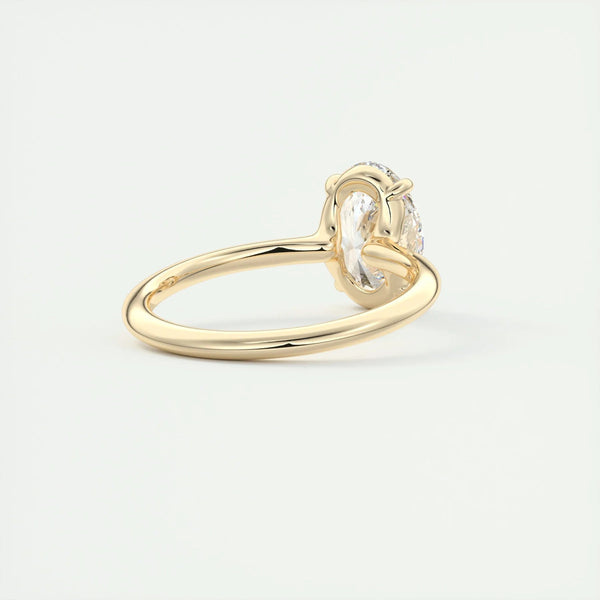
- A euro shank, with a flattened, squared-off underside. It is designed in at casting, so it is a choice to make when you order rather than a fix later, but it keeps a top-heavy ring upright and resists spinning in the cold.
- A resize, only once you have worn the ring through a full winter and a full summer and know your real range. A resize on an eternity band or pavé all the way around is often not possible, so for those, beads or a guard are usually the answer.
Settings that cope better with winter
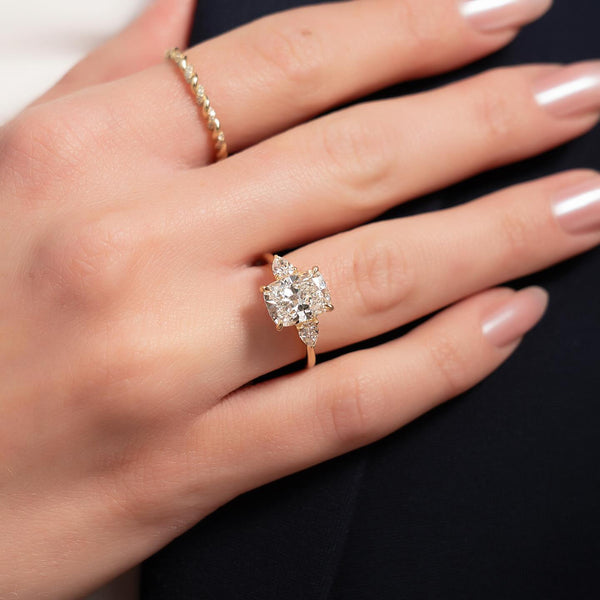
Winter clothing is hard on rings in a specific way: wool, knit and fleece catch on anything raised. A high cathedral setting with exposed prongs will snag on a scarf, a mitten liner and a toque all season. That is annoying, and over months it pulls on the prongs.
- Lower profile settings snag far less. If you live somewhere with a long winter, it is a reasonable thing to weigh when choosing the head height.
- Bezel and hidden-halo designs have smoother outlines and catch less than open claw settings.
- A shank of at least 1.8mm thick holds its shape better under the grip load of shovels, ski poles and steering wheels in the cold.
- Use the snag as a free check. If a ring that never used to catch on wool suddenly does, a prong tip may have lifted or worn. Have it looked at before a stone moves.
One more winter habit: heated indoor air dries hands out, so hand cream goes on more often, and it builds up on the underside of the stone where a cloth cannot reach. Dull-looking stones in February are almost always this, not the stone. We cover cleaning in our winter jewellery care guide.
Winter checklist for a Canadian ring owner
- Measure size indoors, mid-afternoon, on more than one day.
- Send ring sizes as inside diameter in millimetres when in doubt.
- Take gloves off by the cuff, ring hand closed.
- Ring off for shovelling, and always into the same spot.
- Loose only in winter? Guard or sizing beads, not a resize.
- Ring suddenly snagging on wool? Get the prongs checked.
Keep reading
- Buying moissanite and lab grown diamond jewellery in Canada — duty, GST/HST and your rights
- How to measure your ring size at home
- Proposing in winter
Frequently asked questions
Do fingers really get smaller in the cold?
Yes. In the cold the body narrows blood vessels near the skin, and fingers lose volume. The base of the finger changes more than the knuckle, which is why a ring can feel loose in winter yet still not come off easily — until a glove drags it over the knuckle.
When is the best time to measure ring size in Canada?
Indoors, mid-afternoon, after your hands have been at room temperature for at least half an hour. Avoid measuring straight after coming in from outside, first thing in the morning, or after exercise. Measuring on two or three different days gives you your real range.
My engagement ring is loose only in winter. Should I resize it?
Usually not. Resizing down fits the ring to your coldest finger, and it will then feel tight all summer. A removable ring guard or a pair of sizing beads inside the shank solves the winter problem without changing the ring's size.
Does cold weather damage moissanite or lab grown diamonds?
No. Ordinary Canadian winter temperatures do not harm either stone. The risks in winter are to the fit and the setting: rings slipping off with gloves, prongs snagging on wool, and grip load from shovels and ski poles on a thin shank.
Does Canada use the same ring sizes as the US?
Yes, Canadian jewellers generally use the same numeric ring sizes as the United States. Older or inherited rings may be in UK letter or European sizes, so when in doubt, measure the inside diameter of a ring that fits in millimetres and give the jeweller that number.
Made in our Surat workshop, shipped to Canada.
Tell us your size in millimetres if you are unsure, and ask about a lower profile or euro shank when you order.
Leave a comment