Education
How to Read a CAD Render Before You Approve a Custom Ring
It is a measurement drawing wearing a photograph’s clothes.
Written by the Mapple Gems workshop, Surat · Updated 17 August 2026
Short answer
A CAD render is completely accurate about geometry — proportions, millimetre dimensions, stone placement, profile height — and systematically misleading about appearance: metal colour, surface finish, sparkle and scale. Read it for measurements, ignore it for beauty, and always ask for the side view and a hand shot at true scale before approving.
Approving a CAD is the last moment a custom ring is cheap to change. After that render is signed off, the design goes to wax and then to casting, and altering it means starting the piece again. So it is worth ten careful minutes.
The difficulty is that renders look like photographs. Modern rendering software produces studio lighting, perfect reflections and a black velvet background, and your eye reads all of that as a picture of a real object. It is not. It is a solid model with a lighting simulation on top.
What a render is accurate about
- Every dimension. Band width, shank thickness, stone diameters, gallery height, the gap between a ring and its band. These are exact, because they are the model.
- Stone count and placement. If there are nineteen stones down each shoulder in the render, there will be nineteen on the finished ring.
- Proportion between elements. How large the centre stone reads against the band is real.
- Profile height. How far the ring stands off the finger, which decides whether a band will sit flush and whether it catches on gloves.
The four things it always flatters
| In the render | In reality |
|---|---|
| Metal colour — a chosen swatch | Depends on karat and alloy. 18K yellow is visibly warmer than 10K. Rose gold varies more between alloys than any other colour. |
| Sparkle — a simulated refraction | The renderer does not model your actual stone. It cannot show moissanite’s stronger dispersion or a diamond’s whiter return. |
| Surface finish — flawless mirror | Real polished metal shows the room. Matte, brushed and hammered finishes almost never render convincingly. |
| Scale — filling your screen | A 6.5 mm stone is the width of a pencil. On a monitor it looks like a doorknob. |
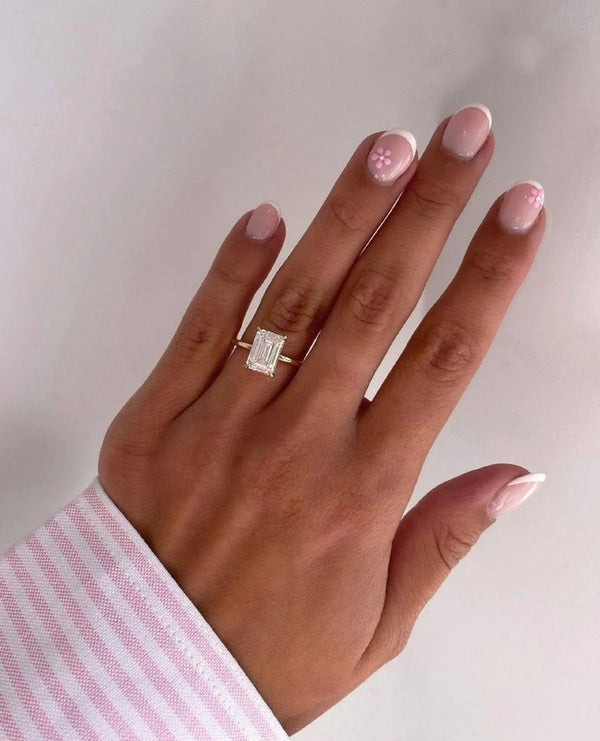
The scale trap. This is the single most common cause of disappointment on delivery, and it has nothing to do with the workshop. A render viewed at 400% on a laptop primes your eye for an object four times the size of the one arriving. The fix takes thirty seconds: hold a ruler to your screen, measure the centre stone in the image, and compare it to the millimetre figure on the spec. If they do not match, you are not looking at real scale — ask for a render on a hand at 1:1.
Six checks before you approve
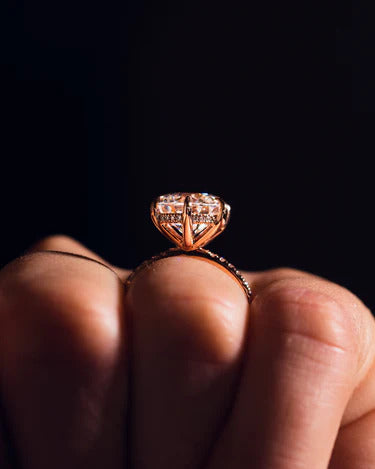
- Ask for the side elevation. Most renders are sent as a top view because it is the flattering angle. The side view is where problems live: profile height, gallery, whether a band can sit flush, whether the basket sits so low it will press the finger.
- Check the millimetre figures, not the carat figures. Carat is weight. Millimetres are what you see. This matters doubly with moissanite, which is about 15% less dense than diamond, so a stone sold as 1 ct measures like a 1 ct diamond but weighs less.
- Count the prongs and look at where they land. On a pear, marquise or heart, one prong must cover the point — usually a V-prong. If the render shows a plain round prong sitting beside the point instead of over it, that is a real durability problem, not a drawing style.
- Look at the band width where it meets the head, not just at the back. Many designs taper. A shank that reads 2 mm at the base may be 1.4 mm at the shoulders, and thin shoulders under a heavy head is where rings bend.
- Ask what the finish will be, in words. High polish, satin, brushed, milgrain edge. Do not infer it from the render.
- Confirm the metal colour of the head separately from the band. If you are setting a large moissanite in yellow or rose gold, a white head keeps the stone neutral while the band stays warm. Renders rarely make this distinction visible — it has to be in the spec.
Say what is wrong in millimetres
If something is off, the useful feedback is dimensional. “It looks chunky” means one thing to you and another to the person at the bench — we have had “dainty” used to mean 1.5 mm and 2.5 mm in the same week.
“Take the band from 2.2 mm to 1.8 mm” is a change that can be made in one pass. So is “lower the head by 1 mm” or “move the side stones 0.5 mm closer to the centre”. Feelings translate slowly; numbers translate immediately.
And if you are unsure whether a dimension will feel right, ask for a comparison against a ring you already own and can measure. That is the fastest calibration there is.
Keep reading
- How to order a bridal set — why the band has to be decided before casting
- Round brilliant moissanite engagement rings
- All Education guides
Frequently asked questions
What is a CAD render in jewellery?
It is a computer-generated image produced from the 3D model that will be used to make the ring. The model drives the wax and then the casting, so the render’s geometry is exactly what gets built. The lighting, metal colour and sparkle in the image are a simulation added on top.
Will my ring look exactly like the CAD render?
Dimensionally, yes. Visually, not quite. Real metal reflects the room rather than a studio light, real stones behave differently from simulated ones, and the finished piece will look smaller than it did on screen. Expect the shape to match precisely and the look to differ.
Can I change the design after approving the CAD?
Before approval, changes are quick and normally free. After approval the model goes to wax and casting, and a change means remaking the piece from the beginning. This is why the render stage deserves proper attention rather than a quick yes.
How many CAD revisions should I expect?
Two or three rounds is normal for a custom piece. If you are on the fifth round, the problem is usually that the feedback has been descriptive rather than dimensional. Switching to millimetres almost always closes it in one more pass.
We would rather answer ten questions than remake a ring.
Every custom piece from our Surat workshop goes through render approval before anything is cast. Ask for the side view — we will send it.
Leave a comment