Engagement Rings
Profile Height: The Ring Measurement Nobody Asks For
How far your ring stands off your finger decides more about living with it than the stone does.
Written by the Mapple Gems workshop, Surat · Updated 28 August 2026
Short answer
Profile height is the distance from your finger to the top of the stone. Under about 6 mm is low and practical; 6–9 mm is typical for a solitaire; above 9 mm the ring catches on gloves and pockets, rolls on the finger and is more exposed to knocks. It also decides whether a wedding band can ever sit flush. It is fixed the moment the ring is cast — and almost no listing states it.
People compare rings on carat, metal and setting style. Almost nobody compares them on height, and height is the measurement that determines how the ring behaves every single day.
It is also the one number that cannot be changed afterwards. A ring can be resized, repolished, replated and reset. Its profile is decided at the wax stage and is permanent.
What profile height actually is
Measured from the inside of the shank — the part touching your finger — to the highest point of the stone. It is the sum of three things: the thickness of the shank, the height of the basket or gallery holding the stone, and the depth of the stone itself sitting in it.
That third component is why the same setting produces different heights with different shapes. A deep cushion sits higher than a shallow oval of the same carat, because more of the stone is below the girdle.
| Height | Feels like | Typical of |
|---|---|---|
| Under 5 mm | Barely noticeable; nothing catches | Bezel settings, flush settings |
| 5 – 7 mm | Comfortable everyday | Low-set solitaires, half bezels |
| 7 – 9 mm | Present, occasionally catches | Standard solitaires, most halos |
| 9 – 11 mm | Noticeable; rolls if slightly loose | Cathedral settings, hidden halos |
| Above 11 mm | You will adapt around it | Large stones on raised galleries |
Why a tall ring rolls, and why that is a fit problem in disguise. The higher the stone sits, the further its weight is from the finger — and the more leverage it has to rotate. Two rings of identical weight will behave completely differently if one carries that weight at 5 mm and the other at 10 mm. This is why people with tall rings report constant spinning and assume they need soldering. Usually they do not: they need the size half a step snugger, or sizing beads. Height amplifies a fit problem that a low ring would hide.
What height costs you, and what it buys
A taller profile buys: more light entering the stone from below, so more brightness; a stone that reads larger because it sits proud of the hand; and room for a hidden halo or a decorative gallery, which many people love.
A taller profile costs you: snagging on knitwear, gloves and pockets; more exposure to knocks against doorframes and worktops; a tendency to roll; and, frequently, the ability to wear a straight wedding band flush.
Neither is right. But the decision should be made deliberately rather than inherited from whatever the design happened to be.
The wedding band connection
Height and band fit are the same question viewed from two angles.
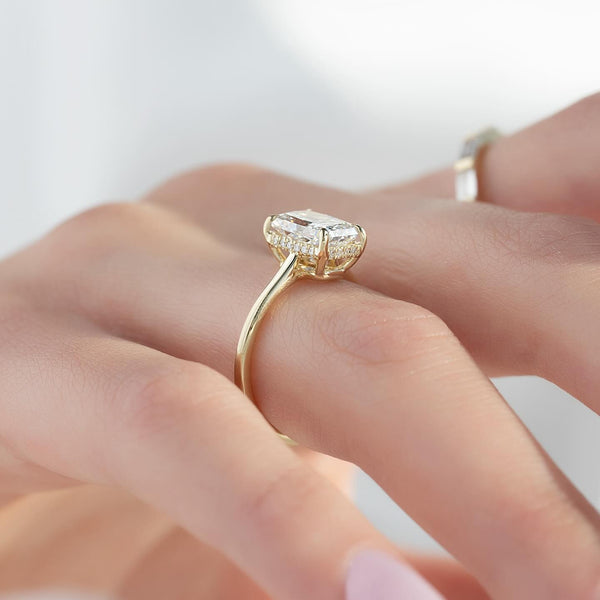
A high setting usually means a raised basket, and a raised basket means the underside of the head projects into the space beside the shank — exactly where a straight band wants to sit. So a tall ring is more likely to need a contoured band, and a low ring is more likely to take a straight one without fuss.
If you already know you want a plain straight band, say so before the engagement ring is designed. A workshop can lower the gallery a millimetre or two at the wax stage and solve the problem before it exists.
How to find out what a ring’s height is
- Ask for the figure in millimetres. A workshop knows it. A reseller usually does not, which is itself informative.
- Ask for the side elevation of the render. Top-down views hide height entirely, which is why they are the ones sent.
- Compare against a ring you own. Measure an existing ring’s height with a ruler against the profile. It is the fastest way to calibrate what a number means for you.
- Ask what could be lowered. Often the basket can be reduced without changing how the ring looks from above.
Who should care most
- Anyone who wears gloves regularly — healthcare, cold climates, trades. A tall ring tears glove fingers and catches every time.
- Anyone with small hands. Height reads proportionally larger on a smaller hand, and rolls more.
- Anyone who works with their hands — more height is more exposure to impact.
- Anyone who wants a flush band. Decide the height with that in mind.
- Anyone buying a large stone. Height compounds with size — a big stone on a raised gallery is a very tall ring.
Keep reading
- How to read a CAD render — why the side view matters
- Contour bands: do you need one?
- Bezel settings and everyday wear
Frequently asked questions
What is a good profile height for an engagement ring?
Five to seven millimetres is comfortable for everyday wear, and seven to nine is typical of a standard solitaire. Above nine millimetres the ring catches on gloves and pockets and is more exposed to knocks. Below five is very low and practical, typical of bezel settings.
Why does my engagement ring keep spinning?
Usually a combination of a slightly loose fit and a high profile. The taller the setting, the further the weight sits from the finger and the more leverage it has to rotate. The fix is normally a half-step snugger size or sizing beads inside the shank, rather than soldering the rings together.
Can a ring’s height be changed after it is made?
Not meaningfully. Profile height is determined by the shank thickness, the gallery and the stone’s depth, and it is fixed when the ring is cast. Resizing, repolishing and resetting are all possible later; lowering the profile effectively means remaking the piece. Decide it at the render stage.
Does a higher setting make a diamond sparkle more?
Somewhat. A raised setting lets more light reach the stone from below and from the sides, and the stone sits proud of the hand so it reads larger. The trade-offs are snagging, rolling, greater exposure to impact and a harder time fitting a straight wedding band.
We give you the height in millimetres.
Along with the side elevation — before anything is cast, while it can still be changed.
Leave a comment