Engagement Rings
Side Stones: Baguettes, Trilliants and Tapered Cuts
Two well-chosen stones beside the centre do more for a ring than forty tiny ones on the band.
Written by the Mapple Gems workshop, Surat · Updated 7 September 2026
Short answer
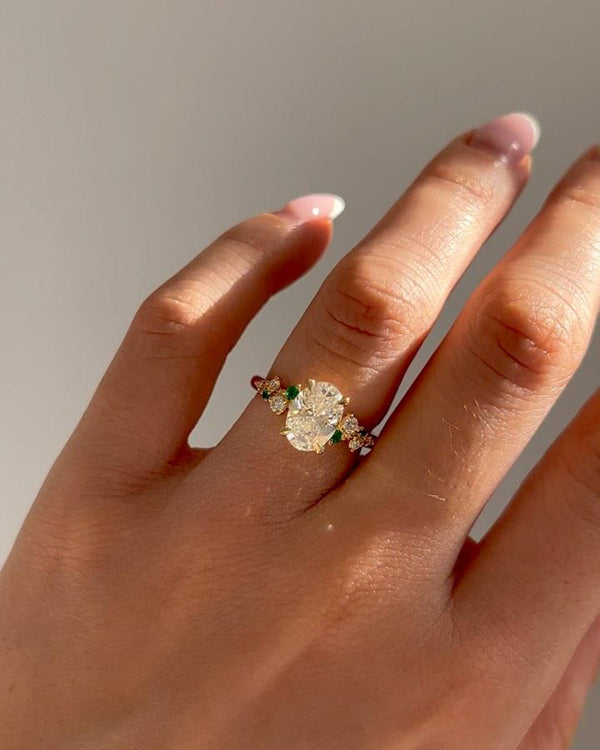
Side stones sit beside the centre rather than around it or along the band. Tapered baguettes are the classic — step-cut, calm, and they visually elongate the ring. Trilliants are brilliant-cut triangles that add sparkle and width. Half-moons and trapezoids hug the centre closely. All of them are fewer settings than a pavé band, so less maintenance — but they make the ring wider, which affects wedding band fit.
Side stones sit in an odd gap in most people’s thinking: not a solitaire, not a halo, not a pavé band. They are worth knowing about because they solve a specific problem well — adding presence to a moderate centre stone without adding forty small settings to maintain.
The main shapes
| Shape | Character | Pairs best with |
|---|---|---|
| Tapered baguette | Step cut — broad calm flashes, no fire | Emerald, Asscher, round; anything wanting restraint |
| Trilliant | Brilliant-cut triangle — lively, wide | Round, oval, pear |
| Half-moon | Curved edge hugging the centre | Round, cushion, radiant |
| Trapezoid | Step cut with angled sides; very architectural | Emerald, radiant, princess |
| Pear or marquise | Points outward — strongly elongating | Round, oval; vintage-leaning designs |
| Round or oval | The three-stone classic | Almost anything |
For moissanite, step-cut side stones are the quiet upgrade. Tapered baguettes and trapezoids have a handful of large parallel facets, so they return broad white flashes rather than scattering rainbow fire — the opposite of what small brilliant-cut accents do. That matters specifically here: a halo or a pavé band surrounds a moissanite centre with dozens of tiny brilliant stones, every one of them dispersing light, which amplifies the exact characteristic that identifies the material. Two baguettes do not. You get added presence and width with less total fire than the same ring in a pavé setting. It is the most useful and least discussed design decision for anyone who wants moissanite to read as understated.
Proportion: how big should they be?
The usual failure is side stones that compete with the centre rather than framing it.
- Classic framing: each side stone roughly 15–25% of the centre’s weight. Clearly present, clearly secondary.
- Three-stone proper: around 40–50% each, where the three read as a set rather than a centre with accents.
- Above 50%: the eye stops knowing where to look. Occasionally deliberate, usually a mistake.
Ask for the millimetre dimensions of the side stones and the total width across the setting, not just the centre size. That total is what determines whether the ring fits your finger comfortably and whether a band will sit against it.
The band-fit consequence
Side stones widen the ring at exactly the point where a wedding band wants to sit, so this needs deciding at the same time rather than afterwards.
Run the coin test on any render: place a straight edge against the side of the ring, parallel to the finger. If daylight shows between them, a straight band will not sit flush and you need a contour or chevron.
Side-stone rings almost always need one. That is not a reason to avoid them — it is a reason to order the band with the ring, when the fitting is part of the build rather than later bench work charged separately.
Setting and durability
- Points need protection. Trilliants, pears and marquises used as side stones have exposed points, and each one needs a V-prong or to be tucked under the centre’s setting. This is where side-stone rings chip.
- Step cuts need corner cover. Baguettes and trapezoids chip at the corners; a channel or a prong over each corner solves it.
- Fewer settings is the real advantage. Two side stones means two settings to check every couple of years, against twenty or forty in a pavé band.
- The shank stays plain, which means the ring resizes easily — a genuine long-term benefit over a fully-set band.
Matching the material
Side stones sit directly against the centre, and adjacency is unforgiving — the same reason melee colour matters in a pavé row, but more so, because these stones are larger and more visible.
Two practical points. Match the material or disclose it: a lab grown centre with moissanite side stones is a legitimate build, and it should be stated rather than discovered later. And match or better the colour — going one step warmer on the sides to save money is visible at this size, in a way it is not at 1.3 mm.
Who this suits
Side stones are a strong answer if you want a ring with presence but not a halo, if you want the width without forty settings to maintain, or if you have a moderate centre stone and want the ring to read larger without buying a larger stone.
They are a weaker answer if your hands take heavy contact — the extra width and any exposed points are additional exposure — or if you specifically want a plain straight wedding band to sit flush.
Keep reading
Frequently asked questions
What are tapered baguettes on a ring?
Long, narrow step-cut side stones that taper toward the shank, set either side of the centre. Because step cuts have few large facets they return broad white flashes rather than rainbow fire, which makes them calm framing stones and visually elongates the ring.
How large should side stones be relative to the centre?
Roughly 15–25% of the centre’s weight each for classic framing, or 40–50% for a true three-stone look where all three read as a set. Above about half, the eye stops knowing where to look. Ask for the millimetre dimensions and the total width across the setting, not just the centre size.
Are side stones better than a halo for moissanite?
If you want moissanite to read as understated, yes — particularly step-cut sides. A halo surrounds the centre with dozens of small brilliant stones that all disperse light, amplifying the characteristic that identifies the material, while two baguettes add presence and width with less total fire.
Do side-stone rings need a contour wedding band?
Almost always, because side stones widen the ring exactly where a band wants to sit. Test it on the render by placing a straight edge against the side of the ring parallel to the finger — visible daylight means a contour is needed. Order the band with the ring, when the fitting is part of the build.
Two baguettes instead of forty small stones.
More presence, less fire, and two settings to maintain instead of forty. Ask us for the total width across the setting.
Leave a comment