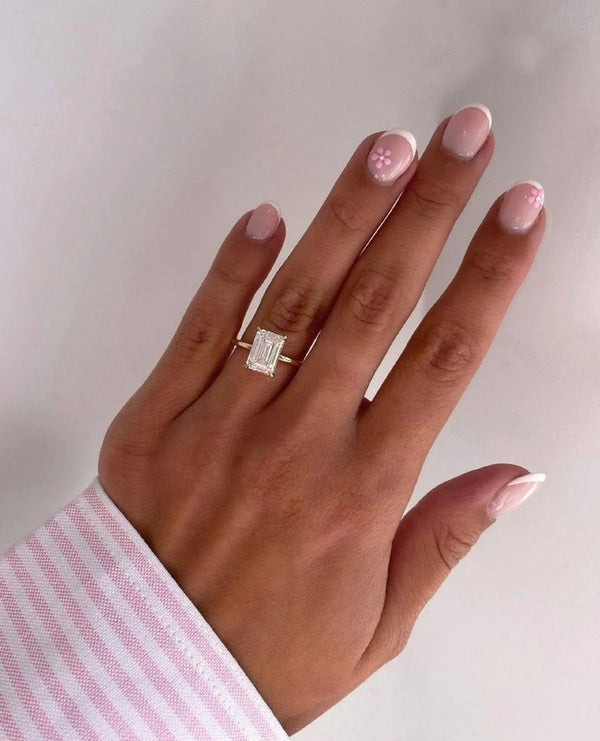
Emerald cut
Eight Ways It Goes Wrong
Almost every emerald cut disappointment traces back to advice that was perfectly sound — for a different shape. Here is the whole list, and what each one costs to avoid.
Written by the Mapple Gems workshop, Surat · Updated 29 August 2026
Short answer
The emerald cut is a window, not a mirror. Every piece of standard diamond advice built on the assumption that sparkle hides things — drop to SI1, accept an I colour, judge from a photograph — inverts on a step cut. Add four structural details specific to the shape (corner prongs, side stone matching, band fit, bezel metal) and you have the eight errors that account for nearly every emerald regret.
We see the same failures repeatedly, and they are almost never carelessness. They are people applying good advice from the wrong shape. Nothing below requires expertise to avoid — only knowing which question to ask, and asking it while the ring is still a drawing.
1. Buying it like a brilliant
The most consequential one. Almost all mainstream diamond advice says clarity is where to save: drop to SI1, take an H or I colour, spend the difference on size. That advice exists because a round brilliant's scintillation genuinely does hide inclusions and warmth.
A step cut has no scintillation to hide behind. You are looking through a large flat table straight into the stone, and whatever is in there is on view in ordinary light. VS1 is the practical floor, and G or better in white metal. The fix: budget for the grade before you budget for the size. Emerald cut clarity sets out where each grade actually lands.
2. Comparing carat weight instead of millimetres
Carat is mass, not size, and a step cut carries an unusually large share of its mass in depth. Two 2.00ct emerald cuts can differ visibly in face-up size because one was cut deep to preserve weight from the rough. The certificate looks identical.
The fix: ask for length, width and depth in millimetres, plus depth percentage, for every stone you are comparing. It is the single question that most reliably separates a good quote from a bad one, and it is covered in why two emerald cuts with the same 4Cs cost different money.
3. Judging the stone from a photograph
Product photography is shot square-on, from above, in a lightbox. That is close to the only condition under which a mediocre step cut looks like a good one: even lighting fills the table, and none of the things that go wrong — a dull plane that stays put as the stone turns, a dark inclusion, moissanite doubling — get a chance to appear.
The fix: rotating video, in ordinary indoor light, of the specific stone. If a seller only has lightbox stills, they are showing you the best case of every stone they own.
4. Letting the ratio happen to you
Length-to-width ratio decides whether an emerald reads broad and architectural or long and elegant, and it appears on no grading report and few listings. Buyers who never considered it end up with a stone that is a perfectly good diamond and not the shape they had in their head.
The fix: divide the length by the width from the measurements line. Decide the band you want — roughly 1.30–1.35 for broad, 1.40–1.50 for classic, 1.50+ for elongated — and specify it as a range before anything is sourced.
5. Prongs on the sides instead of the corners
An emerald cut has four cropped corners, and those corners are facet junctions with a real bearing surface. The long sides are flat edges with nothing to grip. A prong on a flat side relies on pressure alone, which is how stones work loose — and it leaves the four most vulnerable points of the stone uncovered.
The fix: specify prongs on the four cropped corners, with seats cut into this stone rather than a stock head. See emerald cut solitaire rings.
6. Treating side stones as "accent diamonds"
On a three-stone emerald ring the sides are not accessories, they are half the design. If they are cut to a house standard rather than to your centre stone's ratio, or set a fraction low, or a grade warmer in colour, the ring reads as a stone with two strangers attached — and on straight-edged step cuts there is no sparkle to blur it.
The fix: ask for the millimetres and colour grade of all three stones, and ask explicitly, in writing, that the three tables will finish level. Match beats grade covers why.
7. Never running the straight-edge test
An emerald cut takes a plain straight wedding band more readily than any other fancy shape, which is exactly why people assume it will and never check. Then the head turns out to be high, or the shoulders cathedral, and the assumption fails after casting — at which point the ring cannot change and only the band can.
The fix: hold a straight edge against the side elevation before the wax is cut. Ten seconds, no cost, and it is the ring decision people most often wish they had made earlier. The straight-edge test, in full.
8. Choosing the bezel metal against the colour grade
The subtlest one, and specific to this shape. A step cut's open table gives a clear view of what the pavilion is reflecting — and inside a bezel, what it reflects is the rim. A yellow gold bezel puts warmth into the stone; rose gold puts pink into it. Buyers who paid for a G colour and then chose a yellow bezel have spent that money and immediately undone it.
The fix: white metal rim on a coloured shank if you want both, or accept a warmer colour grade and save the difference. The bezel argument has the full trade-off.
From our bench in Surat
Seven of these eight cost nothing to avoid. Only the first — buying the grade the shape actually needs — costs money, and it usually costs less than people fear, because the honest response is to buy a slightly smaller stone rather than a much more expensive one. A clean 1.5 carat emerald is a better ring than a compromised 2.
And the concession we have made throughout this series: our product pages carry carat weight but not millimetres, depth percentage, profile height or shank thickness — which are the four numbers most of this list depends on. You cannot run these checks on our listings today. Ask us and we will send them for any piece. We would rather answer the question than have you find out after casting, and we would say the same about any seller you are comparing us with.
The whole list, in one table
| Mistake | Fix | When it must happen |
|---|---|---|
| Buying it like a brilliant | VS1 minimum, G+ in white metal | Before sourcing |
| Comparing carats | Ask for mm and depth percentage | Before sourcing |
| Judging from stills | Rotating video, ordinary light | Before paying |
| Ignoring ratio | Specify a range, not a figure | Before sourcing |
| Prongs on the sides | Corner prongs, seats cut to the stone | Before casting |
| Side stones as accents | Match ratio, colour and table height | Before casting |
| No band test | Straight edge on the side elevation | Before casting |
| Bezel metal vs colour grade | White rim on a coloured shank | Before casting |
Six of the eight have to happen before casting. That is the real lesson of the list: an emerald cut is a shape where almost every important decision is made while the ring is still a drawing, and almost none of them can be revisited once metal exists.
Keep reading
Emerald cut engagement rings: what to check before you buy
Frequently asked questions
What is the biggest mistake when buying an emerald cut?
Buying it like a round brilliant. The standard advice to drop to SI1 clarity and accept a warmer colour depends on sparkle hiding those things, and a step cut has no sparkle to hide behind. VS1 and G in white metal is the realistic starting point.
Are emerald cuts harder to buy well than other shapes?
Yes, in the sense that fewer things are hidden and no laboratory grades the cut. That cuts both ways: a poor emerald is more obviously poor, and a good one is more obviously good. The information you need is all available, but you have to ask for it rather than read it off a certificate.
Can any of these be fixed after the ring is made?
Six of the eight have to be settled before casting, because setting height, prong placement, side stone seating and shoulder shape are all fixed in the wax. Afterwards the realistic options are a different wedding band or a rebuild. Choosing the stone can be revisited; the ring around it cannot.
Is a smaller, cleaner emerald better than a larger compromised one?
On this shape, usually yes. A clean, well-proportioned 1.5 carat step cut reads better than a 2 carat with a visible inclusion or a dull plane, because there is nothing else on the ring to look at. If size is the priority above all, a radiant cut or moissanite are the honest routes to it.
What should I ask a seller before ordering an emerald cut?
Millimetres and depth percentage for the stone, symmetry and polish marks, a rotating video in ordinary light, prong placement, profile height on a side elevation, and shank thickness. A seller who answers all six made the piece. One who answers two is reselling and letting the certificate do the talking.
Six decisions, all before casting
Everything is made to order in our Surat workshop, so every one of them is still a choice. Send us the ring you are considering and we will go through the list with you.
Leave a comment