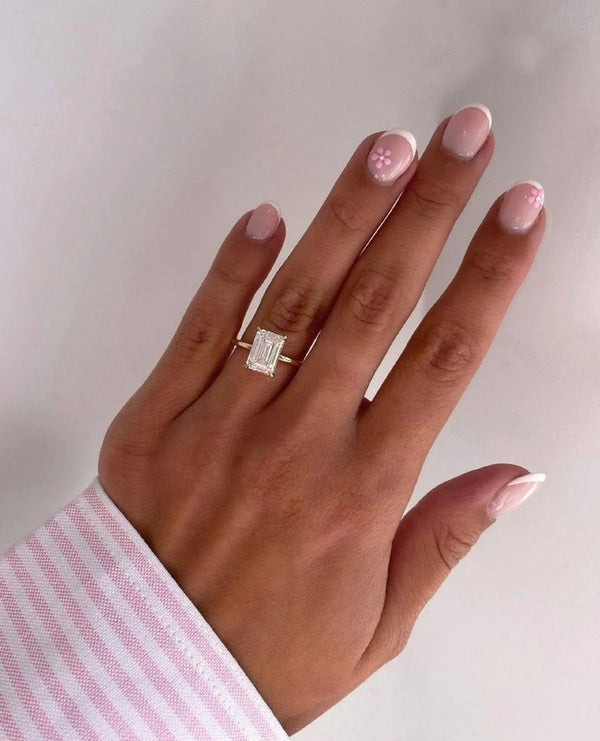
Emerald cut
Where the Money Actually Sits
Two certificates reading identically, two prices that are not. On a step cut the explanation is almost always in the figures nobody quotes.
Written by the Mapple Gems workshop, Surat · Updated 29 August 2026
Short answer
The 4Cs describe about half of what an emerald cut costs. The rest is depth percentage (how much of the weight you can actually see), ratio (unusual proportions are harder to source), corner and facet symmetry (which no grade covers on a fancy shape), and setting labour, which on a step cut is genuinely higher than on a brilliant. Two stones matching on paper can differ by a fifth in price and by more than that in how they look.
The general architecture of a jewellery price — stone, metal, labour, overhead, margin — is covered in where the money goes and stone vs metal. This piece is narrower: given that you have decided on an emerald cut and you are looking at two quotes that should be the same, why are they not.
1. Depth percentage, the biggest hidden variable
A step cut needs depth to make its long planes work, and depth is weight below the girdle that you paid for and cannot see. Two 2.00ct emerald cuts, one cut to a sensible depth and one cut deep to preserve weight from the rough, will differ noticeably in face-up size.
The deep one costs the same per carat and gives you less stone. Sellers rarely volunteer the figure because it is the one number that makes a stone look worse without any grade changing. Ask for depth percentage alongside the measurements every single time. If the millimetres are small for the weight, you have found your answer.
2. Ratio, which is a sourcing cost not a quality one
Ratio is not a grade and does not make a stone better or worse. It does move the price, in both directions, for entirely commercial reasons.
Stones in the classic 1.40–1.50 band are what most buyers want, so they command a normal price. Very elongated stones above 1.60 are sometimes softer, because fewer people want them. Unusually square emeralds can be dearer in a given weight simply because they are less common. None of this reflects cut quality; it reflects how many other people are asking for the same outline.
3. Corner and facet symmetry, which no grade covers
No laboratory issues a cut grade for a fancy shape. On a round brilliant a cut grade rolls up symmetry, polish and proportion into one word; on an emerald cut you get symmetry and polish as separate marks and nothing about proportion at all.
What this means in practice is that four corners can be cropped at slightly different lengths, the parallel facets can step at slightly uneven intervals, and the stone can still carry a fine report. On a shape made of straight lines these things are visible. A well-cut emerald costs more because cutting one well takes longer and wastes more rough, and there is no line on the certificate to tell you it happened.
4. The clarity floor
This is the one that catches people moving to an emerald cut from another shape. On most shapes SI1 is a reasonable value play. On a step cut it is a gamble, so the realistic entry point is VS1 — and VS1 costs meaningfully more than SI1 in every size.
It is not that emerald cuts are more expensive per carat. It is that the grade you have to buy is higher. The mechanics are in emerald cut clarity, and it is worth reading before comparing a step cut quote to a radiant cut one, because the radiant is genuinely cheaper to buy well.
5. Setting labour
| Work | On a round brilliant | On an emerald cut |
|---|---|---|
| Head | Stock sizes work | Built to the individual girdle outline |
| Prong seats | Even, repeatable | Cut into four cropped corners individually |
| Alignment | Rotation invisible | Must run true to the shank axis |
| Bezel | A circle — forgiving | Four straight edges — every variation shows |
| Three-stone | Standard | Three tables to finish level at three seat depths |
None of this is itemised on an invoice anywhere in the trade, which is why a cheaper emerald ring is so often cheaper here rather than in the stone. It is also where the difference shows up years later rather than on arrival — the theme of where cheap shows on a ring.
From our bench in Surat
We are occasionally undercut on an emerald cut quote and we can usually guess where without seeing the competing stone. It is the depth. A deep step cut is the easiest way in this trade to sell somebody less stone for the same money while every figure on the certificate stays identical, and nothing about it is against the rules.
Our own concession: we do not publish depth percentage or millimetre measurements on our product pages, which means you cannot run this check on us either. That is a gap and we know it. Until it is closed, ask — and ask whoever you are comparing us against. The seller who sends the numbers without hesitating is the one to trust, regardless of which of us is cheaper.
What you can safely decline
- The round carat figure. 1.90 rather than 2.00 saves real money for a tenth of a millimetre. See the two carat emerald cut.
- Clarity above VS1. Real to a loupe, invisible to a person.
- Colour above H in yellow or rose gold. The metal is warming the stone regardless.
- Brand premium. A separate question from craft premium, and worth understanding — see brand premium vs craft premium.
- Platinum, if budget is tight. 14k white gold with good rhodium work looks the same and costs less; put the difference in the stone.
What to ask before comparing two quotes
- Length, width and depth in millimetres for each stone.
- Depth percentage for each.
- Ratio, calculated from those figures rather than described in words.
- Symmetry and polish marks, since there is no cut grade to lean on.
- Whether the head is built to the stone or a stock size.
- Metal weight in grams and shank thickness at the base.
- Rotating video of each stone in ordinary indoor light.
Seven questions. A seller who answers all seven has made the piece; a seller who answers two is reselling somebody else's and hoping the certificate does the talking.
Keep reading
Ct, ctw and cttw: what each one means
Frequently asked questions
Are emerald cuts cheaper than round diamonds?
Per carat, usually yes, because cutting an emerald wastes less of the rough than cutting a round. In practice the saving is smaller than it looks, because a step cut needs a higher clarity and colour grade and faces up smaller for the weight. Compare finished rings, not per-carat rates.
Why is one emerald cut cheaper than another with the same 4Cs?
Most often depth. A stone cut deep to preserve weight carries the same carat figure and faces up smaller, so you see less diamond for the same money. Ratio, corner symmetry and setting labour explain most of the rest. Ask for depth percentage and millimetres before comparing.
Does the ratio affect the price of an emerald cut?
It can, but for commercial rather than quality reasons. The classic 1.40 to 1.50 band is what most buyers want and prices normally. Very elongated stones are sometimes softer because demand is thinner, and unusually square ones can be dearer because they are harder to source in a given weight.
Is there a cut grade for emerald cuts?
No. Laboratories issue cut grades only for round brilliants. On an emerald cut you get symmetry and polish as separate marks and nothing about proportion, so assessing the cut is your own job — done with the measurements, the depth percentage and a rotating video.
Does an emerald cut cost more to set?
Yes. The head has to be built to the individual girdle outline, prong seats are cut into four cropped corners separately, and the stone must sit true to the shank axis because a rectangle shows any rotation. None of this is itemised, which is why a cheaper emerald ring is often cheaper in the bench work rather than the stone.
Ask us the seven questions
We will answer all of them for any stone we quote, and we would encourage you to ask whoever you are comparing us against.
Leave a comment