Emerald cut
The Emerald Solitaire
A step cut on a plain band is the most exposed build in jewellery. Everything is a straight line, and straight lines are the only thing the eye can check without being told how.
Written by the Mapple Gems workshop, Surat · Updated 27 August 2026
Short answer
An emerald cut solitaire is a single step-cut stone on a plain band. Four things decide it: prongs seated on the cropped corners rather than the long sides, a shank that runs true to the stone's axis, a profile height low enough to live with, and an open gallery. It is also the emerald build most likely to take a straight wedding band, because the stone's outline has flat parallel sides rather than a curve.
Most engagement ring styles give the eye somewhere to go. A halo draws a border, pavé carries a line down the shank, a three-stone build sets up a rhythm. A solitaire offers none of that, and a step-cut solitaire offers less than any of them — because a brilliant at least fills the space with movement, and an emerald cut sits there calmly being a rectangle.
The result is a ring made almost entirely of straight lines and right angles, which is exactly the sort of thing human vision is unusually good at judging. Nobody needs training to notice that a stone is fractionally out of parallel with the band it sits on. They will not be able to name it, but they will see it.
The corners are the design
Every emerald cut has four cropped corners. On a decorated ring they are somewhere the setting happens to grip. On a solitaire they are the only structural event in the whole piece, and where the prongs sit is the single biggest decision.
Prongs belong on the corners. Not on the long sides. A prong on a flat side has nothing to hold onto — it is gripping a straight edge and relying on pressure, which is how stones work loose. The corner is a facet junction with an actual bearing surface, and a seat cut properly into it holds the stone through decades of knocks. It also puts metal over the most vulnerable point of the stone, which is a second benefit for free.
The visual consequence is that a four-prong emerald solitaire reads as a rectangle with four small marks at its diagonals. Get them even, matched in size, and set flush, and the ring is finished. Get them uneven and there is nothing else on the ring for the eye to look at instead.
The four specifications that carry it
1. Corner prong seating. Cut into the girdle at each cropped corner, not pressed onto it. Ask whether the seats are cut to the individual stone — on a made-to-order piece they should be, because two emeralds of the same weight do not share a girdle outline.
2. Shank alignment. The band has to run true to the long axis of the stone. On a round solitaire a degree or two of rotation is invisible. On a rectangle it is not, and it is the commonest thing we correct on incoming repairs from elsewhere.
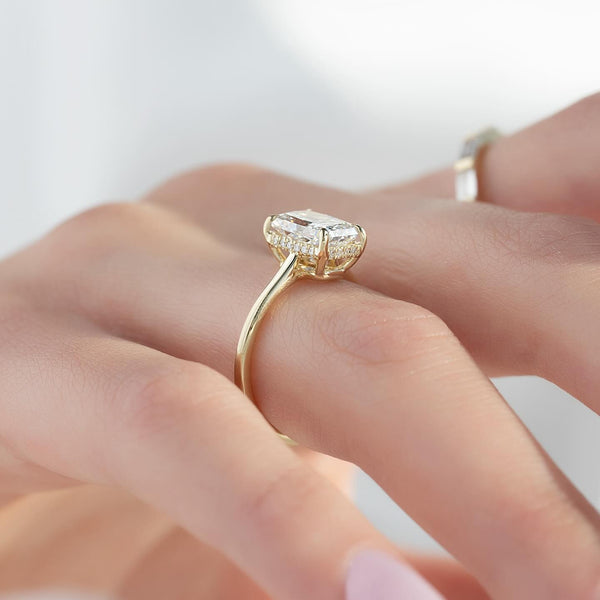
3. Profile height. Step cuts are deep stones, and depth has to go somewhere. Set high and a two carat emerald becomes a ring that catches on every jumper sleeve. Ask for the height in millimetres on a side elevation before casting — it is fixed the moment the wax is made.
4. Gallery. Open, always. A step cut takes a large share of its light from below, through the pavilion, and an enclosed gallery starves it. It is also the only way the underside of the stone can ever be properly cleaned.
Where a solitaire helps, and where it costs
| Consideration | Emerald solitaire | Emerald halo or pavé |
|---|---|---|
| Straight wedding band | Usually sits flush — flat sides help | Often needs a contour |
| Settings to check every 2 years | 4 | 30–50 |
| Tolerance for a lower clarity grade | None — nothing distracts the eye | A little; accent stones add activity |
| Apparent size for the carat | What the stone is, no more | A halo adds roughly 2.5mm of width |
| Changing your mind in ten years | Open — add stones, swap the centre | Largely spent |
The row worth dwelling on is clarity. A solitaire removes every visual distraction from a shape that already had none, so the stone has to carry the ring alone. If the budget forces a choice between a better stone in a plain setting and an average stone in a decorated one, the step cut is the shape where the plain setting wins. See emerald cut clarity for where that floor actually sits.
From our bench in Surat
This is the hardest ring we make to sell from a photograph, and the easiest to get subtly wrong. A catalogue shot is taken from directly above, square to the stone, in a lightbox. From that angle a solitaire with the shank a degree off axis and a solitaire built true look the same. So does one set 1.5mm higher than it needed to be. Both differences are obvious on a hand and neither survives into the image.
The concession: our product pages do not currently publish profile height or shank thickness, so you cannot check either from a listing. Ask us for the side elevation. On a made-to-order piece it is still a choice, and it is a choice you only get to make once.
The wedding band advantage
One genuine benefit rarely mentioned. Most fancy shapes are curved — an oval, a pear, a marquise all bulge over the shank and force a contoured band or a gap. An emerald cut has flat parallel sides and a squared-off outline, so a plain straight band frequently sits flush against it with no shaping at all.
Frequently, not always. Height and head design still decide it. Hold a straight edge against the side elevation before you commit: visible daylight beneath the stone means a contour is coming.
What to specify
- Prongs on the four cropped corners, with seats cut to this stone.
- Shank running true to the long axis — ask for a top-down render to check it.
- Shank 1.8mm at the base, 2mm from two carats up. Taper the width, never the thickness.
- Open gallery beneath the stone.
- Profile height in millimetres on a side elevation.
- Straight-edge test on that elevation, to see whether a straight band will fit.
- Euro shank if the stone is two carats or more, so the head does not roll on the finger.
Keep reading
The best settings for an emerald cut
Frequently asked questions
How many prongs does an emerald cut solitaire need?
Four, one on each cropped corner. What matters far more than the count is placement: a prong on a corner has a real facet junction to seat into, while a prong on a flat side is relying on pressure alone. Eight prongs badly placed is worse than four placed correctly.
Will a straight wedding band fit an emerald cut solitaire?
More often than with any other fancy shape, because the stone's sides are flat and parallel rather than curved. It still depends on head design and setting height, so hold a straight edge against the side elevation before casting. Daylight under the stone means you will need a contour.
Is a solitaire safe for an emerald cut, given the corners?
Yes, and arguably safer than a decorated setting, because corner prongs put metal exactly over the four most vulnerable points. The risk on a step cut is not the format but the seating: prongs pressed on rather than cut in are what allow movement, and movement is what chips a corner.
Does an emerald solitaire look smaller than a halo version?
At the same centre weight, yes — a halo adds roughly 2.5mm of apparent width. The alternative worth pricing is putting that halo budget into a larger or cleaner centre stone, which on a step cut usually gives the better ring.
Can I add a halo to an emerald solitaire later?
Usually yes, and this is a real advantage of starting plain — the upgrade path runs from simple to decorated, not the reverse. It normally means a new head built around the existing stone rather than modifying the current one.
Ask for the side elevation
Profile height, shank thickness, prong placement. Everything is made to order in our Surat workshop, so all three are still choices before casting.
Leave a comment