Emerald cut
Turned Sideways
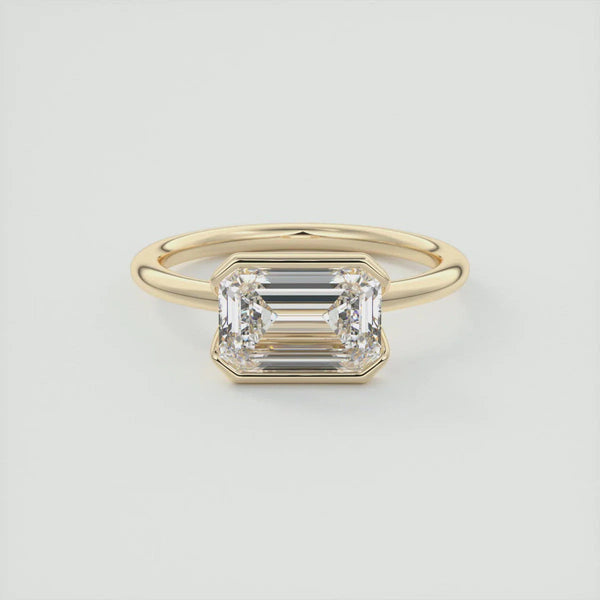
The same stone, rotated ninety degrees. It changes how the ring fits, how it bands, where the prongs go and whether the whole thing reads as a decision or a mistake.
Written by the Mapple Gems workshop, Surat · Updated 29 August 2026
Short answer
An east-west emerald cut is set with its long axis across the finger rather than along it. It works when the stone is elongated enough to look intentional — roughly 1.45 and above — and when the finger is wide enough to carry the length without overhang. It makes a straight wedding band easier, not harder, because the band now meets the narrow side of the stone. It suits long slender fingers, which is the reverse of the usual advice for elongated stones.
East-west is one of the few genuinely modern moves in engagement ring design, and it is also one of the easiest to get wrong. The general principles are set out in east-west settings: what they are and what they are not. The step cut version has its own rules, because a rectangle behaves differently from an oval or a marquise when you turn it.
Why a rectangle turns better than a curve
Turn an oval sideways and you have a curve sitting across a curve. The stone bulges over the finger on both sides and the eye reads two competing arcs. It can be done well but it is a fight.
Turn an emerald cut sideways and you have a flat-sided rectangle bridging the finger, with its two long parallel edges running across. Those edges give the design a clear horizontal line to sit on, and the shank meets flat metal-to-flat-stone rather than tangent to a curve. It is a cleaner piece of geometry, and it is the reason east-west reads as deliberate on a step cut more readily than on almost any other shape.
It also puts the shape's Art Deco ancestry back on display. A rectangle set horizontally is a period gesture, and it sits naturally with the restraint an emerald cut already has.
What actually changes
| Set north-south (standard) | Set east-west | |
|---|---|---|
| Effect on the finger | Lengthens | Shortens and broadens |
| Suits | Shorter fingers | Long, slender fingers |
| Overhang risk | Low — width is the narrow dimension | Real — length now crosses the finger |
| Straight wedding band | Usually fits | Easier again — band meets the short side |
| Prong positions | Corners at the diagonals | Same corners, now at the outer edges |
| Reads as | Classic | Modern, or Deco, depending on the band |
The row that catches people out is overhang. Set the normal way, the widest part of the ring across the finger is the stone's width — about 6mm on a two carat. Turned east-west, it is the stone's length, nearly 9mm. That is a serious jump, and on a narrow finger it can be more ring than the hand carries comfortably.
The ratio line
This is where east-west succeeds or fails, and the threshold is more specific than most design advice.
Below about 1.40, the stone is not long enough for the rotation to be legible. A viewer sees a squarish stone sitting slightly off and reads it as a ring that has spun on the finger — which is a real and common thing for rings to do, so the interpretation is reasonable. The design says nothing.
At 1.45 and above, the length is unmistakable. Nobody thinks the ring has turned; they see a stone deliberately laid across the finger. That is the whole effect, and it needs the length to work.
There is a practical corollary. If you are choosing a stone specifically for an east-west setting, the same weight will serve you better as a longer, narrower stone than a broad one — which is the opposite of what most emerald cut advice suggests. Buy the ratio for the setting, not in isolation.
From our bench in Surat
There is one thing we insist on for east-west and get asked about every time: the shank has to be wider than you would use north-south. A stone lying across the finger is a horizontal bar, and a thin band under a horizontal bar looks like the bar is balancing on it. Around 2mm, and often with a slight flare where it meets the head. It also fixes a mechanical problem — a wide stone set across the finger has more leverage to roll, and a wider shank resists it.
The concession: we photograph east-west rings the same way we photograph everything, square on and from above, which is the one angle that makes them look most like a ring that has slipped. Ask us for a hand shot. This is a setting that has to be seen worn, and a catalogue image genuinely undersells it.
The wedding band bonus
Worth stating clearly, because it runs against expectation. East-west usually makes banding easier.
Set the standard way, a wedding band runs along the finger and meets the full length of the stone and its head — the part that overhangs most. Set east-west, the band meets the stone's narrow dimension instead, so there is less to work around and a plain straight band frequently sits flush.
It is not automatic — head design and setting height still decide it — but of all the reasons to consider east-west, this is the one most likely to be a genuine practical win rather than a matter of taste.
Who should not
- Narrow fingers, where 9mm across is simply too much ring.
- Anyone who wants the classic version. East-west is a strong stylistic statement and it does not fade into the background.
- Stones below 1.40 ratio, which will read as accidental.
- Three-stone builds, where the horizontal row is already doing the widening.
What to specify
- Stone ratio 1.45 or above, chosen for the setting rather than inherited from stock.
- Total width across the finger in millimetres — this is now the stone's length, so check it against the finger.
- Shank around 2mm, wider than you would use north-south, with a flare into the head if the stone is large.
- Euro shank or a weighted base, so a horizontal stone does not roll.
- Corner prongs seated into the girdle as normal — rotation does not change where the corners are.
- A hand photograph or video, not a top-down render.
- Straight-edge check on the side elevation for the band.
Keep reading
East-west settings: what they are, and what they are not
Frequently asked questions
What is an east-west emerald cut ring?
One where the stone's long axis runs across the finger rather than along it. The stone is unchanged; only its orientation in the setting differs. On a rectangular step cut it reads as a clean horizontal bar, which is why the look sits so naturally with Art Deco design.
Does an east-west setting make your finger look shorter?
Yes, and that is the point when it suits you. A horizontal line across the finger shortens and broadens it visually, which flatters long slender fingers. If your fingers are already short, the standard north-south orientation is the more flattering choice.
Will an east-west ring look like it has spun on my finger?
Only if the stone is not elongated enough. Below about 1.40 ratio a viewer reads it as a ring that has turned. At 1.45 and above the length makes the intent obvious. Choose the ratio for the setting rather than the other way round.
Is it harder to find a wedding band for an east-west ring?
Usually easier. A band running along the finger now meets the narrow side of the stone rather than its full length, so there is less to work around and a plain straight band often sits flush. Setting height still decides it, so check the side elevation.
Does an east-west ring roll on the finger?
It can, because a stone lying across the finger has more leverage than one lying along it. The fixes are a wider shank of around 2mm, a euro shank flattened on the underside, and correct sizing. Specify all three rather than discovering the problem after casting.
Ask for it on a hand
East-west is the one setting a catalogue photograph undersells. We will send a worn shot before you commit, from our Surat workshop.
Leave a comment