Moissanite 101
Why Is Moissanite So Much Cheaper?
Not because it is inferior. Because of supply, and because nobody spent a century building a story around it.
Written by the Mapple Gems workshop, Surat · Updated 2 September 2026
Short answer
Three reasons, none of them about quality. Supply is unconstrained — silicon carbide is manufactured to order in weeks, so scarcity does not exist. The supply chain is short — no mining, no rough trading, no cutting-centre layers, no certification per stone. And there is no marketing inheritance: nobody spent decades building a cultural expectation around it, so no premium is attached to the name. What you are not paying for is scarcity and story, not hardness or beauty.
The price gap makes people suspicious, which is reasonable — a large difference usually means a large difference in something. Here it does, but not in the thing people assume.
Reason one: supply has no ceiling
Diamond pricing, for most of the last century, rested on managed scarcity. Rough came out of a small number of mines, moved through a controlled distribution system, and reached the market at volumes that supported the price.
Silicon carbide is manufactured. A producer can grow more of it next month, and if demand rises the response is more production rather than higher prices. That single structural fact accounts for a large part of the gap, and it is the same reason lab grown diamond prices fell steeply between 2020 and 2024 once growing capacity expanded.
Reason two: a much shorter chain
| Stage | Mined diamond | Moissanite |
|---|---|---|
| Extraction | Mining, at scale | None — grown |
| Rough trading | Multiple intermediaries | Producer to cutter |
| Sorting and grading | Extensive — huge variation | Minimal — consistent output |
| Certification | Per stone, at cost | Not graded on diamond scales |
| Wholesale layers | Several | Few |
Every removed stage is a margin that no longer exists in the final price. The cutting itself is comparable work — a moissanite is faceted with the same skill and equipment — but almost everything around it is thinner.
Reason three, and the honest one: you are not paying for a story. A great deal of a mined diamond’s price is inherited cultural expectation — decades of advertising that made a specific stone the default answer to a specific question. That is not fraud; it is genuinely what many people want, and wanting it is a legitimate reason to buy one. But it is worth naming, because it is the part of the price that has nothing to do with the object. Moissanite has no such inheritance. It is a stone with excellent physical properties and no mythology, and the price reflects exactly that.
What the lower price does not mean
- Not softer. Mohs 9.25, against household dust at 7. It will not abrade in ordinary wear, unlike cubic zirconia at 8.25–8.5, which does.
- Not less brilliant. Its refractive index of about 2.65–2.69 exceeds diamond’s 2.42, and its dispersion of 0.104 is roughly 2.4 times diamond’s 0.044. More light return, more fire — whether you want that much is a preference question.
- Not fragile. It is tough as well as hard. The realistic risk is a chip from a sharp impact, which is a setting question and applies to diamond too.
- Not going to cloud. That is the cubic zirconia experience, and it is a hardness issue moissanite does not share.
What it genuinely does mean
Being straight about the trade-offs, because they exist.
- Essentially no resale value. There is no established second-hand market. Buy it to wear, not as a store of value. In fairness, lab grown diamonds are in much the same position, and mined diamond resale returns a fraction of retail.
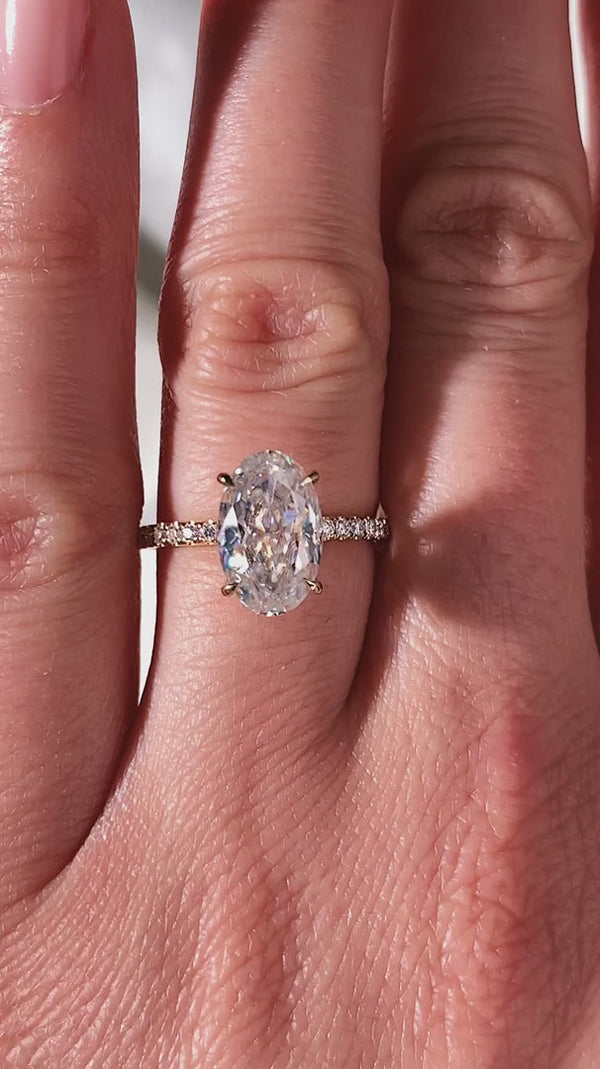
- Visible extra fire at large sizes. Above roughly 8.5 mm, under directional light, the dispersion shows. Some love it; some find it announces itself.
- Identifiable in seconds. Doubly refractive, so a jeweller sees doubled facet edges under a loupe immediately. It cannot be a lifelong secret, and the version of this that works is simply saying what it is.
- No standardised grading. No lab grades it for colour or cut on the diamond scales, so seller claims are not comparable. You judge by video.
Where the saving is best spent
This is the practical question underneath the price question.
The metal and the construction are where a ring’s life is decided — a shank of adequate thickness, a properly built gallery, prongs with enough metal in them, solid gold rather than plating. Those are the things that determine whether a ring is still good in thirty years, and they are what the stone saving can fund.
Spending the difference on a much larger moissanite instead is the option we would gently argue against: it maximises the one characteristic that makes the stone identifiable, and buys nothing structural.
Keep reading
Frequently asked questions
Why is moissanite so much cheaper than diamond?
Because supply is unconstrained — silicon carbide is manufactured to order, so scarcity does not exist — because the supply chain has far fewer stages than mined diamond, and because there is no inherited marketing premium attached to the name. None of those reasons relate to the stone’s hardness, brilliance or durability.
Does cheaper mean lower quality?
Not in any measurable property. Moissanite is Mohs 9.25 against household dust at 7, so it does not abrade; its refractive index exceeds diamond’s and its dispersion is about 2.4 times higher. It will not cloud the way cubic zirconia does. The real trade-offs are resale value, visible fire at large sizes, and easy identification under a loupe.
Will moissanite get cheaper still?
It has been inexpensive throughout, so there is less room to fall than there was for lab grown diamonds, which dropped steeply between 2020 and 2024 as growing capacity expanded. Either way, buying jewellery in anticipation of price movement is a poor plan — none of it holds value well.
What should I spend the saving on?
Metal and construction — an adequate shank thickness, a properly built gallery, prongs with enough metal, solid gold rather than plating. Those decide whether a ring is still good in thirty years. Spending it on a much larger stone instead maximises the one characteristic that makes moissanite identifiable and buys nothing structural.
Put the saving into how it is built.
Solid 925 silver or solid 10K, 14K and 18K gold. Nothing plated, and we will tell you the gram weight.
Leave a comment