Lab Grown Diamonds
Oval or Round at the Same Budget?
The oval looks bigger and costs less per carat. It also carries a risk the round does not.
Written by the Mapple Gems workshop, Surat · Updated 17 September 2026
Short answer
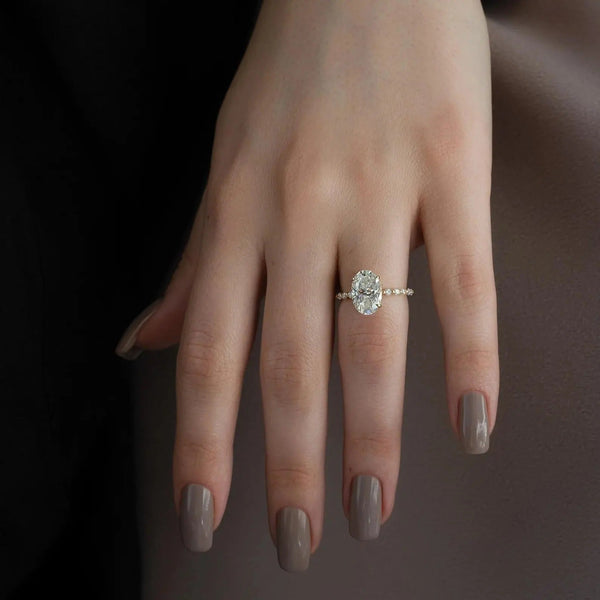
At the same weight, an oval spans about 7.5 mm against a round’s 6.5 mm, and typically costs less per carat — so an oval buys visibly more ring for the money. The trade is that only rounds receive a cut grade. With an oval you are the cut grader, and the specific hazard is the bow-tie, which appears on no report and cannot be seen in a still photograph. Choose the oval if you will insist on video; choose the round if you would rather the grading do the work.
This is the most common shape decision after “round or something else”, and the honest version is not that one is better — it is that they distribute risk and value differently.
The comparison at 1 carat
| Round brilliant | Oval | |
|---|---|---|
| Face-up size | 6.5 mm across | ~7.5 × 5.5 mm |
| Price per carat | Highest of all shapes | Lower |
| Cut grade | Yes — graded by every lab | No — none exists |
| Characteristic fault | None specific | Bow-tie; uneven shoulders |
| Effect on the finger | Neutral | Lengthens |
| Setting protection needed | Standard prongs | Prongs at the ends, not just sides |
| Wedding band fit | Usually straightforward | Often needs a contour |
The whole decision comes down to one thing: the round comes with a cut grade and the oval does not. Every laboratory grades cut on round brilliants, because their proportions are standardised enough to assess consistently. No laboratory grades cut on any fancy shape, including ovals — so two ovals with identical carat, colour and clarity can perform completely differently and nothing on either report will tell you. The specific hazard is the bow-tie: a dark band across the centre caused by your own head and hand blocking light. A slight one is normal and present in nearly every oval; a pronounced one sits there permanently. It appears on no report, and a still photograph is chosen from hundreds of frames at the angle where it shows least. Only rotating video in ordinary light reveals it — so on an oval, that is not a nice-to-have.
Choose the oval if
- Visible size matters most. A full millimetre more span at the same weight, plus a lower price per carat — the two compound.
- You want the finger to look longer. An elongated stone does this and a round does not.
- You are willing to insist on video and check the four things below.
- You will order the wedding band at the same time, since a contour is frequently needed.
What to check on any oval: no pronounced bow-tie through rotation, a symmetrical outline when you halve it mentally along the long axis, crisp facet junctions, and a ratio you actually like — 1.35 reads rounder, 1.45 reads distinctly elongated, and the difference is larger than the numbers suggest.
Choose the round if
- You would rather the grading did the work. Take Excellent or Ideal cut with Excellent or Very Good polish and symmetry, and you have a reliable stone without judging video yourself.
- You are buying remotely with limited communication — a cut grade travels; a video assessment depends on getting a good video.
- You want a plain straight wedding band to sit flush without a contour.
- You prefer the shape. Which is a complete reason and needs no arithmetic behind it.
Two things that apply to both
Buy just under the round weights. A 0.90 ct round measures 6.2 mm against 6.5 mm at 1.00 ct — three tenths of a millimetre nobody detects, at a meaningfully lower price. The same step exists on ovals.
Match the colour grade to the metal. In yellow or rose gold, G–H reads white at these sizes because the metal is warmer than the stone. Save there rather than on cut or construction.
If the stone is moissanite rather than lab grown
One extra consideration. Neither shape is cut-graded in moissanite — no laboratory grades moissanite cut at all — so the video requirement applies to both equally.
And the fire question runs the other way from the size question: a round brilliant shows more dispersion than an oval, and both show more than a step cut. If you want the elongated look with less rainbow, an emerald cut at a 1.40–1.50 ratio gives you length and calm at once.
Keep reading
Frequently asked questions
Does an oval look bigger than a round of the same carat?
Yes. At 1 ct an oval spans roughly 7.5 mm against a round’s 6.5 mm, because elongated shapes carry more of their weight in the face and less in the depth. Ovals also typically cost less per carat, so the two effects compound.
Why do ovals not have a cut grade?
Because their proportions are not standardised enough to grade consistently — only round brilliants receive a formal cut grade from any laboratory. So two ovals with identical carat, colour and clarity can perform completely differently, and nothing on either report will tell you which is which.
What ratio should an oval be?
Between about 1.35 and 1.45 for most people. 1.35 reads rounder and 1.45 reads distinctly elongated, and the visual difference is larger than the numbers suggest — so ask for the ratio as well as the millimetre dimensions and decide deliberately.
Do oval rings need a contoured wedding band?
Frequently, because the stone extends along the finger past where a straight band wants to sit. Test it on the render by pressing a straight edge against the side of the worn ring — visible daylight means a contour is needed. Order the band with the ring, when the fitting is part of the build.
On an oval, video is not optional.
Rotating, in ordinary indoor light. It is the only way the bow-tie shows — and we will send it before you commit.
Leave a comment