Moissanite 101 · Shape vs Shape
Moissanite Emerald vs Asscher Cut: One Cut, Two Outlines
The two calmest moissanite shapes. The choice is about length, presence and how a square step cut behaves.
Written by the Mapple Gems workshop, Surat · Updated 26 September 2026
Short answer
An Asscher is essentially a square emerald cut with deeper cropped corners. Both are step cuts and the two calmest moissanite shapes. Choose emerald (about 7.0 × 5.0 mm at 1 ct DEW) for length and a larger look. Choose Asscher (about 5.5 mm square) for a compact, Art Deco "hall of mirrors" and a straight wedding band that fits more easily.
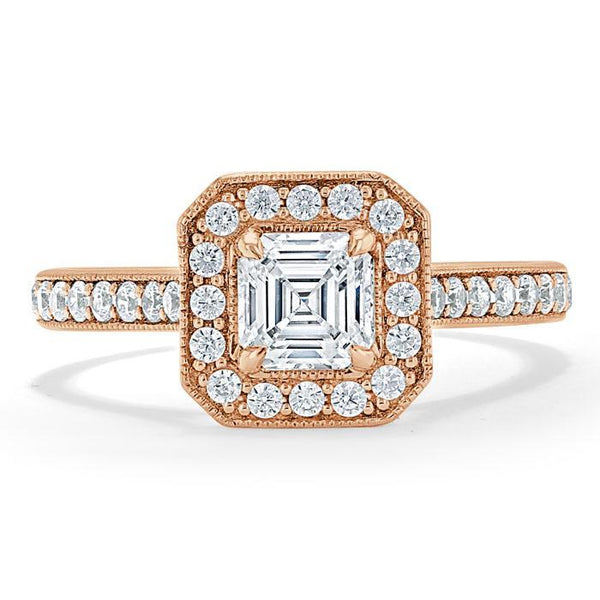
Emerald and Asscher cuts are built the same way: long, flat, parallel step facets that return light in broad, mirror-like flashes rather than scattered sparkle. The Asscher simply uses a square outline and larger cropped corners, which creates its signature look from above — a set of concentric squares, often described as a hall of mirrors or a window into the stone.
Because moissanite's dispersion (0.104) is more than twice diamond's (0.044), step cuts are valuable: they are the shapes that keep a moissanite calm and restrained. For all ten shapes, see our moissanite shape comparison.
Emerald vs Asscher moissanite at a glance
| Emerald | Asscher | |
|---|---|---|
| Outline | Rectangle | Square |
| Face-up at 1 ct DEW | 7.0 × 5.0 mm | about 5.5 × 5.5 mm |
| Face-up at 2 ct DEW | about 8.5 × 6.5 mm | about 7.0 × 7.0 mm |
| Fire | Least of any shape | Very low, a touch more than emerald |
| Signature look | Long steps, elegant | Concentric squares, Art Deco |
| Must protect | Four cropped corners | Four cropped corners |
| Wedding band | Often contour | Straight often fits |
| Effect on the finger | Lengthens | Compact, balanced |
DEW = diamond equivalent weight. See the moissanite size chart.
Size: emerald spreads, Asscher concentrates
An Asscher is cut deep and square, so it carries a lot of its weight below the surface. At 1 ct DEW it faces up about 5.5 mm square — among the smallest face-up sizes of any shape. An emerald spreads the same weight into a rectangle about 7 mm long, so it looks larger and lengthens the finger. If visible size is a priority, the emerald wins clearly.
The Asscher's depth is not wasted: it is what creates the concentric-square effect that makes it so distinctive. It suits people who want a compact, jewel-box look rather than the largest possible stone.
Sparkle and what each reveals
Both give broad, glassy flashes rather than a spray of colour. The Asscher's squarer, deeper shape returns a little more light toward the centre, so it can look slightly brighter than an emerald of the same weight, but both sit at the calm end of moissanite's fire ranking. That makes either one a strong choice for anyone who likes moissanite but wants less rainbow, especially above 2 ct.
Step cuts are windows. Any faint tint, inclusion or unevenness in the cutting shows more readily than in a brilliant. No laboratory grades moissanite, so judge either stone on a straight-down video: the step facets should run dead parallel, the corners should be symmetrical, and on an Asscher the concentric squares should be centred rather than drifting to one side.
From the workshop: step cuts reward good metal choices.
Because a step cut hides nothing, the metal around it matters more than with a brilliant. White gold and platinum make an emerald or Asscher moissanite look crisp and icy, but also show any faint warmth in the stone. Yellow and rose gold soften that warmth and give step cuts a warm, vintage character that suits their Art Deco roots.
One more practical point: with step cuts, a stone cut slightly off moissanite's optic axis can show a faint softness through the large table — something a busy brilliant would hide. It is another reason to insist on a clear, straight-down video before the stone is set.
Wear and the wedding band
Both are Mohs 9.25 and both have four cropped corners rather than sharp ones; each corner should still sit under its own prong. The Asscher's compact square usually lets a straight wedding band sit flush, while an emerald's length often calls for a contour or slightly spaced band. Check the side view of the design first.
How to decide
- Want a larger look and a longer finger? Emerald.
- Want a compact, Art Deco jewel? Asscher.
- Want the least rainbow possible? Emerald, with Asscher a close second.
- Want an easy straight band? Asscher.
- Either way: a prong on each corner and a straight-down video before buying.
Keep reading
Frequently asked questions
What is the difference between emerald and Asscher cut moissanite?
Both are step cuts. An emerald is rectangular; an Asscher is square with deeper cropped corners, giving a concentric-square "hall of mirrors" look from above.
Does an emerald or Asscher moissanite look bigger?
The emerald. At 1 ct diamond equivalent weight it is about 7.0 × 5.0 mm, while an Asscher is about 5.5 mm square because it is cut deeper.
Do emerald and Asscher moissanites sparkle?
Yes, with broad, mirror-like flashes rather than scattered colour. They are the two calmest moissanite shapes, which is why people choose them for a restrained look.
Do step cut moissanites show tint more?
They can, because a step cut is a window into the stone. Yellow or rose gold softens faint warmth; white gold and platinum show it more.
Which is better for a straight wedding band?
The Asscher, whose compact square usually lets a straight band sit flush. An emerald's length often needs a contour or slightly spaced band.
Long steps or concentric squares?
Every ring is made to order in our Surat workshop. Ask for a straight-down video of the stone before it is set.
Leave a comment