Moissanite 101
Antique Cuts in Moissanite: Old Mine, Old European and Rose
Cuts designed for candlelight, which turn out to suit this material unusually well.
Written by the Mapple Gems workshop, Surat · Updated 10 September 2026
Short answer
Antique cuts have fewer and larger facets than modern brilliants, so they return broad, slow flashes rather than fine scattered sparkle. In moissanite that is a real advantage: bigger facets separate less dispersion at once, so an old mine or old European cut reads calmer and more diamond-like than a modern round of the same size. They also show a small open culet and a higher crown, which is the visual signature people recognise as antique.
Antique cuts were developed before electric light, to look their best under candles and lamps — large facets throwing occasional bright flashes rather than constant fine sparkle. That design goal, entirely by accident, addresses the one thing people most often want to moderate in moissanite.
The three main cuts
| Cut | Character | Fire shown |
|---|---|---|
| Old mine | Softly squared cushion outline, high crown, small table, open culet | Moderate — broad flashes |
| Old European | Round outline, high crown, small table, open culet | Moderate |
| Rose cut | Flat back, domed faceted top, no pavilion | Low — a soft glow |
| Modern round brilliant | 57–58 small facets, large table, no culet | Highest |
Why antique cuts suit moissanite better than modern brilliants do. Dispersion is split by facets: many small facets throw many separate coloured flashes at once, which is what reads as rainbow. Antique cuts have far fewer and much larger facets, so each flash is broader and there are fewer of them competing — the effect is a slow, warm scintillation rather than a busy shimmer. Moissanite disperses roughly 2.4 times as strongly as diamond, so it has more to moderate, and this faceting does the moderating. It is the same reason step cuts read calmly, arriving at it from a different direction. If someone wants moissanite with vintage character rather than maximum sparkle, this is the answer.
The open culet: the signature detail
A culet is the very bottom point of a stone. Modern brilliants finish in a point; antique cuts were finished with a small flat facet there instead.
Looked at from directly above, that flat facet appears as a tiny circle or dot at the centre of the stone. People sometimes mistake it for a chip or an inclusion — it is neither. It is the single clearest visual marker of an antique cut, and if a stone is sold as old mine or old European without one, it is a modern cut with an antique-ish outline.
It also has a practical side: a pointed culet is the most fragile part of a stone and can chip during setting. A flat culet has no point to lose.
Rose cuts: a special case
A rose cut has no pavilion at all — it is flat underneath with a domed, faceted top. That produces a soft internal glow rather than sparkle, and it is by a distance the most understated way to wear a large stone.
Three practical consequences follow. It sits very low, so it is excellent for anyone who catches rings on things. It looks larger per carat, since all the weight is spread across the face rather than hidden below. And it needs a bezel or low-profile setting, because a flat-backed stone has no depth for prongs to grip properly.
What to check when buying
- Is the culet actually open? Ask for a straight-down photograph. No visible culet means it is not a true antique cut.
- Is the crown genuinely high? Ask for the side elevation. A high crown is what produces the flash pattern — a flat stone with a small table is not the same thing.
- Is the outline deliberately irregular? Old mine cuts were shaped by hand and are often slightly asymmetric. In an antique cut a little irregularity is character; in a modern cut it is a fault. Decide which you want.
- Video, rotating, in ordinary light. The flash pattern is the entire point and a still cannot show it.
- Dimensions in millimetres. A high crown means an antique cut of a given weight looks smaller face-up than a modern brilliant, so compare millimetres rather than carats.
Settings that suit them
- Bezel — particularly for rose cuts, and the most secure choice generally.
- Four-prong with a low basket — keeps the high crown from sitting too tall.
- Milgrain and gallery detail — period-appropriate, and if you put the milgrain on an inner edge or the gallery it will still be crisp in twenty years.
- Step-cut side stones — tapered baguettes echo the calm faceting rather than competing with it.
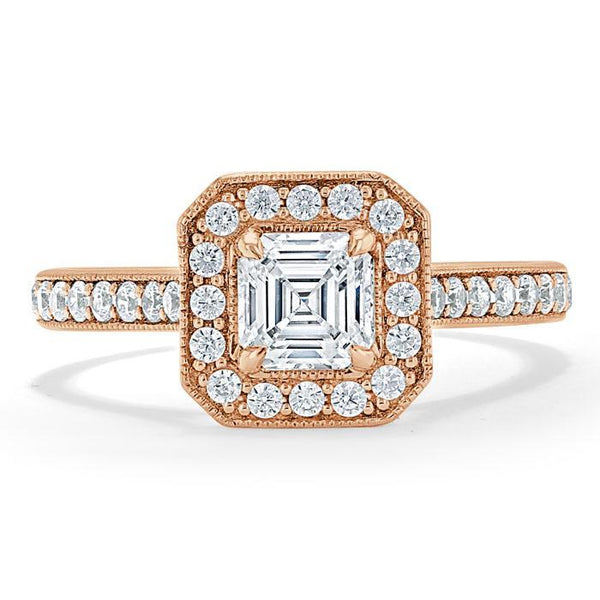
What to avoid: a halo of fine modern brilliants around an antique cut. The two faceting styles argue with each other, and the halo reintroduces exactly the busy dispersion the antique cut was chosen to avoid.
One honest caveat
Antique cuts return less light overall than a well-cut modern brilliant. That is not a flaw in the execution — it is inherent to proportions designed for candlelight. If what you want is maximum brightness in an office, a modern round is the better tool.
Antique cuts are for people who prefer character, calm and a stone that looks like it has a history. Knowing that beforehand is the difference between a considered choice and a surprise.
Keep reading
Frequently asked questions
What is an old mine cut?
A softly squared cushion-shaped cut with a high crown, small table and an open culet — a small flat facet at the very bottom instead of a point. It has far fewer and larger facets than a modern brilliant, so it returns broad slow flashes rather than fine scattered sparkle.
Why do antique cuts suit moissanite?
Because dispersion is split by facets, and antique cuts have fewer and larger ones — so each flash is broader and fewer compete at once. Moissanite disperses about 2.4 times as strongly as diamond, so it has more to moderate, and this faceting does exactly that. The result reads calmer and more diamond-like than a modern round of the same size.
Is the dot at the centre of my stone a flaw?
No — that is the open culet, a small flat facet at the bottom of the stone seen through the table. It is the clearest visual marker of a genuine antique cut, and it is more robust than a pointed culet, which can chip during setting. A stone sold as old mine or old European without one is a modern cut with an antique outline.
What setting suits a rose cut?
A bezel or low-profile setting. A rose cut has no pavilion — it is flat underneath with a domed faceted top — so there is little depth for prongs to grip. It sits very low, which suits anyone who catches rings on things, and looks larger per carat since all the weight is spread across the face.
Ask for the straight-down shot.
If you can see the culet, it is a genuine antique cut. If you cannot, it is a modern stone with an antique outline.
Leave a comment