Shape comparison
Oval or Pear?
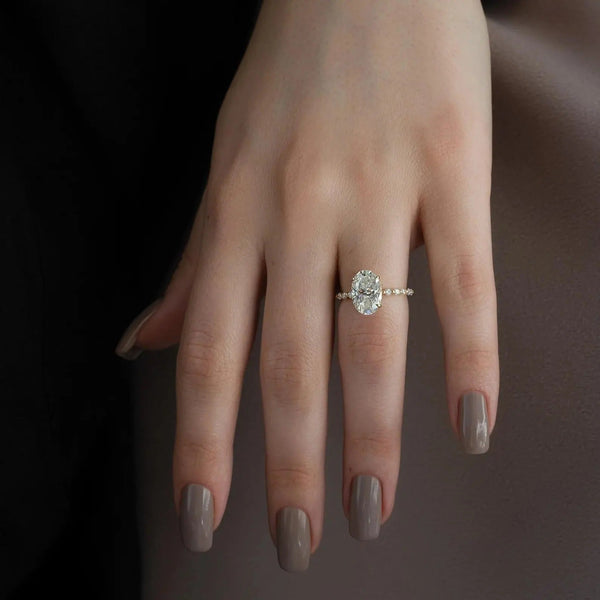
Two elongated brilliants that look related in a photograph and behave very differently on a hand.
Written by the Mapple Gems workshop, Surat · Updated 22 August 2026
Short answer
A pear faces up slightly larger per carat than an oval and is more distinctive. But it has a single sharp point that must be covered by a V-prong, it dates in cycles where the oval does not, and it is harder to fit a wedding band to. Choose the pear for character; choose the oval for lower risk.
Both are elongated brilliant cuts. Both flatter the finger. Both spread their carat weight into face-up area rather than depth, so both look larger than a round of the same weight. From there they diverge more than most people expect.
Side by side
| Oval | Pear | |
|---|---|---|
| Approx. size at 1ct | 7.7 × 5.5 mm | 8.4 × 5.5 mm |
| Usual ratio band | 1.35–1.45 | 1.45–1.70 |
| Vulnerable areas | Two soft tapered tips | One sharp point — the most exposed feature on any brilliant |
| Required prong | Standard prongs at the shoulders | A V-prong over the point, non-negotiable |
| Bow-tie | Always present, varies in strength | Also present, plus a second risk of a dull zone near the point |
| Symmetry to judge | Even curve, no orientation issue | Shoulders must match; the point must sit on the axis |
| Wedding band fit | Usually needs a contour | Almost always needs a contour |
| How it ages as a style | Has never really dated | Cyclical — moves in and out over generations |
The point is the whole difference
Hardness and toughness are not the same property. A diamond sits at Mohs 10, which describes resistance to scratching, and it says nothing about resistance to impact. All diamonds have cleavage planes and can chip.
Chips happen where material is thin: at points and at narrow girdles. An oval has two soft tapered ends, which are thin but rounded. A pear has one genuine point, and it is the most exposed feature on any brilliant cut.
This makes the pear a setting decision more than a stone decision. A V-prong — a prong shaped to cup the point from two sides — is not a style option on a pear. It is the thing that makes the shape wearable. Any pear ring offered without one should be modified before it is made.
Symmetry you have to judge yourself
Neither shape gets a cut grade. No laboratory grades cut on any fancy shape — cut grades exist only for round brilliants — so on both stones you are the grader. But a pear gives you more to get wrong.
On an oval, symmetry means an even outline curve. On a pear there are three separate checks: are the two shoulders the same height and curve, does the point sit exactly on the long axis rather than off to one side, and is the belly rounded rather than flat? A pear that is fractionally asymmetric reads as a mistake in a way an oval never does, because the eye has a centre line to measure against.
Add the standard fancy-shape rule for both: judge on a rotating handheld video in ordinary room light, never on still photographs, because a lightbox hides the bow-tie on every elongated brilliant regardless of quality.
From our bench in Surat
When a pear comes back to us for repair, it is almost never the point that failed — it is the V-prong over the point, worn thin from doing exactly the job it was built for. That is not a fault. It is a consumable part protecting a stone, and re-tipping it is quick and cheap if it is caught early.
The honest asymmetry between these two shapes is therefore not fragility, it is attention. An oval tolerates an owner who forgets it exists. A pear needs the tip looked at every couple of years, and the people who have trouble with pears are the ones who were never told that.
Which to choose
Choose the pear if: you want a stone that is recognisably itself, you like the way a point aims along the finger, you are willing to specify a V-prong and check it, and you are not troubled by a shape that has moved in and out of fashion before.
Choose the oval if: you want the elongating effect with fewer variables, you want a shape with a long undated record, you want a slightly better chance of a straight wedding band, or you are buying without seeing the stone in person and want to reduce what can go wrong.
One point in the pear's favour worth stating plainly: it faces up a little larger per carat than an oval, because the shape carries more of its outline away from the centre. If maximum visible size per carat is the goal, the pear wins narrowly.
Before you decide
- Ask for a handheld video in ordinary light, for either shape.
- Calculate the ratio from the measurements line yourself.
- On a pear, check shoulder symmetry and whether the point sits on the axis.
- Specify a V-prong on any pear; prongs at the shoulders on any oval.
- Order the contoured wedding band with the ring for either.
- Cut a paper shape at the actual millimetres and hold it against the hand.
Frequently asked questions
Is a pear more fragile than an oval?
The material is identical — both are diamond at Mohs 10. The pear's single sharp point is thinner than an oval's rounded tips, so it is more exposed to impact. A V-prong over the point removes most of that difference, which is why it is essential rather than decorative.
Which looks bigger, an oval or a pear?
A pear faces up slightly larger per carat — around 8.4mm long at 1ct against an oval's 7.7mm at a typical ratio. Both are noticeably larger than a 1ct round at 6.5mm, because elongated shapes spread weight into face-up area rather than depth.
Do pears have a bow-tie like ovals?
Yes. Any brilliant cut stretched into an elongated outline develops one, because pavilion facets must be lengthened to fill the shape. Pears can also show a separate dull zone near the point if the cutting is poor. Judge both on rotating video.
Which way should a pear point?
Conventionally the point aims toward the fingertip, which lengthens the finger. It is a preference rather than a rule, but it should be decided at the design stage because the setting, and any contoured band, are built around that orientation.
Does either shape get a cut grade?
Neither does. Cut grades are issued only for round brilliants, so on an oval or a pear the report gives colour, clarity, measurements, polish and symmetry but no assessment of light performance. That judgement is left entirely to the buyer.
Undecided? Ask for both on video
Everything is made to order in our Surat workshop, so the shape, the prong build and the band are all still open before casting.
Leave a comment