Shape comparison
Oval or Elongated Cushion?
At a glance they can be almost indistinguishable. The difference is in the corners, the faceting style, and how forgiving each one is.
Written by the Mapple Gems workshop, Surat · Updated 22 August 2026
Short answer
An oval has a continuous curved outline and faces up larger per carat. A cushion has four softened corners and sits deeper, so it looks smaller for the same weight but is better protected and hides inclusions more readily. The cushion's real variable is faceting style — crushed ice versus chunky — which changes the stone completely and appears on no report.
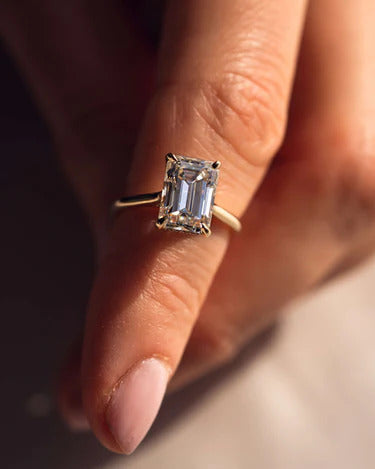
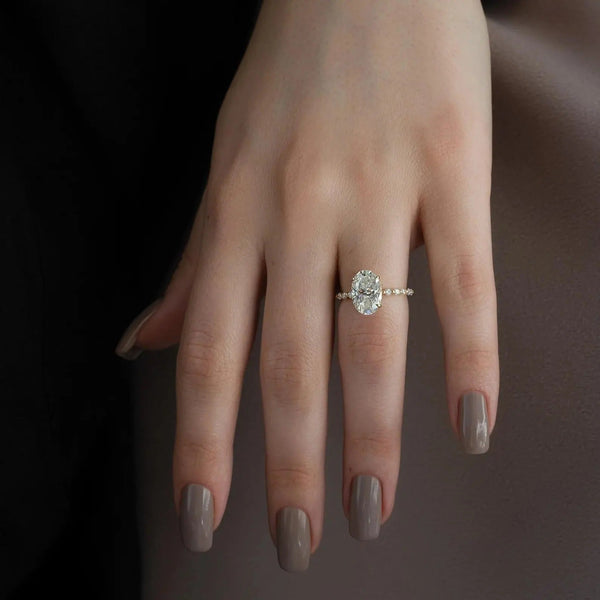
An elongated cushion and an oval, photographed from above on a white background, can be hard to tell apart. Put them in the hand and the differences are structural rather than cosmetic.
Side by side
| Oval | Cushion | |
|---|---|---|
| Approx. size at 1ct | 7.7 × 5.5 mm | 5.9 × 5.9 mm square; ~7.0 × 5.5 elongated |
| Outline | Continuous curve, no corners | Four rounded corners, straighter sides |
| Depth | Shallower — more weight in the face | Deeper — more weight below the girdle |
| Vulnerable areas | Two tapered tips | Corners, but softened — the most forgiving fancy shape |
| Hides inclusions | Moderately | Well, especially crushed ice |
| Bow-tie | Always present | Only on elongated cushions; square ones rarely |
| Wedding band fit | Usually needs a contour | Often takes a straight band |
The size row is the one people react to. At the same carat weight an oval simply shows more of itself, because it carries less of its mass below the girdle. If face-up size per carat is what you are buying, the oval wins clearly.
The variable nobody warns you about
Cushions are not one cut. They divide into two faceting styles that produce genuinely different stones, and the difference appears nowhere on a grading report.
Crushed ice uses many small facets under the table, so the stone reads as a shimmer of tiny sparkles. It hides inclusions and tint extremely well and looks lively in almost any light. It also reads softer, and some people find it less defined than they wanted.
Chunky (sometimes called antique or old-mine style) uses fewer, larger facets. Light comes back in bigger distinct flashes. It looks more like a vintage stone, but with fewer facets to break up the view it shows inclusions and colour more readily, so it wants a slightly better grade.
Two cushions with identical 4Cs, identical measurements and identical polish and symmetry can therefore look nothing alike. There is no field on any certificate that tells you which you are getting. You have to look, and you have to ask.
From our bench in Surat
This is a gap on our own side and we would rather name it than have you find it. Our cushion listings do not currently state whether a stone is crushed ice or chunky, and that is the single most consequential thing about a cushion — more consequential than a clarity grade.
So until the listings say so, ask before ordering a cushion, and ask for a rotating video rather than a still. Everything is made to order, so the stone is specified per ring rather than pulled off a shelf, and it is a question we can answer in one message. The equivalent question on an oval is different but just as unlisted: what is the length-to-width ratio, and how strong is the bow-tie.
Setting and band implications
A cushion's corners are rounded rather than sharp, which makes it arguably the most forgiving fancy shape to set. It does not need V-prongs the way a pear or a princess does, and it does not have an oval's two thin tapered ends. Four prongs at the corners is a complete answer for most cushions.
Because it sits more compactly on the finger, a cushion is also more likely to accept a straight wedding band. An oval extends along the finger and usually occupies the space a straight band wants, which is why most oval rings need a contoured band. Run the straight-edge test on the CAD side elevation for either shape rather than assuming.
One thing they share: neither gets a cut grade. Cut grades are issued only for round brilliants, so on both stones light performance is a judgement you make from a rotating video in ordinary room light, not something the document certifies.
Which to choose
- Oval if you want maximum face-up size per carat, a clean modern outline, or a finger-lengthening effect.
- Cushion if you want a softer, warmer look, better protection at the outline, or a shape that will tolerate a lower clarity grade without showing it.
- Elongated cushion if you want something between the two — but be aware it reintroduces the bow-tie that a square cushion largely avoids.
- Either if the deciding factor is the setting; both are well served by a bezel or a plain four-prong solitaire.
Frequently asked questions
Does an oval or a cushion look bigger at the same carat?
The oval, clearly. A cushion carries more of its weight below the girdle, so a 1ct cushion faces up around 5.9mm square while a 1ct oval runs about 7.7mm long. Elongated cushions close some of that gap but do not eliminate it.
What is the difference between crushed ice and chunky cushions?
Crushed ice uses many small facets and reads as a shimmer, hiding inclusions and tint well. Chunky uses fewer, larger facets and returns light in bigger flashes with a more vintage look, but shows inclusions more readily. Neither appears on a grading report.
Do cushion cuts have a bow-tie?
Square cushions rarely do, because their outline is close to symmetrical in every direction. Elongated cushions can, for the same reason ovals always do — pavilion facets are stretched to fill a longer outline. Judge on a rotating video.
Can I use a lower clarity grade on a cushion?
Generally yes, particularly with crushed ice faceting, where visual noise breaks up the view. Position still beats grade on any stone: open the plot diagram and check whether anything sits under the table and whether it is visible unmagnified.
Which shape is easier to fit a wedding band to?
The cushion, usually. It occupies a more compact footprint so a straight band often meets it cleanly, while an oval extends along the finger and generally needs a contoured band. Confirm with the straight-edge test on the CAD side elevation either way.
Ask which faceting style before you order a cushion
Made to order in our Surat workshop, so the stone is specified for your ring — and we will send video rather than a lightbox still.
Leave a comment