Oval diamonds
Length-to-Width Ratio, Explained Properly
One number decides whether your oval reads long and slender or full and rounded. It is not printed on any report — you have to work it out yourself.
Written by the Mapple Gems workshop, Surat · Updated 21 August 2026
Short answer
Divide an oval's length in millimetres by its width. Most people choose between 1.30 and 1.50. Around 1.35 to 1.45 reads as a classic oval; below 1.30 it starts looking like a rounded cushion; above 1.50 it reads distinctly elongated and narrows across the finger. The ratio is derived from the measurement line on the report, never stated.
Two ovals of exactly the same carat weight can look like different shapes. One is broad and full, the other long and slim. Nothing on the certificate names this difference, which is why so many people order an oval and receive something that is technically correct and visually not what they pictured.
The number that governs it is the length-to-width ratio, and it takes about ten seconds to calculate.
How to work it out
Every grading report carries a measurements line, written as three figures: length × width × depth, in millimetres. On an oval it might read 8.05 × 5.75 × 3.52 mm.
Divide the first number by the second. 8.05 ÷ 5.75 = 1.40. That is your ratio.
Laboratories do not print it, because it is not a graded property — it is arithmetic on data they have already given you. Sellers rarely print it either. So on the single specification that most determines what the shape looks like, the buyer is the one who has to do the work.
What each band actually looks like
| Ratio | How it reads | Approx. mm at 1ct | Suits |
|---|---|---|---|
| 1.25–1.30 | Soft, full, close to a rounded cushion | 7.0 × 5.5 | Longer fingers; buyers who want an oval that still reads round |
| 1.35–1.45 | The classic oval most people picture | 7.7 × 5.5 | Almost everyone; the safe default when ordering unseen |
| 1.45–1.55 | Visibly elongated, finger-lengthening | 8.2 × 5.4 | Shorter fingers; buyers who want the modern look |
| 1.55+ | Long and narrow; approaching moval territory | 8.7 × 5.3 | A deliberate choice, not a default. See the stone on video first. |
Notice what happens down the right-hand column of millimetres. As the ratio rises, the stone gains length but loses width — and it loses width faster than it gains length, because carat weight is fixed. At 1.25 you are looking at 5.5mm across the finger; at 1.55 you are looking at 5.3mm. The stone is longer, and it covers less of the finger.
The ratio does not describe the outline
This is the part almost nobody is told, and it is the reason two stones quoted at the same ratio can still look different.
Length-to-width is a single number describing a rectangle drawn around the stone. It says nothing about the curve of the outline inside that rectangle. Two 1.40 ovals can differ substantially:
- A full-bodied oval holds its width almost all the way to the ends before turning. It reads generous and slightly softer.
- A pinched or pointed oval starts narrowing early, so the ends taper. It reads sharper and, to most eyes, smaller — despite identical measurements.
- A flat-shouldered oval has slightly straightened sides. It looks more like an elongated cushion than an oval.
No report describes any of this. There is no measurement for it, no grade for it, and no vocabulary for it in most listings. The only way to see outline shape is to look at the stone face-up in a photograph or video with the outline clearly visible against a plain background.
From our bench in Surat
When a customer sends us an inspiration photograph of an oval they love, the first thing we do is measure the ratio in the image rather than trust the words around it. The description almost always says "elongated oval". The picture is almost always about 1.40.
The honest version is that the word "elongated" has become a style label rather than a measurement, and it is applied to everything from 1.35 upward. If elongation actually matters to you, do not send us an adjective — send us a number, or send the photograph and let us measure it. That is a two-minute conversation that prevents the most common oval disappointment we see.
Ratio, apparent size and the finger
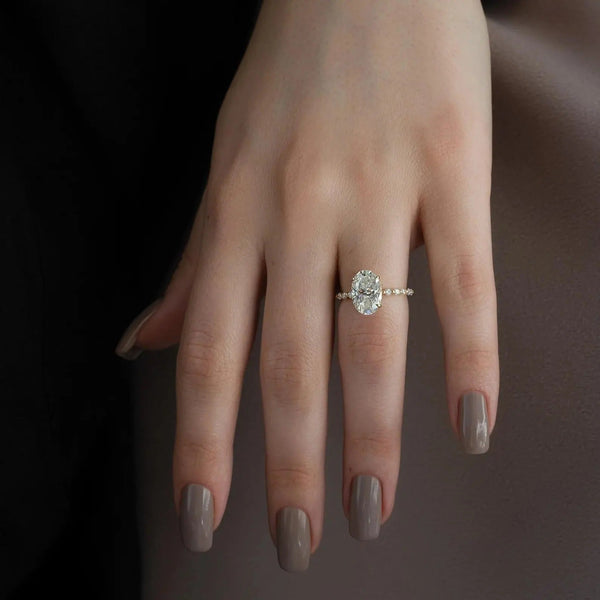
An oval is chosen by many people because it looks larger than a round of the same weight — which is true. Carat is a measure of weight, not size, and an oval pushes that weight into face-up spread rather than depth. A 1ct round is about 6.5mm across; a 1ct oval at 1.40 measures roughly 7.7mm long.
But apparent size on the hand is a ratio, not an absolute. The same stone reads noticeably larger on a size 4 finger than on a size 7. And because a longer oval is a narrower oval, the finger-coverage effect people are chasing does not keep improving as the ratio climbs. Past about 1.50 the stone looks longer in a photograph and thinner in person.
The practical rule: if you want the ring to look big, buy width. If you want the finger to look long, buy length. Those are different purchases and the ratio is the dial between them.
Ratio also changes the setting
A longer oval is a more demanding stone to build around, and this is worth deciding before CAD rather than after.
- The ends need protection. The further the ends taper, the thinner the girdle at those points and the more exposed they are. Above about 1.50, prong placement at the tips stops being cosmetic.
- The band almost always needs to be contoured. A long oval sits low over the finger and a straight wedding band will gap under it. This is true of most ovals and unavoidable above 1.45.
- The bow-tie usually widens with ratio. Stretching pavilion facets to fill a longer outline is what creates the dark band across the waist in the first place.
- Halos have to be drawn to match. A halo built for a 1.35 outline will not sit correctly around a 1.50 stone; the spacing at the ends goes wrong.
Before you commit to a ratio
- Calculate it yourself from the measurements line — do not accept an adjective.
- Default to 1.35–1.45 if you are ordering without seeing the stone.
- Ask for the face-up outline against a plain background, not just a sparkle shot.
- Decide whether you are buying width (apparent size) or length (finger-lengthening).
- Above 1.50, confirm prong placement at the tips and order the wedding band at the same time.
- Compare the stone's millimetres against the standard size for its weight — much larger than standard usually means a shallow cut.
Keep reading
The bow-tie in an oval diamond, and how to judge it
Frequently asked questions
What is the best length-to-width ratio for an oval diamond?
There is no single best ratio, but 1.35 to 1.45 is the safest default because it reads as a classic oval to most people and suits most hands. Choose 1.45–1.55 if you specifically want a finger-lengthening look, and 1.25–1.30 if you want a fuller, softer outline.
Where do I find the ratio on a grading report?
You will not find it — no laboratory prints it. Take the measurements line, which reads length × width × depth in millimetres, and divide the first figure by the second. An 8.05 × 5.75 mm oval has a ratio of 1.40.
Does a higher ratio make an oval look bigger?
It makes it look longer, not bigger. Carat weight is fixed, so length is gained at the cost of width — the stone covers less of the finger as the ratio climbs. If apparent size is the goal, a lower ratio with more width usually wins.
Can two ovals with the same ratio look different?
Yes, and frequently. The ratio describes the box around the stone, not the curve of the outline within it. One 1.40 oval can hold its width to the ends while another tapers early and reads sharper and smaller. Only a face-up image shows this.
Does ratio affect the wedding band?
It does. Most ovals sit low enough that a straight band gaps beneath the stone, and above roughly 1.45 a contoured band is effectively required. Order the band alongside the engagement ring rather than afterwards so both are drawn from the same file.
Send us a number, not an adjective
Every piece is made to order in our own Surat workshop, so the ratio, the outline and the setting are all still open before casting.
Leave a comment