Engagement Rings
Pear Cut Engagement Rings: The Three Things That Go Wrong
The bow-tie, the point, and the crooked shoulder. All three are checkable before you order.
Written by the Mapple Gems workshop, Surat · Updated 27 August 2026
Short answer
A pear looks larger than a round of the same carat and flatters the finger — but it has three specific failure modes: a bow-tie (a dark band across the middle from poor cutting), an unprotected point (which must carry a V-prong), and asymmetric shoulders (which make the whole stone look crooked). All three are visible in a video and none of them appear on a grading report, because pears receive no cut grade.
Pears are among the most rewarding shapes and the least standardised. Two pears of identical carat, colour and clarity can be dramatically different stones, because everything that separates them is a cutting decision that no laboratory grades.
That sounds worrying. It is actually good news — because all three problems are things you can check yourself in about a minute.
1. The bow-tie
A dark band running across the width of the stone, shaped like a bow tie. It happens when the pavilion facets are angled such that light entering the middle of the stone leaks out of the bottom instead of returning to your eye.
Every pear has some bow-tie. The question is whether it is faint and mobile, or dark and fixed.
- Acceptable: a soft shadow that shifts, breaks up and disappears as the stone moves.
- Not acceptable: a hard dark band that stays put through a full rotation.
- How to check: video only. A still photograph is taken at the angle where it shows least — that is precisely why stills are used.
2. The point
The narrow tip is the thinnest part of the stone and the only genuinely vulnerable part of a pear. It is where chips happen, and it is entirely a setting question.
A V-prong — a prong shaped to wrap the point from both sides — is the correct answer, and it should be specified rather than assumed. A plain round prong sitting beside the point rather than over it leaves the tip exposed, and that ring will eventually be damaged.
Check this on the render before approval. It is the single most common construction fault we see on pear rings made elsewhere, and it cannot be corrected afterwards without resetting the stone.
3. The crooked shoulder — the fault nobody looks for. Draw an imaginary line from the point straight down the middle of the stone. Both halves should mirror each other: the shoulders should curve out at the same place and with the same fullness, and the belly should be even on both sides. When they are not, the stone looks tilted on the finger even though it is set perfectly straight — and once you have seen it you cannot unsee it. Ask for a straight-on photograph of the stone alone, and look for symmetry rather than sparkle. This never appears on a report and is the thing people regret most.
Ratio: how long a pear do you want?
| Length-to-width | Character | Suits |
|---|---|---|
| 1.40 – 1.50 | Rounded, softer, almost teardrop | Longer fingers; a gentler look |
| 1.50 – 1.60 | The classic pear | Most hands. The safe range. |
| 1.60 – 1.75 | Elongated, dramatic | Shorter fingers — strong lengthening effect |
| 1.75 + | Very narrow | A deliberate choice; point is more fragile |
Note the last row. A longer pear has a sharper, thinner point, so ratio and durability are linked — the more dramatic the shape, the more the V-prong matters.
Which way should it point?
Conventionally the point faces the fingertip, which visually lengthens the finger — the main reason people choose a pear.
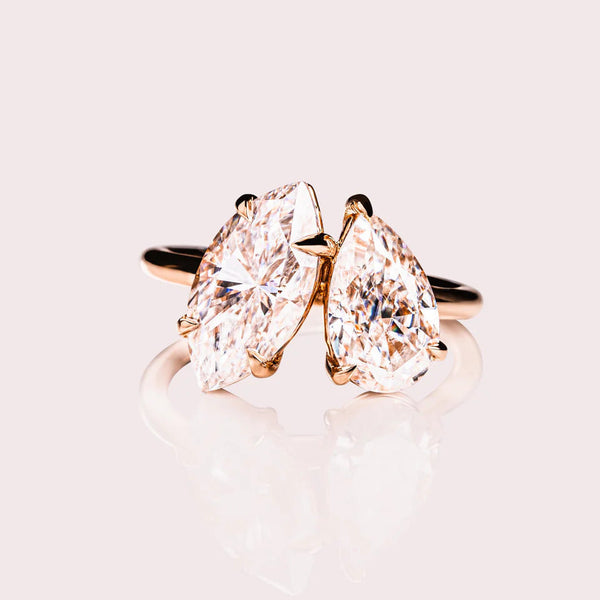
Pointing it toward the wrist is a legitimate alternative and reads as more unusual. And setting it east-west, across the finger, is increasingly common and has a practical advantage: the point no longer extends toward where a wedding band sits, so the band problem largely disappears.
Decide before casting. It is not adjustable afterwards.
The wedding band problem
With the point toward the fingertip, a pear’s widest part sits low on the finger, right where a straight band wants to be. A gap is common.
The usual answer is a chevron band — a V-shape that nests against the point — rather than a curved contour, because the shape you are accommodating is angular. Order it with the ring so it can be cut to the actual profile; fitting one afterwards is charged as bench work.
Pear in moissanite
Pears are brilliant-cut, with many small facets, so moissanite’s extra dispersion is fully on display here — more so than in an emerald or Asscher. At larger sizes a pear moissanite throws noticeably more coloured fire than a diamond would.
Whether that is a feature or a drawback is entirely your preference, but it is worth knowing before ordering rather than after. If you want the pear shape with less fire, a lab grown diamond is the alternative.
Keep reading
- Why video beats photographs — how to spot a bow-tie
- Contour bands: do you need one?
- East-west settings
Frequently asked questions
What is a bow-tie in a pear cut?
A dark band across the width of the stone, caused by light leaking out of the bottom instead of returning to the eye. Every pear has some. A faint shadow that shifts and breaks up as the stone moves is normal; a hard dark band that stays fixed through a full rotation is a cutting fault. Only video reveals which you have.
Do pear shaped rings chip?
The point can, and it is the only genuinely vulnerable part. A V-prong shaped to wrap the tip from both sides protects it properly. A plain round prong sitting beside the point rather than over it leaves it exposed. Check this on the render before approving, since it cannot be corrected later without resetting the stone.
What is the best length-to-width ratio for a pear?
1.50 to 1.60 is the classic range and suits most hands. Below that the stone reads softer and more rounded; above it, more dramatic and strongly lengthening, which flatters shorter fingers. Note that longer ratios produce a sharper, thinner point, so the V-prong matters more.
Which way should a pear ring point?
Conventionally toward the fingertip, which lengthens the finger. Pointing toward the wrist is a legitimate alternative, and setting it east-west across the finger has a practical benefit: the point no longer extends toward where a wedding band sits, largely removing the gap problem. Decide before casting, as it is not adjustable afterwards.
Ask for the stone straight on, alone.
Symmetry first, sparkle second. We will send that photograph before anything is set.
Leave a comment