Lab Grown Diamonds
Matching the Colour Grade to the Metal
The setting decides how much colour grade you actually need — and buying above it is money the ring gives back.
Written by the Mapple Gems workshop, Surat · Updated 26 September 2026
Short answer
Colour is graded face-down against white, but you wear a stone face-up surrounded by metal — and warm metal reflects into it. In yellow or rose gold, H–I reads white; in white gold or platinum, aim for G or better, since a neutral setting hides nothing. A white head on a warm shank gets both. And step cuts need one grade higher in any metal, because there is no visual noise to disguise body colour.
Colour is the C most often over-bought, and the reason is a mismatch between how it is graded and how it is worn.
A diamond is graded upside down against a white background beside master stones — conditions designed to make tiny differences visible, and conditions you will never reproduce. That is the point of grading: it isolates the property so it can be measured consistently. But the stone spends its life face-up, set in metal, on a moving hand, in mixed light — and in that state the differences between neighbouring grades largely disappear. Warm metal makes this stronger still, because a yellow or rose gold basket reflects into the pavilion and the stone picks up the setting’s warmth regardless of its grade. So an H in yellow gold and a D in yellow gold look far more alike than their grades and prices suggest — the metal has already decided the colour you see. The practical rule is simple and it saves real money: let the setting choose the grade. Warm metal, go down. White metal, hold your grade. Spend what you save on cut, which is the only C that changes how the stone actually performs, or on the shank, which is what still matters in thirty years.
The grade to aim for
| Setting | Aim for | Why |
|---|---|---|
| Yellow gold | H–I | Metal is warmer than the stone |
| Rose gold | H–I | Same, with a pink cast |
| White gold | G or better | Neutral setting hides nothing |
| Platinum | G or better | The most revealing background |
| White head, warm shank | G–H | Neutral where it touches the stone |
| Bezel in warm metal | I is fine | Most metal contact of any setting |
Three things that shift the answer
Size. Colour depends on how far light travels through the stone, so a larger stone shows its grade more. Under a carat you can comfortably drop a grade from these figures; above three carats, go up one.
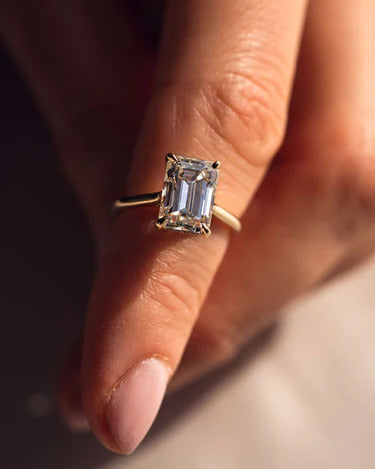
Shape. Round brilliants scatter light and disguise body colour well. Step cuts — emerald, Asscher, baguette — need one grade higher in any metal, because a large open table with few facets is a window rather than a mirror.
How much metal touches the stone. A bezel transfers the most warmth, a basket or cathedral moderate amounts, a peg head or open gallery the least. If you are relying on warm metal to carry a lower grade, a bezel does it most reliably.
The two-tone answer
This is the design decision people treat as decorative and it is actually optical. A white metal head on a warm gold shank puts a neutral background immediately around the stone — where it matters — while the band does the visual work on the hand.
It has two further benefits. Platinum or white gold prongs wear better than warm gold ones, so the more durable metal ends up on the component that fails first. And it gives you flexibility on the grade: G–H sits comfortably in a two-tone build, between the two single-metal answers.
One caution: distinguish a separately made white head from rhodium plating over a yellow head, which wears through at the prong tips within a couple of years and then reads as patchy.
Where to put the money instead
- Cut. Production clusters at high colour and clarity, so cut is the only C genuinely separating stones — Excellent or Ideal with polish and symmetry both Excellent or Very Good.
- Just under a round weight. 0.90 ct measures 6.2 mm against 6.5 mm at 1.00 — the round numbers are price thresholds, not size thresholds.
- The shank. 1.8–2 mm is the difference between a ring that holds its shape for thirty years and one that needs reshanking in ten.
- The head. A properly built basket with a prong over every point outlasts any grade decision.
How to check before committing
Ask for rotating video of the stone already set, in ordinary indoor light rather than a lightbox. A loose stone photographed on white shows its colour most honestly — which is useful for grading and misleading for buying, because you will never see it that way again.
And if you are comparing two stones a grade apart, ask for them in the same setting, in the same clip. Side by side is the only condition where most people can tell — and if you cannot tell in that clip, you certainly will not on a hand.
Keep reading
Frequently asked questions
What colour grade should I buy for a yellow gold ring?
H–I reads white in yellow or rose gold, because the metal is warmer than the stone and reflects into it. In white gold or platinum aim for G or better, since a neutral setting hides nothing. Buying above the setting’s requirement is money the ring gives back.
Why does a graded colour difference disappear once set?
Because colour is graded face-down against white beside master stones — conditions designed to make tiny differences visible. Worn face-up, set in metal, on a moving hand in mixed light, neighbouring grades look far more alike, and warm metal removes the difference almost entirely.
Do step cuts need a higher colour grade?
Yes, one grade higher in any metal. An emerald or Asscher has few long parallel facets and a large open table, so it behaves like a window rather than a mirror — there is no visual noise to disguise body colour the way a round brilliant’s scattering facets do.
Does a two-tone ring change the colour grade I need?
It sits between the two answers — G–H works well, since a white head puts a neutral background immediately around the stone while the warm shank does the visual work. Check it is a separately made white head rather than rhodium plating over a yellow one, which wears through at the prong tips.
Tell us the metal first, then we will tell you the grade.
In warm gold that usually means saving two grades — and putting the difference into the shank.
Leave a comment