Engagement Rings
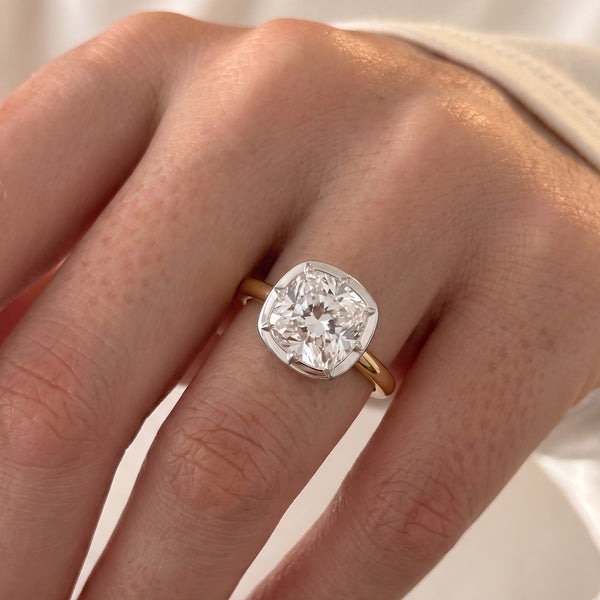
Two-Tone Rings: A White Head on a Coloured Band
A practical build that solves a real optical problem — and lets you buy a lower colour grade.
Written by the Mapple Gems workshop, Surat · Updated 8 September 2026
Short answer
A two-tone ring uses one metal for the head holding the stone and another for the shank — almost always white metal at the head, yellow or rose on the band. It exists because white metal keeps a stone reading neutral while warm metal is what many people want on the finger. The practical benefit is real: it lets you drop a colour grade or two without the stone looking warm, and the saving usually exceeds the small extra cost of the build.
Two-tone gets treated as a style choice, and it can be one. But its origin is optical rather than decorative, and understanding why it exists tends to change how people feel about it.
The problem it solves
Your eye judges a stone’s colour against whatever sits immediately beside it. Against white gold or platinum you have a neutral reference, so any warmth in the stone is visible. Against yellow or rose gold the metal is warmer than the stone, so the stone reads white by comparison.
That produces an awkward trade-off. Choose white metal and you need a higher colour grade to look neutral. Choose warm metal and the stone reads white at a lower grade — but now the setting is warm, which not everyone wants directly around the stone.
A two-tone build takes both halves: white metal touching the stone, warm metal everywhere else.
| Build | Colour grade needed | Look |
|---|---|---|
| All white metal | Higher — the metal reveals tint | Cool, contemporary |
| All yellow or rose | Lower — the metal masks tint | Warm throughout |
| White head, warm band | Lower — stone still reads neutral | Warm on the hand, clean at the stone |
Above about 7 mm we build this as standard, and most people do not know to ask. There are two reasons, and only one is optical. The first is colour: tint accumulates with depth, so on a larger stone the metal beside it matters more — a white head keeps a G or H reading neutral where an all-warm setting would be doing the masking. The second is structural: platinum prongs wear far better than gold, because platinum displaces metal rather than losing it. So a platinum head on a gold band is a durability decision as much as an appearance one, and on a heavy stone it is the build we would recommend regardless of colour preference. Ask for it by name — almost no listing offers it as an option.
How the two metals actually join
Worth knowing, because “two-tone” covers two quite different things.
- A separate head soldered to the shank. The traditional and more durable method — two components made in their own metals and joined. Repairable, and the head can be replaced later.
- Rhodium plating over a yellow gold head. Cheaper, and it looks the same on day one — but the plating wears through where prongs meet fingers and fabric, and then yellow shows at the tips. Ask which you are being sold.
- Cast as one piece in mixed metal. Uncommon and technically awkward; the join is usually the weak point.
The first is what you want. The second is not dishonest if disclosed, but it is a maintenance commitment presented as a design.
Proportion: how much white is right
The rule that keeps two-tone from looking accidental is that the split should be obvious rather than marginal. The eye reads a large difference as design and a small one as error.
- Head only. The most restrained — white confined to the prongs and basket. From a normal viewing distance it barely registers, which is the point.
- Head and gallery. Slightly more visible from the side, and cohesive.
- Head and shoulders. A deliberate two-tone look rather than a discreet one.
- Alternating sections along the band. Strongly of-a-moment; be sure it is what you want long term.
The wedding band question
A two-tone engagement ring gives you more freedom rather than less, which surprises people.
Because the ring already contains two metals, a band in either of them reads as intentional. A yellow band matches the shank; a white band echoes the head. Both work, and you are not locked in the way you would be with a single-metal ring.
The one thing to hold constant is karat. 14K yellow beside 18K yellow is visibly different, and adjacent rings on one finger are the least forgiving place for that. Match 585 to 585, or 750 to 750.
What to ask for
- Is the head a separate component or plated? The important question.
- What metal is the head — platinum, palladium white gold, or nickel white gold?
- Both karats, stated separately. 585 or 750 on the shank, and the head’s specification too.
- Whether the colour grade can drop given the build — this is where the saving is.
- Whether it affects resizing. Generally not, since the shank is a single metal, but confirm it.
Keep reading
Frequently asked questions
What is a two-tone engagement ring?
One that uses different metals for the head and the shank — almost always white metal holding the stone with a yellow or rose gold band. It exists for an optical reason: white metal keeps the stone reading neutral while warm metal is what many people want on the finger.
Does a white head let me buy a lower colour grade?
It lets you buy a lower grade than an all-white-metal ring would need, because the warm shank contributes to how the ring reads overall while the white head keeps the stone itself neutral. The saving on the stone usually exceeds the small extra cost of the two-component build.
Is a two-tone ring a separate head or just plating?
It can be either, and they are different products. A separately made head soldered to the shank is durable and repairable. Rhodium plating over a yellow gold head looks identical on day one but wears through at the prong tips, showing yellow. Ask which you are being sold.
Which wedding band goes with a two-tone ring?
Either metal works, which is more freedom than a single-metal ring gives you — a yellow band matches the shank, a white band echoes the head, and both read as intentional. The one thing to hold constant is karat: match 585 to 585 or 750 to 750, since 14K and 18K yellow visibly differ side by side.
Ask for a platinum head on a gold band.
Above 7 mm we build it this way anyway — better colour, better prong wear, and almost no listing offers it as an option.
Leave a comment