Lab Grown Diamonds
Reading the Plot Diagram
Every report has one, hardly anyone opens it, and it frequently matters more than the clarity grade printed above it.
Written by the Mapple Gems workshop, Surat · Updated 27 September 2026
Short answer
The plot is a map of the stone from above and below, with inclusions marked in red and surface features in green. What you are looking for is position, not count: marks under the table sit in the clearest line of sight, while marks near the girdle are usually hidden by a prong for the life of the ring. That is why a well-positioned SI1 routinely outperforms a badly positioned VS2 face-up — and costs less. Two minutes with the plot is the highest-value check a buyer can make.
The clarity grade is a summary of size, number and nature of inclusions. The plot tells you the one thing the grade leaves out, which is where they are.
Position is the variable that decides whether you ever see an inclusion, and it is the one thing the clarity grade does not encode. A stone is graded at 10× magnification by an examiner looking for what is there. You look at it face-up, unmagnified, on a hand, in ordinary light — and in that condition the table is the window. An inclusion sitting directly beneath it is in the clearest, most direct line of sight through the stone. The identical inclusion placed out near the girdle sits where a prong will cover it and where the facet pattern breaks up the view, and it is invisible for the entire life of the ring. So two SI1 stones can be completely different purchases, and an SI1 with clean centre and marks at the edge is a better face-up stone than a VS2 with a mark under the table — at a lower price. Open the plot on every stone you are seriously considering. It is printed on the report you already have, it takes two minutes, and it is the single most useful thing an ordinary buyer can do with grading paperwork.
The symbols you will see
| Term | What it is | Concern? |
|---|---|---|
| Crystal | A small mineral inclusion inside | Depends entirely on position |
| Feather | A small internal fracture | Large ones reaching the surface: ask |
| Pinpoint | A tiny dot | Almost never |
| Cloud | A group of pinpoints | Only if large and central |
| Needle | A thin rod-shaped inclusion | Rarely |
| Natural / extra facet | Surface features (green) | Cosmetic; check the girdle |
| Twinning wisp | A growth-structure ribbon | Only if it crosses the table |
Names sound alarming and mostly are not. The two questions that matter are: is it under the table, and is it large enough to see unmagnified? Everything else is detail.
How to read it in two minutes
- Find the two diagrams — crown (from above) and pavilion (from below). Most marks are drawn on whichever view they are visible from.
- Look at the centre circle on the crown view. That is the table. A clean table area is what you want.
- Count what sits at the edge. Marks near the girdle are the good news — prongs go there.
- Check the comments line underneath. “Clouds are not shown” is common and worth asking about on an SI stone, since an unmapped cloud can affect transparency.
- Then ask for video and see whether you can find what the plot describes. If you cannot, it is eye-clean, which is the only standard that matters in wear.
Where prongs actually fall
Useful to know, because it turns the plot into a design decision rather than a pass/fail test.
On a round in a four-prong head, the prongs sit at roughly the four quarter positions on the girdle. On six prongs, six evenly spaced. On fancy shapes, every point and corner gets one — which conveniently covers the exact positions where inclusions are most often found in pears, marquises and princesses.
So if a stone has a mark near the girdle, ask the workshop to orient the setting so a prong covers it. That is an ordinary request, it costs nothing, and almost nobody makes it.
Where the plot matters most
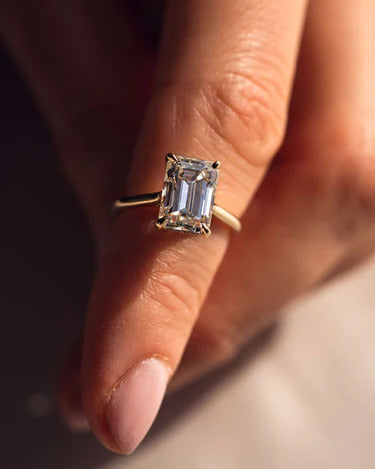
- Step cuts — emerald, Asscher, baguette. A large open table with few facets is a window rather than a mirror, so there is nothing to break up the view. Go one grade higher and read the plot.
- Larger stones. Above about 2 ct everything is amplified, including what is inside.
- Anything at SI1 or SI2, where position is the difference between eye-clean and not.
- Bezel settings, which cover the girdle completely — so edge inclusions matter even less than usual.
Where it matters least: melee. Stones under about 0.20 ct are never individually certified in any material, so there is no plot to read — ask for the parcel specification instead.
One structural check worth making
Nearly all inclusions are cosmetic rather than structural. The exception worth a question is a large feather reaching the surface, particularly near a girdle or a point, since that is where impact stress concentrates.
It is uncommon and it is not a reason to avoid feathers generally — small internal ones are ordinary. But if the plot shows a substantial feather at an edge, ask the seller directly whether it breaks the surface, and prefer a protective setting if it does.
Keep reading
Frequently asked questions
What is the plot diagram on a diamond report?
A map of the stone from above and below, with internal inclusions marked in red and surface features in green. It shows where the inclusions are, which is the one thing the clarity grade does not encode — and position decides whether you ever see them.
Can an SI1 diamond look better than a VS2?
Routinely, if its inclusions sit near the girdle where a prong covers them and the VS2’s sits under the table. The table is the clearest line of sight through the stone, so a clean centre matters more than the grade — and the SI1 costs less.
Are feathers in a diamond a problem?
Small internal ones are ordinary and cosmetic. The exception worth a question is a large feather reaching the surface near a girdle or point, where impact stress concentrates — ask the seller directly whether it breaks the surface, and prefer a protective setting if it does.
Can a setting be oriented to hide an inclusion?
Yes — ask the workshop to orient the head so a prong covers a girdle inclusion. It is an ordinary request that costs nothing and almost nobody makes it. A bezel covers the girdle completely, which makes edge inclusions matter even less.
Send us the report and ask us to read the plot.
Including for a stone you are considering elsewhere. It takes two minutes and it is the check most buyers never make.
Leave a comment