Lab Grown Diamonds
Diamond Colour Grades: What D, F and H Actually Look Like
The scale measures something real. It just measures it under conditions you will never wear a ring in.
Written by the Mapple Gems workshop, Surat · Updated 9 September 2026
Short answer
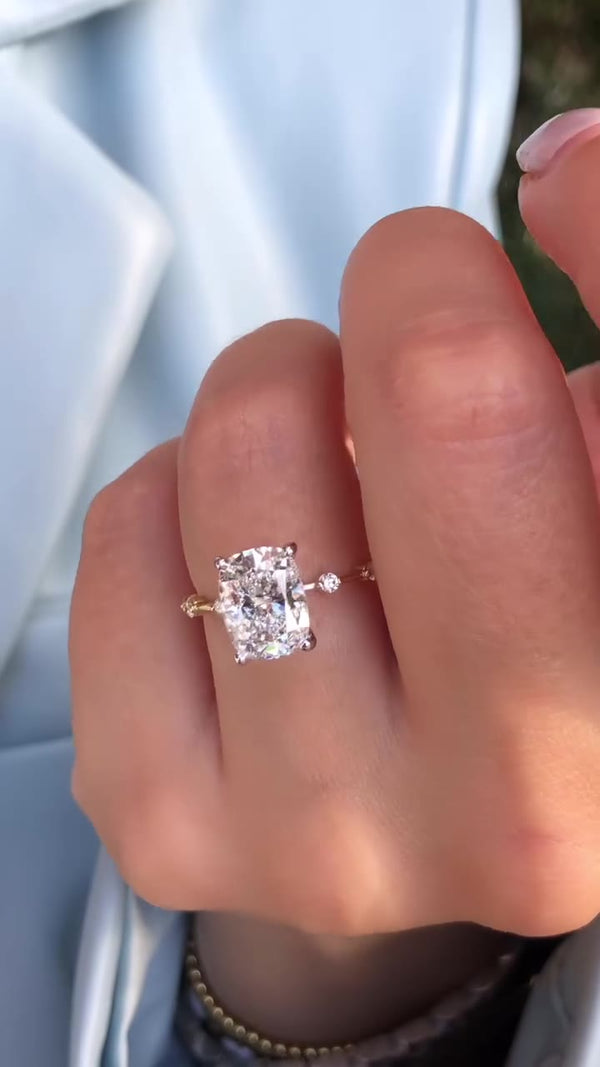
Colour is graded face-down against white, under controlled light, next to master stones — none of which describes a ring on a hand. Face-up in a setting, D through H all read as white, and I–J only begin to show warmth in white metal at larger sizes. So the useful rule is: match the grade to the metal and the size, not to the top of the scale. In yellow gold, G–H is genuinely indistinguishable from D at ordinary sizes.
The colour scale is one of the more misunderstood parts of buying a stone, because the grade is accurate and the conclusion people draw from it usually is not.
How the grading is actually done
A grader places the stone face-down in a white tray, under standardised lighting, beside a set of master stones of known colour. Face-down, because the pavilion shows body colour most clearly. Against white, because a neutral background gives the eye a reference.
Every part of that is designed to make small differences visible. It is a laboratory comparison, and it works — a D and an H are clearly different in those conditions.
Then the stone is set face-up in metal, worn on a hand, and seen in mixed light against skin. Almost none of the conditions that revealed the difference still apply.
What each range means in practice
| Grade | Category | Face-up, in a setting |
|---|---|---|
| D–F | Colourless | White. Indistinguishable from each other without master stones. |
| G–H | Near colourless | Still reads white in any metal at ordinary sizes. |
| I–J | Near colourless | Faint warmth in white metal; invisible in yellow or rose. |
| K and below | Faint tint | Visibly warm. Some people like it in yellow gold. |
The metal is doing more work than the grade is. Your eye judges a stone against whatever sits immediately beside it. In white gold or platinum, the metal is neutral, so it gives the eye a reference and any warmth in the stone becomes findable — which is why colour matters there. In yellow or rose gold the metal is warmer than the stone, so the stone reads white by comparison regardless of whether it is a D or an H. This is not a trick or a compromise; it is how contrast works. Paying up the colour scale for a warm-metal setting is money spent on something nobody will ever see, including you — and the saving between G and D at 1 ct is enough to fund a substantially better-built ring.
Size changes the answer
Body colour depends on how much material light passes through, so the same grade shows more in a bigger stone. This is the one factor that genuinely moves the recommendation.
- Under 1 ct: H–I in warm metal, G in white metal. There is simply not enough depth for tint to accumulate.
- 1–2 ct: G–H in warm metal, F–G in white metal.
- Above 3 ct: G–H still fine in warm metal, but consider E–F in white metal — here the difference becomes findable.
- Step cuts at any size: go one grade higher than you would for a brilliant. Large open facets show body colour with no scatter to disguise it.
The GIA change, and what it means now
From October 2025, GIA moved away from letter grades for laboratory-grown diamonds, describing them instead as Premium or Standard. The stated reasoning was that lab grown production clusters in a narrow band near the top of both colour and clarity scales, so fine gradations were separating stones that were, in practice, alike.
IGI and GCAL continue to issue full 4C reports with letter grades, which is why an IGI report currently gives you more granular information on a lab grown stone.
The practical implication is worth stating: if most lab grown production is already high colour, then paying a premium for the very top of the scale buys less differentiation than it would in mined stones. Cut is where the meaningful variation now lives.
Where the colour saving should go
- Cut grade. Excellent or Ideal on rounds — the only C that changes appearance in ordinary light.
- Shank thickness. 1.8 mm and up, which decides whether the ring survives decades.
- A white head on a coloured band, which keeps the stone neutral while letting the grade drop.
- Millimetres, if size matters to you — buying just under a round weight for the same visible size.
- Setting quality, which is what people actually register as expensive.
How to check for yourself
Ask for video of the stone already set, in the intended metal, under ordinary indoor light — not loose on white, and not in a lightbox. A lightbox flatters every stone equally and a white background is precisely the grading condition that exaggerates the difference.
If a seller will only show a stone against white, that is worth noticing. The question you are answering is not what the stone looks like in a laboratory; it is what it will look like on a hand.
Keep reading
Frequently asked questions
Can you see the difference between a D and a G diamond?
Not face-up in a setting at ordinary sizes. Colour is graded face-down against white under controlled light beside master stones — conditions designed to make small differences visible. Worn on a hand in mixed light, D through H all read as white.
What colour grade should I buy for yellow gold?
G–H is genuinely indistinguishable from D at ordinary sizes, and H–I is fine under 1 ct. Warm metal is warmer than the stone, so the stone reads white by comparison regardless of grade. Paying up the scale for a warm-metal setting buys something nobody will see.
Does stone size change which colour grade I need?
Yes — body colour depends on how much material light travels through, so tint accumulates with depth. Under 1 ct, H–I in warm metal is ample. Above 3 ct in white metal, consider E–F. Step cuts need one grade higher than brilliants at any size, since large open facets show colour with no scatter to disguise it.
Why did GIA stop giving lab grown diamonds letter grades?
From October 2025 GIA describes lab grown stones as Premium or Standard instead, on the reasoning that production clusters near the top of both colour and clarity scales, so fine gradations were separating stones that are in practice alike. IGI and GCAL still issue full 4C reports with letter grades.
Ask to see it set, in ordinary light.
Not loose on white — that is the grading condition, and it is the one place the difference shows.


Leave a comment