Lab Grown Diamonds
Lab Grown and Mined Diamonds: The Honest Comparison
Same material, same grading, same tests — and one difference that is real and worth understanding before you buy either.
Written by the Mapple Gems workshop, Surat · Updated 25 September 2026
Short answer
Both are diamond — identical carbon structure, identical hardness at Mohs 10, identical optical behaviour, graded by the same laboratories on the same scales, and both test positive on a standard diamond tester. The differences are origin, price, and resale: lab grown prices have fallen substantially as production has grown, which is excellent when buying and poor when selling. Choose lab grown for size and specification at a given budget; choose mined if origin or resale matters to you.
This is the question underneath most diamond buying now, and it deserves a straight answer rather than a pitch in either direction. We sell lab grown, which is a reason to be careful about what we claim.
What is genuinely the same
| Property | Lab grown vs mined |
|---|---|
| Composition | Identical — crystalline carbon |
| Hardness | Mohs 10 both |
| Refractive index / dispersion | 2.42 / 0.044 both |
| Diamond tester | Both read as diamond |
| Grading | Same laboratories, same 4Cs |
| Cleavage planes | Both have them — both can chip |
The fourth row surprises people. A standard diamond tester measures thermal conductivity, which is a property of the material rather than its origin — so it cannot distinguish the two. Identifying a lab grown stone requires specialist laboratory equipment, which is exactly why reputable labs inscribe them.
The one difference that will actually affect you is not optical — it is that lab grown prices have been falling, and that cuts both ways. Production capacity has grown enormously, and unlike mined supply it is not constrained by geology, so prices at retail have dropped substantially over recent years and may continue to. Buying, this is excellent: the same budget buys a noticeably larger, better-specified stone than it did, and considerably more than mined. Selling, it is poor: a stone bought several years ago may be worth markedly less than it cost, because the equivalent new stone now costs less. Mined diamonds also resell for far below retail — the retail markup does not transfer either way — but the direction of travel is different. So the honest framing is: treat a lab grown diamond as something you buy to own and wear, not as a store of value. That is true of nearly all jewellery, but it is more emphatically true here, and any seller implying otherwise is selling you something that is not in the box.
How they are made, briefly
HPHT reproduces the pressure and temperature conditions of natural formation, using a metal flux; stones grown this way sometimes contain tiny metallic inclusions and can occasionally show a magnetic response.
CVD grows the crystal from carbon-rich gas at lower pressure, layer by layer; inclusions here tend to be graphitic rather than metallic.
For a finished, graded stone this matters less than it sounds. A stone is graded on what it is, not how it was made — so the growth method is a fact about the stone rather than a quality tier, and it should not by itself drive the decision.
What changed in grading
Worth knowing because it affects how you compare reports. GIA moved to Premium and Standard descriptors for lab grown stones on 1 October 2025, while IGI and GCAL continue to issue full 4Cs.
The practical consequence: a GIA lab grown report and an IGI one cannot be lined up cell by cell, and a stone with a GIA report will not show the same detail. Neither is better; they are different documents. If you want the full grading detail on a lab grown stone, that currently means IGI or GCAL.
Where each one makes sense
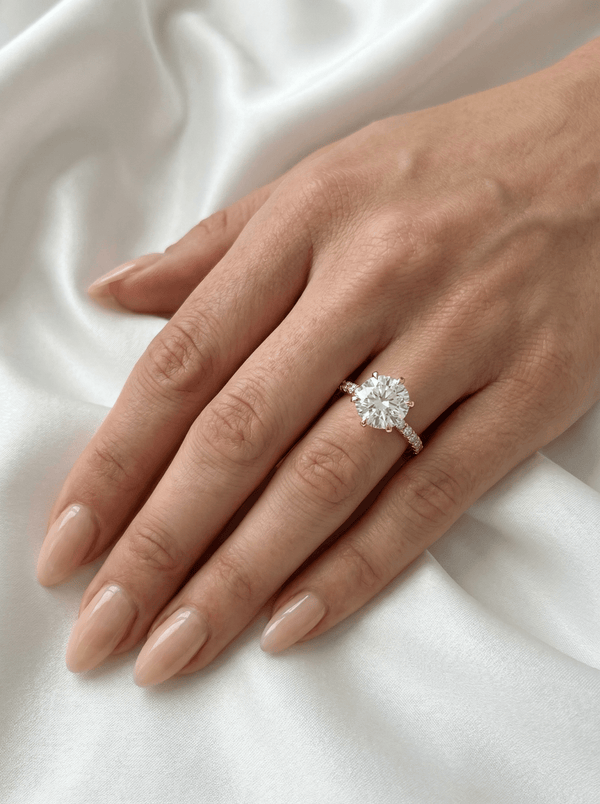
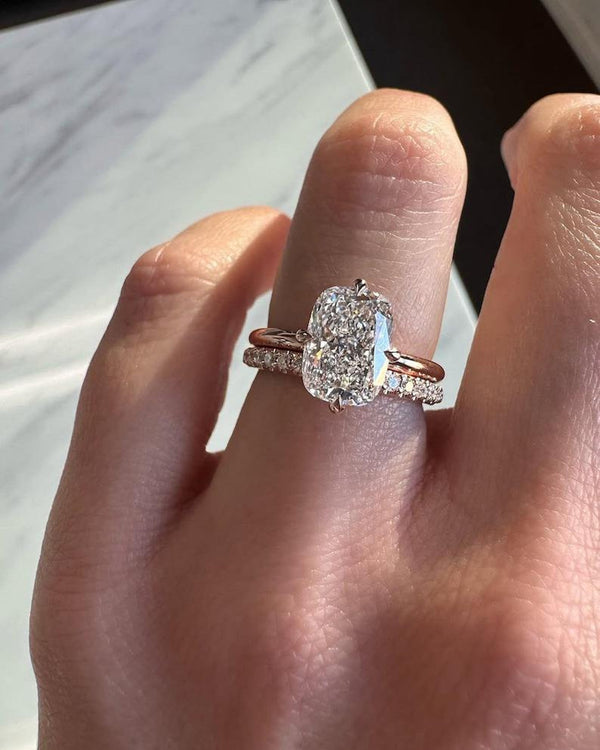
Lab grown suits you if visible size or specification at a given budget is the priority, or if you would rather put the difference into construction — a thicker shank, a platinum head, a better setting — than into the stone. It is also the straightforward choice if you find the price of the mined equivalent hard to justify for what is, materially, the same thing.
Mined suits you if origin genuinely matters to you — and that is a legitimate reason that needs no defending — or if resale value forms part of how you think about the purchase, or if the piece is meant to sit alongside inherited stones of known provenance.
What should not decide it: claims that one sparkles more, one is harder, or one is “real”. Those are marketing positions rather than physical differences.
If you choose lab grown, spend it here
- Cut, always. Production clusters at high colour and clarity, so cut is the only C genuinely separating stones. Excellent or Ideal, with polish and symmetry both Excellent or Very Good.
- Just under a round weight. 0.90 ct measures 6.2 mm against 6.5 mm at 1.00 — the round numbers are price thresholds, not size ones.
- Eye-clean, not high clarity. Below a carat, SI1 is usually invisible — and the plot diagram matters more than the grade, since position beats grade.
- Colour matched to the metal. G–H reads white in warm gold. Paying for D in yellow gold is paying for something the setting removes.
- The construction. A 1.8–2 mm shank and a properly built head outlast any grade decision you make.
And one honest boundary
Below roughly 0.30 ct per stone, the case for lab grown diamond thins considerably. Melee under about 0.20 ct is never individually certified in any material, so the documentation advantage disappears — and at three or four millimetres, a well-cut moissanite is not something anyone distinguishes in wear.
So for pavé, small studs, tennis bracelets and eternity rows, moissanite is the more efficient purchase. We make both and would rather say that than sell you the dearer one for no visible gain.
Keep reading
Frequently asked questions
Are lab grown diamonds real diamonds?
Yes — identical crystalline carbon, identical hardness at Mohs 10, identical refractive index and dispersion, graded by the same laboratories on the same scales. A standard diamond tester measures thermal conductivity and reads both as diamond; distinguishing them requires specialist laboratory equipment.
Do lab grown diamonds hold their value?
Poorly. Production is not constrained by geology, so prices have fallen substantially and may continue to — excellent when buying, poor when selling. Mined diamonds also resell far below retail, but the direction differs. Treat any diamond as something to own and wear rather than as a store of value.
Does CVD or HPHT make a better stone?
Neither by itself. HPHT can leave tiny metallic inclusions and CVD graphitic ones, but a finished stone is graded on what it is rather than how it was made — so growth method is a fact about the stone, not a quality tier, and should not drive the decision.
Can I compare a GIA and an IGI lab grown report?
Not cell by cell. GIA moved to Premium and Standard descriptors for lab grown on 1 October 2025, while IGI and GCAL still issue full 4Cs — so the documents carry different levels of detail. For full grading detail on a lab grown stone, that currently means IGI or GCAL.
Buy it to wear, and put the difference into the ring.
A thicker shank and a properly built head outlast any grade decision — and they are what still matters in thirty years.

Leave a comment