Lab Grown Diamonds
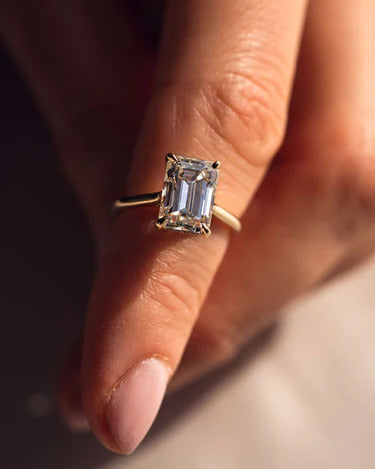
Step Cuts: Emerald and Asscher, and What They Demand
A step cut is a window rather than a mirror — which is why the grades that hardly matter elsewhere matter here.
Written by the Mapple Gems workshop, Surat · Updated 23 September 2026
Short answer
Step cuts — emerald, Asscher, baguette — use long parallel facets that return light in broad flashes instead of scattering it. That makes them elegant and calm, and it also means they hide nothing: go one grade higher on both clarity and colour than you would for a brilliant, VS2 and G rather than SI1 and H. They also face up smaller per carat, receive no cut grade from any laboratory, and have corners that each need a prong.
Step cuts are having a long moment, and they reward a slightly different set of decisions from the brilliant cuts most buying advice is written about.
A brilliant cut is designed to scatter light; a step cut is designed to let you look through the stone — and that single difference drives every buying decision here. A round brilliant has 57 small facets angled to bounce light in all directions, which is why it sparkles and, incidentally, why it disguises inclusions and tint so effectively: the visual noise hides everything. A step cut has a small number of long, flat, parallel facets and a large open table. There is no noise. You are looking into a clear window, and anything inside the stone or any warmth in its body colour is plainly visible. That is why the same SI1 that is invisible in a round can be obvious in an emerald cut, and why an H that reads white in a brilliant can look faintly warm in an Asscher. The rule is simple: one grade higher on both, and check the plot diagram rather than trusting the grade — because in a step cut, an inclusion under the table has nowhere to hide.
The two shapes compared
| Emerald | Asscher | |
|---|---|---|
| Outline | Rectangular, elongated | Square |
| Ratio to aim for | 1.35 – 1.50 | 1.00 – 1.05 |
| At 1 ct | ~7.0 × 5.0 mm | ~5.5 × 5.5 mm |
| Effect on the finger | Lengthens | Neutral, compact |
| Character | Long broad flashes | Concentric “hall of mirrors” |
| Corners | Four, cropped | Four, more steeply cropped |
Note the size row against a round brilliant, which measures 6.5 mm at the same weight. An Asscher at 5.5 mm faces up distinctly smaller — step cuts carry more of their weight in depth. If visible size matters, an elongated emerald is the efficient step cut.
No cut grade exists
Only round brilliants receive a formal cut grade, so on any step cut you are the cut grader. Four things to look for in rotating video:
- Even, parallel facet lines. The steps should be regular and the lines straight. Wavering lines are poor cutting and there is nowhere to hide it.
- Symmetrical corners. All four cropped to the same depth — easy to check and frequently wrong.
- No large dead area in the centre as the stone turns. Some depth of shadow is part of the look; a permanently flat, lifeless middle is not.
- A defined pavilion. Too shallow and the stone reads glassy; the flashes should have depth to them.
Setting a shape with corners
The construction requirement people miss. Every corner needs metal over it. A step cut’s corners are cropped precisely because they are the vulnerable points — and all diamonds, lab grown included, have cleavage planes and can chip on impact.
So: four prongs minimum, one on each corner, not on the flat sides. A bezel or half-bezel is the most protective option and suits the geometry beautifully. Avoid any design that leaves a corner exposed for aesthetic reasons.
Two more: step cuts sit lower than brilliants of the same weight, which is a genuine advantage for daily wear — and an emerald cut extends along the finger, so a straight band frequently will not sit flush. Order the wedding band with the ring.
Where the money is well spent
- Clarity, up one grade — VS2 rather than SI1. The single most important change for a step cut.
- Colour, up one grade — G rather than H, unless the setting is warm gold, which masks a good deal.
- The plot diagram — free to check, and position beats grade. An inclusion at the corner under a prong is invisible; the same one under the table is not.
- Polish and symmetry, both Excellent or Very Good — two separate grades, and listings quote the better one.
- Rotating video, always, since no cut grade exists to fall back on.
Where to save: just under a round carat weight, exactly as with any shape. The price steps sit at the round numbers while the millimetres rise smoothly.
If the stone is moissanite instead
Worth stating, because it reverses one of the arguments above. Step cuts show the least dispersion of any shape, so in moissanite they are the natural choice for anyone who wants presence without rainbow — an emerald cut at a 1.40–1.50 ratio gives length and calm at once.
The clarity-and-colour rule does not transfer, because no laboratory grades moissanite on those scales at all. What transfers is the cutting requirement: even parallel facet lines and symmetrical corners matter more in a step cut than in any brilliant, in any material, because there is nothing to distract the eye from a mistake.
Keep reading
Frequently asked questions
Do emerald cut diamonds need higher clarity?
Yes — one grade higher than for a brilliant, so VS2 rather than SI1, and G rather than H on colour. A step cut has few long parallel facets and a large open table, so there is no visual noise to disguise inclusions or body colour the way a brilliant’s 57 scattering facets do.
Do step cuts look smaller than round diamonds?
Yes, at the same weight. An Asscher measures about 5.5 mm at 1 ct against a round’s 6.5 mm, because step cuts carry more weight in depth. An elongated emerald at roughly 7.0 × 5.0 mm is the more efficient step cut if visible size matters.
How do I judge a step cut with no cut grade?
Rotating video: look for even, straight, parallel facet lines, four corners cropped symmetrically, no permanently flat dead area in the centre, and a defined pavilion rather than a glassy shallow one. Only round brilliants receive a formal cut grade from any laboratory.
How should an emerald or Asscher cut be set?
With a prong on each of the four corners, not on the flat sides — corners are the vulnerable points, and all diamonds have cleavage planes and can chip on impact. A bezel or half-bezel is the most protective option and suits the geometry. An emerald cut usually needs a contour wedding band.
One grade higher, and a prong on every corner.
Those two decisions are most of what separates a step cut that works from one that disappoints.
Leave a comment