Lab Grown Diamonds
Buying a Large Lab Grown Diamond: What Changes Above 3 Carats
Everything that was invisible at 1 carat becomes visible. Different rules apply.
Written by the Mapple Gems workshop, Surat · Updated 3 September 2026
Short answer
Above about 3 ct, four things change. Clarity matters more, because a bigger stone gives an inclusion more room to be seen. Colour matters more, because tint accumulates through depth. Cut faults become obvious — a bow-tie or dark zone that hid at 1 ct is plain at 3. And the setting has to be built for the weight: heavier stones need more prong metal, a stronger gallery and a thicker shank. Most large-stone disappointments are setting failures, not stone failures.
Falling lab grown prices have made stones that were once out of reach entirely ordinary. That is genuinely good, and it comes with a set of consequences that the advice written for 1 ct stones does not cover.
1. Clarity: the same grade is not the same experience
A clarity grade describes what a grader sees under 10× magnification. It does not scale with stone size — but visibility does.
An SI1 inclusion in a 1 ct stone sits in a small area with constant flashing over it. The same grade in a 3 ct stone occupies a proportionally larger, calmer window, and the eye finds it far more easily.
Practical adjustment: at 1 ct, VS2 to SI1 is comfortably eye-clean in most brilliant cuts. Above 3 ct, move up to VS1 or VS2, and ask specifically where the inclusion sits — position matters more than grade at any size, and much more at this one.
2. Colour: tint accumulates with depth
Body colour is a function of how much material light passes through. Double the size and you roughly double the path, so warmth that was invisible becomes perceptible — particularly viewed from the side rather than face-up.
| Setting metal | Under 2 ct | Above 3 ct |
|---|---|---|
| Yellow or rose gold | G–H is ample | G–H still fine — metal masks it |
| White gold or platinum | G is fine | Consider E–F — white metal reveals tint |
| White head, coloured band | G–H | F–G — the best compromise |
Note that this is one of the few places where paying up genuinely buys something visible. At 1 ct in yellow gold it does not.
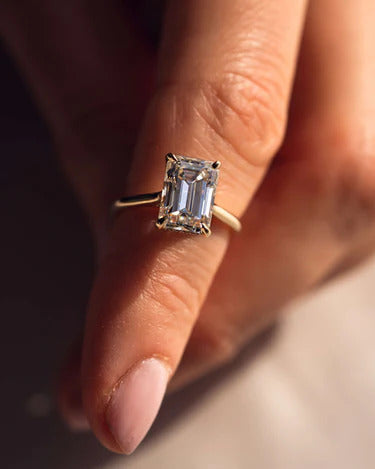
3. The setting is where large stones actually fail. A 3 ct stone is not three times a 1 ct stone in the ways that matter to a setting — it is heavier, it sits higher, and it has far more leverage when it strikes something. Prongs sized for a 1 ct centre will wear through faster under a 3 ct one, a standard gallery flexes, and a 1.6 mm shank will not hold its shape. What we build differently above 3 ct: six prongs rather than four, thicker prong stock, a platinum head even on a gold band, a reinforced gallery, and a shank of at least 2 mm. Ask any seller what they change for a large stone. If the answer is nothing, the setting is the weak point.
4. Cut faults stop hiding
Everything a small stone forgives, a large one displays.
- Bow-tie in ovals, pears and marquises — proportionally larger and harder to ignore.
- Light leakage — a dark zone occupies more of the face and stays visible across a room.
- Asymmetry — uneven shoulders on an oval or pear are obvious at this size and make a correctly set ring look crooked.
- Thick girdle — hides weight you paid for, and on a large stone that is a lot of money in a band of material you cannot see.
For rounds, take Excellent or Ideal cut and check polish and symmetry too. For every fancy shape there is no cut grade at all, so video is the only assessment — and at this size and price it is worth insisting on video of the specific stone rather than the design.
The wearability question
Worth raising because it is the most common regret with a large stone, and it is not about the stone at all.
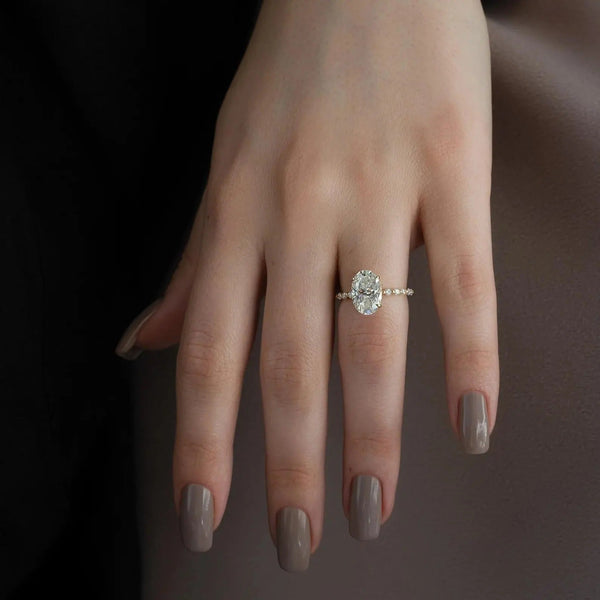
A 3 ct centre sits high, is wide across the finger, and catches on gloves, pockets, knitwear and hair. It rolls if the fit is anything but snug. It cannot be worn under most gloves at all.
None of that is a reason not to buy one — but it is a reason to ask for the profile height in millimetres before casting, and to consider a lower setting than the design as drawn. Many large-stone rings become occasion pieces by accident. Deciding that deliberately is better.
On resale, briefly
The same as at any size, and worth restating because larger sums are involved: lab grown diamonds have very little resale value, prices fell steeply between 2020 and 2024, and a stone bought today competes with cheaper new production tomorrow.
Insure at replacement cost, revalue every few years — replacement cost may have fallen, which can reduce your premium — and buy the stone to wear rather than to hold.
The checklist for a large stone
- Cut first — Excellent or Ideal on rounds, video for everything else.
- VS1–VS2 clarity, plus the plot diagram showing where inclusions sit.
- Colour matched to the setting metal, one step higher than you would at 1 ct in white metal.
- Ask what the seller changes structurally for a large stone.
- Profile height in millimetres, decided before casting.
- An IGI or GCAL report with full 4C detail, and the girdle inscription checked against it.
Keep reading
Frequently asked questions
What clarity should I buy for a 3 carat lab grown diamond?
VS1 to VS2, a step above what you would need at 1 ct. A clarity grade describes what a grader sees under magnification and does not scale with size, but visibility does — the same inclusion occupies a proportionally larger, calmer window in a bigger stone. Ask for the plot diagram showing where it sits.
Does colour matter more in a large diamond?
Yes. Body colour depends on how much material light travels through, so tint accumulates with depth and becomes perceptible at larger sizes, especially from the side. In white gold or platinum consider E–F above 3 ct; in yellow or rose gold G–H remains fine because the metal masks it.
Does a large stone need a different setting?
It should have one. A heavier stone sits higher and has far more leverage on impact, so prongs sized for a 1 ct centre wear through faster, a standard gallery flexes and a thin shank loses shape. Six prongs, thicker prong stock, a platinum head, a reinforced gallery and a shank of at least 2 mm are the usual changes. Ask what a seller alters for large stones.
Is a 3 carat ring practical for everyday wear?
It is a genuine consideration rather than a given. A large centre sits high, spans the finger, catches on gloves, pockets and knitwear, and rolls unless the fit is snug. Ask for the profile height in millimetres before casting and consider a lower setting than drawn — many large-stone rings become occasion pieces by accident.
Ask what we change for a big stone.
Six prongs, thicker stock, a platinum head and a 2 mm shank — and we will quote the profile height before casting.
Leave a comment