Fine Jewelry
Yellow, White and Rose Gold: What Actually Differs
Same gold content, different alloys — and the differences are practical, not just visual.
Written by the Mapple Gems workshop, Surat · Updated 2 September 2026
Short answer
At the same karat, all three contain identical gold — 14K is 58.3% gold whatever the colour. What differs is the remaining alloy. Yellow uses silver and copper; rose uses more copper, which is why it is warmer and also why it marks skin most; white uses pale metals and is usually rhodium plated, which wears off every year or two and needs redoing. That plating cycle is the only genuine ongoing commitment among the three.
Gold colour is normally discussed as pure preference, and mostly it is. But there are three practical consequences that people discover afterwards, and all three are worth knowing before choosing.
The composition
Pure gold is a single colour and too soft to wear. Everything you buy is an alloy, and the colour comes entirely from what is mixed in.
| Colour | Alloy contains | Practical consequence |
|---|---|---|
| Yellow | Silver + copper, balanced | No plating, no upkeep. The low-maintenance choice. |
| Rose | Higher proportion of copper | Slightly harder; most likely to mark skin; shade varies by maker |
| White | Palladium, nickel, silver, zinc | Usually rhodium plated; replate every 1–2 years |
Note what is not different: the gold content. A 14K rose ring and a 14K white ring contain the same 58.3% gold, and the same intrinsic metal value at the same weight.
White gold is not naturally white, and this is the thing people are not told. The alloy underneath is a pale straw or greyish yellow, and the bright white you see is a thin rhodium plating on top. It wears — typically visible first on the underside of a shank where contact is constant — and then the warmer alloy shows through. That is not a fault or a sign of a cheap ring; it is how essentially all white gold works, everywhere. Budget a replate every one to two years, or choose platinum, which is white all the way through and never needs it.
Which colour suits which stone
This one genuinely matters, especially for moissanite and near-colourless diamonds.
- White metal reveals stone colour. Against white gold or platinum, your eye has a neutral reference, so any warmth in the stone shows. If you want white metal at a large size, spend on the higher colour band.
- Yellow and rose gold mask it. A near-colourless stone in a warm setting reads white, because the metal is warmer than the stone. This is a genuine saving — the colour grade you need drops.
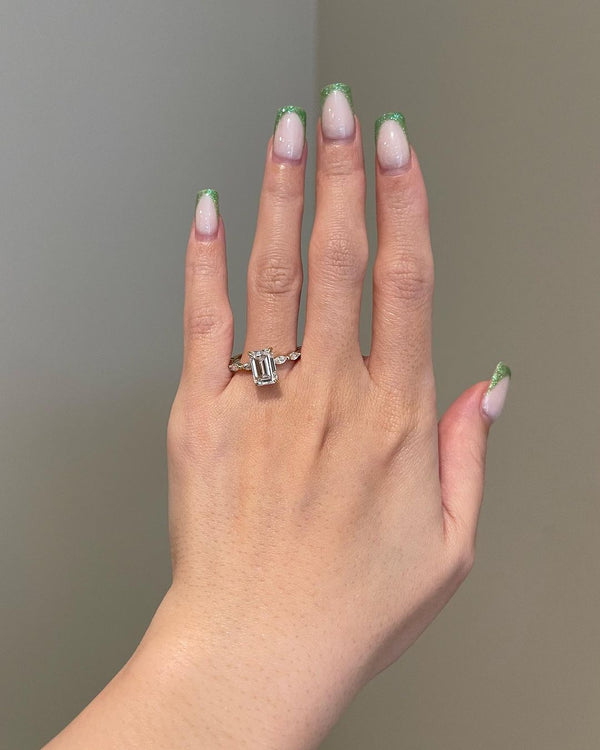
- The best of both: a white head on a coloured band. The stone sits in white metal and stays neutral, while the shank is whatever colour you want. Above about 7 mm we build this as standard, and most people do not know to ask for it.
Durability, briefly
The differences here are small but real. Rose gold’s higher copper content makes it marginally the hardest of the three at a given karat. Yellow and white are broadly comparable, though white gold alloyed with palladium behaves slightly differently from nickel-based versions.
Far more important than colour is karat: 14K is meaningfully harder than 18K in every colour, because more alloy means a harder metal. For a ring worn daily, that comparison matters much more than yellow versus white.
Mixing colours
Mixed metals work, and the rule is that the contrast should be obvious rather than marginal.
Yellow beside white reads as a deliberate choice. Two slightly different yellows — a 14K next to an 18K, or two makers’ rose alloys — read as a mistake, because the eye interprets a small difference as an error and a large one as design.
So if you are stacking or adding a band later: either contrast clearly, or match the karat as well as the colour. “Yellow gold” is not a specification; 585 or 750 is.
The rose gold caveats
Two worth naming, because rose is the colour with the most variability.
Shade varies by workshop. There is no standard rose recipe, so one maker’s 14K rose can be noticeably pinker or more coppery than another’s. If you are matching to an existing rose piece, send a photograph in daylight and ask directly whether they can match it.
It is the most likely to mark skin. The copper that makes it rose is the same copper that reacts with sweat to leave a green or grey mark. Harmless, washes off, but more common here than in yellow or white.
Choosing, practically
- Look at what they already wear. Colour preference is usually strong and long-standing, and a photograph settles it.
- If you want zero upkeep, choose yellow or rose, or platinum if the budget allows.
- If you want white, accept the replate cycle — or ask whether the piece can be supplied unplated, which some people prefer once they have seen it.
- Match the stone colour grade to the metal, not to the top of the scale.
- Ask about a white head on a coloured band if the stone is large.
Keep reading
Frequently asked questions
Is white gold really white?
No. The alloy underneath is a pale straw or greyish yellow, and the bright white finish is a thin rhodium plating applied on top. It wears — usually visible first on the underside of the shank — and needs redoing every one to two years. That is how essentially all white gold works, not a sign of a cheap ring. Platinum is white all the way through.
Does gold colour affect how much gold is in the ring?
No. At the same karat, yellow, white and rose contain identical gold — 14K is 58.3% gold in every colour, with the same intrinsic metal value at the same weight. Only the remaining alloy differs, and that is what produces the colour.
Which gold colour is best for a near-colourless stone?
Yellow or rose, because the warm metal masks any tint and the stone reads white against it — which means you can buy a lower colour grade. White metal gives the eye a neutral reference and reveals warmth. If you want a warm band with a neutral stone, ask for a white head on a coloured shank.
Why does rose gold vary between jewellers?
There is no standard rose alloy recipe, so the copper proportion and therefore the shade differ between workshops — one maker’s 14K rose can be noticeably pinker or more coppery than another’s. If matching an existing piece, send a daylight photograph and ask directly whether they can match it.
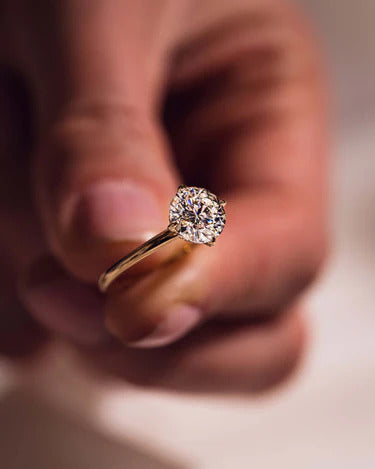
Ask for a white head on a coloured band.
Warm shank, neutral stone. Above 7 mm we build it this way as standard — most people never know to ask.
Leave a comment