Engagement Rings
Three Stone Settings Explained: Who They Actually Suit
More width than a solitaire, more presence than a halo, and one specific problem to plan around.
Written by the Mapple Gems workshop, Surat · Updated 21 August 2026
Short answer
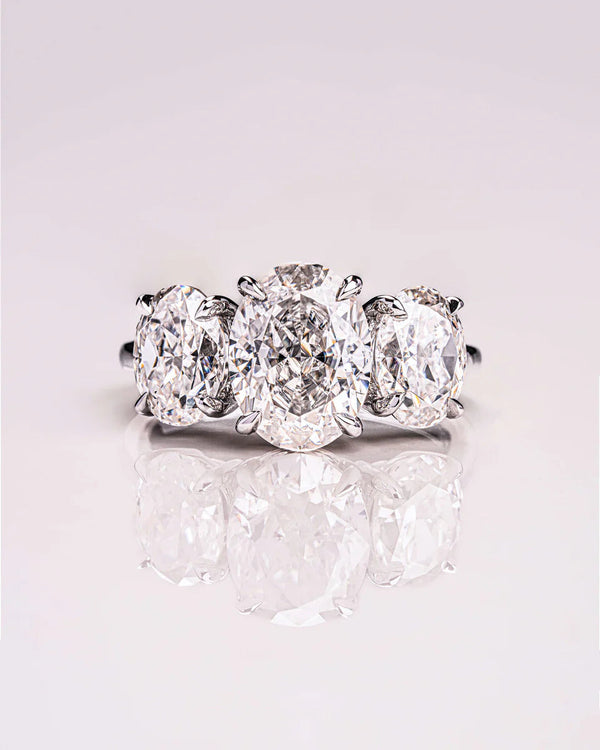
A three stone ring sets a centre stone between two side stones, typically each about a third to a half the centre’s width. It gives more presence across the finger than a solitaire of the same centre size, and unlike a halo it uses few enough stones that maintenance stays simple. It suits long fingers and people who want visual width without a halo. The problem to plan around: side stones sit low and wide, which is exactly where a wedding band wants to be.
Three stone is the oldest alternative to a solitaire and the one that has aged best. It predates the halo by a long way, and unlike most ring trends it has never really left. There is a reason for that, and there is also a reason a lot of people who buy one end up with a gap beside their wedding band.
What it does that a solitaire does not
A solitaire is a point of light. A three stone is a line of it. That changes what the ring does on a hand: it occupies width rather than height, so it reads as substantial without standing tall.
For the same centre stone, a three stone ring covers noticeably more of the finger than a solitaire. For the same total budget, it gives you more apparent spread than putting everything into one stone — because two side stones of, say, 4 mm each cost far less than the difference between a 6.5 mm and an 8 mm centre.
| Three stone | Halo | Solitaire | |
|---|---|---|---|
| Stone count | 3 | 20–40 | 1 |
| Adds width | Yes, considerably | Yes, in a circle | No |
| Long-term maintenance | Low | Highest — small stones loosen | Lowest |
| Wedding band fit | Often needs a contour | Often needs a contour | Usually straightforward |
| Ages well | Very | Dates more visibly | Very |
Getting the proportions right
This is where three stone rings succeed or fail, and it is almost entirely a numbers question.
Side stones that are too small look like an afterthought and make the centre look isolated. Side stones that are too large compete with it, and the eye stops knowing where to land. The range that works is roughly one third to one half of the centre stone’s width.
So for a 7 mm centre, side stones between about 2.5 mm and 3.5 mm. Below that they read as accents rather than as part of a trio; above it the ring starts to look like three separate rings pushed together.
The wedding band problem, stated plainly. Side stones sit low and extend outward along the finger — precisely the space a straight band needs. Almost every three stone ring will show a visible gap beside a straight band, and fitting a contoured band to a finished ring is bench work you pay for twice: once in labour, once in the wait. Decide the band at the same time as the ring. If you order both together, we cut the band to the actual profile while the ring is still unfinished, and the gap never exists. This is the single most common regret we hear about three stone rings, and it is entirely preventable.
Which side stone shapes work
- Tapered baguettes — the classic. Long, clean, step-cut, and they lead the eye inward to the centre. They sit lower than most alternatives, which helps the band problem slightly.
- Trillions — triangular, more sparkle than baguettes, more presence. They have points, so they need proper prong coverage at the tips.
- Round sides — the safest choice and the most forgiving. Nothing to chip, easy to replace if one is ever lost.
- Pears, points inward — softer than trillions and very effective with an oval or pear centre.
- Matching the centre shape — three ovals or three emeralds. Striking, more expensive, and it needs the size ratio to be right or it looks like an eternity band fragment.
Who it suits, and who it does not
It suits longer fingers, which carry the extra width comfortably. It suits people who want a ring that reads as significant without a halo’s upkeep. And it suits anyone who likes that the three stones are commonly read as past, present and future — a meaning attached to the style rather than inherent to it, but one plenty of people genuinely choose it for.
It suits less well short fingers, where the horizontal spread visually shortens them further — an elongated centre in a solitaire usually does more. And it suits hands-on work poorly, because side stones sit at the widest, most exposed part of the ring and take the knocks.
Before you approve one
- All three stones in millimetres, not just the total carat weight.
- The total width across all three, and how that sits on the finger size.
- The side elevation of the render, showing how low the side stones sit.
- Whether the side stones are the same material as the centre. Mixing moissanite sides with a lab grown centre is done, and should be disclosed.
- The wedding band decision, made now rather than later.
Keep reading
- Best settings for a round cut stone
- How to order a bridal set — the flush-fit problem in full
- Choosing carat size for your finger
Frequently asked questions
What size should the side stones be on a three stone ring?
Roughly one third to one half the width of the centre stone. For a 7 mm centre that means side stones of about 2.5–3.5 mm. Smaller and they read as accents rather than part of a trio; larger and they compete with the centre.
Do three stone rings fit a wedding band?
Often not without a contoured band. Side stones sit low and extend along the finger into the space a straight band needs, so a visible gap is common. The fix is to order the ring and band together so the band can be cut to the ring’s actual profile, rather than fitting one afterwards.
Is a three stone ring better value than a halo?
Over time, usually. A halo buys more apparent size for the money up front, but it uses twenty to forty small stones, and small stones in shared settings are what loosen over a decade. A three stone ring has three stones to maintain, ages less visibly, and adds width rather than a ring of sparkle around the centre.
What do the three stones represent?
They are commonly read as past, present and future. That meaning was attached to the style by marketing rather than being inherent to it, but it is widely understood and plenty of couples choose the setting for exactly that reason. Others simply prefer how it sits on the hand.
Order the band at the same time.
On a three stone ring it is not an upsell — it is the difference between a flush fit and a gap you pay to close later.
Leave a comment