Budget decisions
Halo, or a Bigger Centre Stone?
The same money, two entirely different rings — and one of them costs you attention for the next forty years.
Written by the Mapple Gems workshop, Surat · Updated 25 August 2026
Short answer
A halo adds roughly 2.5mm of apparent width for far less than the equivalent centre stone, so it is the cheaper route to size. It also brings 25–45 settings to maintain instead of four to six, usually rules out a straight wedding band, and multiplies fire — which matters most with a moissanite centre. A bigger centre stays simpler forever.
This is the decision almost every engagement ring budget arrives at, and it is usually settled by whichever photograph the buyer saw first. It deserves better, because the two options diverge over decades rather than at the point of purchase.
What a halo actually buys
A halo is a ring of small stones set around the centre. A row of roughly 1.3mm brilliants adds about 2.6mm to the width the eye reads — and apparent size is what people respond to, not carat weight.
Because melee is inexpensive, that width costs far less than buying the same face-up size in a single stone. A 1ct centre in a halo occupies roughly the visual footprint of a 1.75ct solitaire, at nothing like the price difference.
It also does one thing nothing else does: on an oval, marquise or pear, a full halo genuinely masks a bow-tie, because it puts bright material around the outline in the same view as the dark band. (A hidden halo does not — it sits below the girdle and contributes nothing at the face.)
What it costs, over time
| Halo, smaller centre | Solitaire, bigger centre | |
|---|---|---|
| Apparent size per pound spent | Higher | Lower |
| Settings to check every 2 years | 25–45 | 4–6 |
| Straight wedding band | Rarely fits | Often fits |
| Later stone upgrade | Needs a new halo drawn to the new outline | Straightforward |
| Adding a halo later | Already spent | Still available |
| Masks a bow-tie | Yes | No |
| Total fire | Multiplied | Centre only |
The maintenance row is the one people discover afterwards. Every setting point is somewhere a stone can loosen, and a bench check every two years is the whole answer either way — but a solitaire has four things to inspect and a halo has forty. Beads on a halo are frequently shared between neighbouring stones, so when one goes, several nearby are usually thin.
The fire question, which changes with an alternative
A halo does not just add small stones. It adds twenty-five to forty-five small brilliants, each dispersing light independently.
With a lab grown diamond centre — dispersion 0.044 — that reads as extra sparkle and is usually welcome. With a moissanite centre at 0.104, more than twice as strong, a full halo multiplies an effect that is already the loudest thing about the stone. At larger sizes the result can read more like a light show than a ring.
So the usual advice inverts. If your centre is a big moissanite and you want presence rather than rainbow, spend on the centre and skip the halo. If you want width without fire, the better tools are a wide bezel rim or step-cut side stones, both of which add footprint without adding dispersion.
From our bench in Surat
The halo is the most profitable build we make. Melee is inexpensive, the labour is priced in, and it photographs better than anything else in the catalogue. We would sell more of them if we said less about the maintenance, and we are aware of that.
What we actually see is a pattern in the repairs: halo rings arriving at year six or seven with two or three stones gone, from owners who were never told that forty settings is forty things to check. The halo is not a bad choice — it is a choice with a standing commitment attached. Buy it knowing that, and buy it with an open gallery, because a halo creates cavities that trap hand cream where no cloth reaches.
A third option people rarely consider
The framing above is a false binary, and there are cheaper levers for apparent size than either.
A tapered shank narrows slightly toward the head, which makes the centre read larger by contrast. It uses less metal, so it costs less rather than more — the only lever that improves apparent size, comfort and price at the same time.
An elongated shape. An oval at 1ct faces up around 7.7mm long against a round's 6.5mm, for the same weight and often less money per carat.
A weight just under a round carat figure. 0.90 rather than 1.00 is about 6.2mm against 6.5mm and sits below a pricing threshold.
A thin bezel rim, which extends the outline the eye reads while protecting the stone.
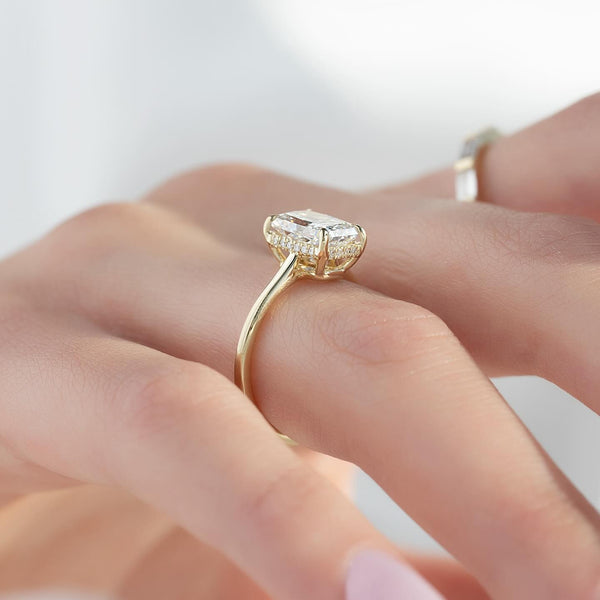
Stack those four and you can often reach halo-like apparent size with solitaire-like maintenance. Two false economies to avoid while doing it: a stone measuring larger than standard for its weight, which means it was cut shallow and will look flat, and a shank below 1.8mm.
Choosing
- Halo if maximum apparent size for the money is the goal, if the centre is an oval or marquise with a bow-tie to mask, and if a two-yearly bench check is realistic for you.
- Bigger centre if you want a straight wedding band, a simple upgrade path, low maintenance, or a moissanite centre without multiplied fire.
- Neither if the honest answer is that you want the ring to look larger — in which case taper the shank, choose an elongated shape and buy just under a round weight first, then see whether you still need the halo.
Keep reading
Frequently asked questions
Is a halo cheaper than a bigger centre stone?
For the same apparent size, yes. A row of roughly 1.3mm stones adds about 2.6mm to the width the eye reads, at far less than buying that face-up size in one stone. The cost arrives later, as 25–45 settings to maintain rather than four to six.
Can I add a halo to a solitaire later?
Usually yes, and this is one of the solitaire's real advantages — the upgrade path runs from simple to decorated, not the reverse. It generally means a new head built around the existing stone rather than modifying the current one.
Does a halo work with a moissanite centre?
It works, but consider what it does. Moissanite disperses at 0.104 against diamond's 0.044, and a halo adds 25–45 more dispersing stones. If you want presence rather than rainbow, a wide bezel rim or step-cut side stones add width without adding fire.
Will a halo ring take a straight wedding band?
Rarely. The halo extends the setting outward and downward, so a straight band usually gaps beneath it. A solitaire is far more likely to allow one. Run the straight-edge test against the CAD side elevation before assuming either way.
Is there a cheaper way to make a stone look bigger?
A tapered shank costs less rather than more and makes the centre read larger by contrast. An elongated shape, a weight just under a round carat figure and a thin bezel rim all help too. Stacked, they can reach halo-like size with solitaire-like maintenance.
Ask us to quote both
Same budget, two builds, side by side. Everything is made to order in our Surat workshop, so the choice stays open until casting.
Leave a comment