Ring construction
Hidden Halo or Full Halo?
They share a name and do almost nothing in common. One buys size; the other buys a profile view. Ordering the wrong one is the commonest halo mistake.
Written by the Mapple Gems workshop, Surat · Updated 23 August 2026
Short answer
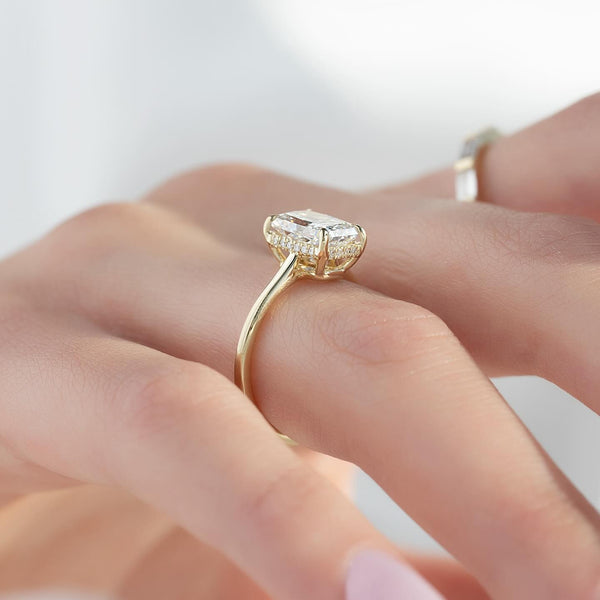
A full halo rings the stone at the face, adding roughly 2.5mm of apparent width and masking a bow-tie. A hidden halo sits beneath the girdle facing outward, adding a line of light visible only from the side and raising the stone 1–2mm. If you want the centre to look bigger, only the full halo does that.
Two settings, one word, opposite jobs. People routinely order a hidden halo expecting a full halo's benefits, and the disappointment arrives once the ring is on a hand and the centre stone looks exactly the size it always was.
Here is what each one actually does. For the general background on the hidden halo as a detail, we have written what is a hidden halo separately.
Side by side
| Full halo | Hidden halo | |
|---|---|---|
| Where the stones sit | Around the outline, facing up | Below the girdle, facing outward |
| Apparent size added | ~2.5mm of width | None |
| Masks a bow-tie | Yes | No |
| Visible from above | Obviously | No — that is the point |
| Effect on profile height | Little | Raises the stone 1–2mm |
| Effect on fire | Multiplies it — 25–45 more dispersing stones | Adds little at the face |
| Settings to maintain | 25–45 | 20–30 |
| Straight wedding band | Rarely fits | Rarely fits |
The fire question, which matters most with moissanite
A full halo does not just add small stones. It adds twenty-five to forty-five small brilliants, every one of them dispersing light independently.
With a diamond centre — dispersion 0.044 — that reads as extra sparkle. With a moissanite centre, dispersion is 0.104, more than twice as strong, and a full halo multiplies an effect that is already the loudest thing about the stone. On a large moissanite this is the difference between a ring that reads rich and one that reads like a light show.
Which flips the usual advice. If your centre is a big moissanite and you want presence rather than rainbow, the hidden halo is arguably the better choice precisely because it contributes nothing at the face. And if you want apparent size without extra fire, neither halo is the answer — a wide bezel rim or step-cut side stones give width with far less dispersion.
The height cost of the hidden version
A hidden halo needs vertical room between the girdle and the top of the basket. That room is the 1–2mm it adds to profile height, and profile height is fixed at casting — it cannot be changed afterwards and it is invisible in the top-down render most people approve from.
On a rounded stone that is a comfort question: more catching on clothing, more knocks. On a pointed stone it is a leverage question. Raising a marquise or pear lengthens the lever arm acting on the tips, so the same knock delivers more force exactly where the stone is thinnest.
The answer is not to drop the look. Ask for a low-profile hidden halo: halo stones tucked tight beneath the girdle with the basket shortened to compensate. You keep the side-view line of light and recover most of the height. It is a CAD edit rather than a listed product, on our site or anyone else's, so it exists only if you ask.
From our bench in Surat
The hidden halo is the detail we most often talk customers into modifying rather than dropping, and the conversation is nearly always the same. They want the profile view. Almost nobody wants the extra two millimetres of height that normally arrives with it. Those two things are separable and the standard build treats them as one.
The honest bit: the version shown in catalogues — ours included — is the version that photographs well from three-quarters on, and that build wants height because height is what makes the halo visible in a product shot. The better ring to actually wear is the shorter one, and it is not the one on the page.
Match the choice to the goal
- Want the centre to look larger? Full halo. It is the only setting that genuinely adds apparent width.
- Want to soften a bow-tie on a marquise or oval? Full halo. The bright frame does the work.
- Want detail from the side while leaving the face-up look untouched? Hidden halo. This is exactly its job.
- Want size without extra fire? Neither. Use a wide bezel rim or step-cut side stones.
- Want the lowest profile and least maintenance? Neither. A plain four- or six-prong head, or a bezel.
- Want both? They can be combined, but count the settings first — that build has fifty to seventy stones to check every two years.
What to specify at CAD
- Which halo, and what you expect it to do — say the goal out loud.
- Low-profile build if it is a hidden halo.
- Side elevation with profile height stated in millimetres.
- Total halo stone count, so you know the maintenance load.
- V-prongs on any pointed centre stone, whichever halo you choose.
- Open gallery, so the pavilion can be cleaned through the setting.
- The contoured wedding band drawn from the same file.
Keep reading
Frequently asked questions
Does a hidden halo make the centre stone look bigger?
No. It sits below the girdle, so it contributes nothing to the face-up view where apparent size is judged. A full halo adds roughly 2.5mm of apparent width; a hidden halo adds detail visible only from the side.
Which halo is better with a moissanite centre?
It depends what you want. Moissanite disperses light at 0.104 against diamond's 0.044, and a full halo multiplies that with twenty-five to forty-five extra dispersing stones. If you want presence rather than rainbow on a large moissanite, the hidden halo contributes nothing at the face — which here is an advantage.
How much height does a hidden halo add?
Typically 1–2mm, because the halo needs vertical room between the girdle and the basket. A low-profile build recovers most of it. Ask for profile height in millimetres on the side elevation before approving the CAD, since it is fixed at casting.
Can you have both a hidden halo and a full halo?
Yes, and it is a genuine style. Count the consequences first: that build carries roughly fifty to seventy small stones, all of which need checking every two years, and it sits high. It also makes a contoured wedding band certain rather than likely.
Can a hidden halo be added to an existing ring?
Not to an existing head. The halo is part of the basket architecture, which is fixed at casting, so it means replacing the head entirely. That is possible bench work but it is a rebuild rather than an addition.
Tell us the goal, not the setting name
Made to order in our Surat workshop — halo type, stone count and profile height are all decided before casting.
Leave a comment