Buying strategy
Buy the Structure, Not the Stone
Stones can be swapped for the life of the ring. Four things cannot be changed after the metal is poured — and they are the ones people spend least on.
Written by the Mapple Gems workshop, Surat · Updated 25 August 2026
Short answer
A centre stone can be swapped, a head replaced, a halo added and a shank rebuilt — but profile height, gallery architecture, overall geometry and shank thickness are fixed at casting. On a constrained budget the right move is a modest stone in a well-built ring, because the stone is the part you can upgrade later.
Almost every budget conversation about an engagement ring is a conversation about the stone. How many carats, which grade, which shape. The ring itself arrives as whatever came attached to it.
That order made sense when the stone dominated the price. It makes much less sense now that lab grown prices have fallen and settled near production cost while gold has not — on many modest rings the metal and labour now cost more than the stone. And it never made sense structurally, because the stone is the one component that stays replaceable forever.
What can change later, and what cannot
| Component | Changeable after casting? | What it takes |
|---|---|---|
| Centre stone | Yes | Unset and reset, if the new stone matches the seat |
| Head and prongs | Yes | A separate component; can even be a different metal |
| Halo or side stones | Usually | Generally a new head built around the same stone |
| Shank thickness | Only by reshanking | Real bench work — possible but not trivial |
| Finish | Yes | Polished, brushed and matte swap freely |
| Profile height | No | A new ring |
| Gallery architecture | No | A new ring |
| Overall geometry | No | A new ring |
The bottom three rows are the whole argument. They are also the three that are invisible in the top-down render most people approve a design from, which is why they get decided by accident rather than on purpose.
The four specifications to protect
Shank thickness — 1.8mm minimum at the base, 2mm under a large stone. Width is cosmetic and can taper toward the head to make the stone read larger. Thickness is structural and almost no listing states it. This single number decides whether the ring needs bench work in year ten or year twenty.
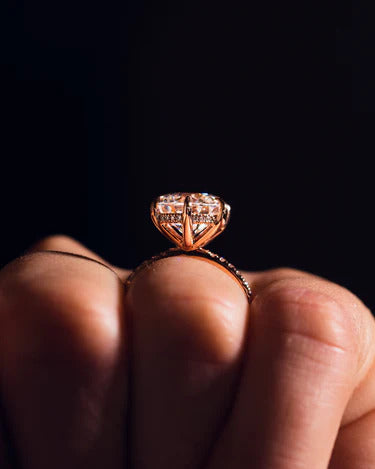
Profile height, in millimetres, on a side elevation. How far the stone sits above the finger determines how much the ring catches, how well a wedding band meets it, and how much leverage a knock has on the setting. Fixed at casting.
An open gallery. The structure under the stone. Light entering from beneath fills the pavilion, and it is the only way the underside can be cleaned — product film collects there and causes nearly every "my stone went dull" message.
Prong placement and count. Prongs at the shoulders rather than on thin tapered tips; V-prongs over any point; six rather than four above roughly 2ct. The head can be replaced later, but a stone chipped in the meantime cannot be unchipped.
From our bench in Surat
The rings that come back to us early are almost never the ones with modest stones. They are the ones with thin shanks — and thin shanks are widely sold because they photograph better than thick ones. A delicate band makes a stone look larger in a product image. It also goes out of round under a heavy head within a few years, and once the shank deforms the setting above it stops sitting square.
So the awkward version, since it argues against the more photogenic option we could sell you: if the budget is tight, take the smaller stone and keep the 1.8mm. A modest stone in a well-built ring is a ring for life with an upgrade available whenever you want it. A large stone on a thin band is a repair with a deadline.
Why this works better with an alternative
The strategy depends on the stone being genuinely replaceable, and alternatives make that easier in two ways.
First, the cost of the swap is low. Replacing a moissanite or a modest lab grown centre later is a fraction of what it would be with a mined stone, so "upgrade in ten years" is a real plan rather than a comforting sentence.
Second, no laboratory grades cut on a fancy shape and moissanite is not graded at all, which means the stone's quality was always a judgement rather than a document. Nothing is lost by treating it as a component.
One practical caution: a head is built to a stone's actual measurements, not to a carat figure. Seats are cut to that particular girdle, so two nominally identical stones are not interchangeable. A later swap is easiest when the new stone matches the old one's millimetres closely — and going significantly larger usually means a new head, which is exactly why the head being replaceable matters more than the stone being small.
Where to save instead
Savings that cost you nothing visible:
- Colour grade matched to the metal. H–I in yellow or rose gold; G or better only in white metals. Buying above that pays for a difference the setting removes.
- Clarity by position rather than grade. A well-placed SI1 beats a badly-placed VS2 and costs less. Open the plot diagram.
- Just under a round carat figure. 1.90 rather than 2.00 is fractionally smaller and sits below a pricing threshold.
- A tapered shank. The only lever that improves apparent size, comfort and price at the same time.
- Three-quarter pavé rather than full eternity, which looks identical on the hand and stays resizable.
And the one saving that is never worth it: a thinner shank. It is invisible in photographs and it is the thing that ends rings.
Keep reading
Affordable diamond alternative engagement rings
Frequently asked questions
Can I upgrade the centre stone in my engagement ring later?
Usually yes. The stone is the most replaceable component, and with an alternative the cost of swapping is low enough that it is a real plan. Bear in mind a head is built to a stone's actual measurements, so a significantly larger stone generally needs a new head as well.
What cannot be changed after a ring is made?
Profile height, gallery architecture and the ring's overall geometry are fixed the moment metal is poured. Shank thickness can only be changed by reshanking. Everything else — stone, head, halo, finish — remains open.
Is a smaller stone in a better setting really the right choice?
On a constrained budget, yes. The stone stays upgradeable for the life of the ring while the structure does not, and a shank under about 1.8mm goes out of round under a heavy head within a few years, after which the setting stops sitting square.
Which savings are invisible and which are not?
Invisible: a colour grade the metal hides, clarity chosen by position, a weight just under a round carat figure, a tapered shank, three-quarter rather than full pavé. Not invisible in the long run: a thinner shank, which is the one saving that ends rings.
Why does profile height matter so much?
It decides how much the ring catches on things, how well a wedding band meets it, and how much leverage a knock has on the setting — and it is fixed at casting. Ask for it in millimetres on a side elevation, because it is invisible in a top-down render.
Specify the structure first
Every piece is made to order in our own workshop in Surat, so shank thickness, profile height and gallery are all still choices until we cast.
Leave a comment