Engagement Rings
Toi et Moi Rings: The Two-Stone Setting Explained
Two stones, one ring — and a set of decisions that do not exist with a solitaire.
Written by the Mapple Gems workshop, Surat · Updated 25 August 2026
Short answer
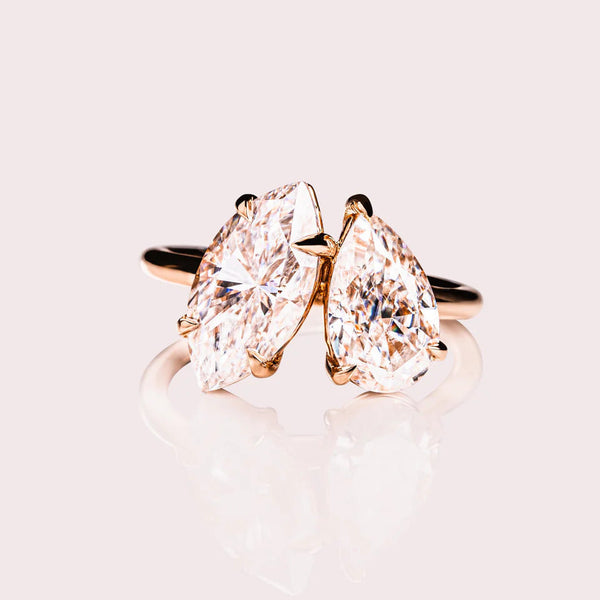
Toi et moi — French for “you and me” — sets two stones side by side on one band, usually of similar size and often of different shapes. The design is centuries old and was revived heavily in recent years. The decisions unique to it: whether the stones are equal or deliberately unequal, whether they sit level or one slightly higher, and which way the ring is oriented on the finger — because unlike a solitaire, a toi et moi has a right way up.
Most ring designs are variations on framing a single stone. Toi et moi is not — it is a genuinely different structure, and that means a different set of questions before you order one.
Equal stones or unequal?
The first decision, and the one that changes the character most.
- Equal stones — two of the same size and shape. Balanced, symmetrical, and the reading is obvious: two equal parts. This is the version that photographs best and the one most people picture.
- Matched shapes, unequal sizes — a larger stone with a smaller companion. Reads more like a solitaire with a partner, and costs less than two large stones.
- Different shapes — a pear with an oval, a marquise with a round. The most interesting version visually, and the hardest to get right, because two shapes have to share one setting and one visual weight.
If you go for different shapes, the practical rule is to match the face area rather than the carat weight. A 1 ct pear and a 1 ct round do not look the same size — the pear looks larger. Matching by millimetre face area keeps the balance.
Orientation: the thing nobody mentions
A solitaire has no wrong way round. A toi et moi does.
The two stones sit along a diagonal, and which stone ends up nearer the knuckle changes how the ring reads on your hand entirely. Worn one way it flows toward the fingertip; the other way it flows back toward the wrist.
Decide this before it is made, and specify it as “larger stone toward the fingertip” or whichever you want. Then be aware that a toi et moi is more prone to rotating than a solitaire, because the weight is distributed along the band rather than centred — which brings us to the next point.
The spinning problem, and why it is worse here. A solitaire’s weight sits over one point, so when it rotates it is obvious and you correct it. A toi et moi’s weight is spread along the band, so it drifts a few degrees at a time and settles crooked without you noticing — and a toi et moi worn crooked looks like a mistake rather than a design. The fix is not soldering. It is getting the size properly snug, and asking for sizing beads inside the shank at the outset. Ask for both when you order rather than discovering it in month two.
The wedding band question
Harder than average, and worth settling before the ring is cast.
Because the two stones sit along a diagonal, the ring’s profile is asymmetric — one side of the shank meets a stone lower than the other. A straight band will usually sit flush on one side and show a gap on the other.
Three workable answers:
- A contoured band cut to the actual profile — the proper solution, and much cheaper if ordered at the same time as the ring.
- Wear the band on the other hand — increasingly common with unusual engagement rings, and it removes the problem entirely.
- A very narrow straight band — at 1.5 mm or so the gap is small enough to read as intentional.
Two stones means two of everything
A practical point that affects cost and construction more than people expect.
- Two settings to build — more bench time than a solitaire, which is why a toi et moi with two 1 ct stones costs more than a solitaire with one 2 ct stone despite similar total weight.
- Two stones to match — they must be consistent in colour and cut quality, or the difference is visible precisely because they sit adjacent. This is the strongest argument for moissanite or lab grown here: consistent material makes matching straightforward.
- Two sets of prongs to check — a little more maintenance, though far less than a halo.
- A wider footprint — two stones side by side occupy more finger than one, so the same total carat weight reads considerably bigger. That is the design’s real value argument.
Is it a trend?
The style is genuinely old — it appears well before the modern revival — so it is not an invention of the last few years. But its current visibility is a revival, and revivals cycle.
The honest framing: a toi et moi will always read as a deliberate design choice rather than a default. If you like that, it is a strength. If you want a ring that will never look of a particular moment, a solitaire is the safer answer, and there is no shame in wanting that.
Keep reading
- Three stone settings explained
- Contour bands: do you need one?
- MM to carat conversion charts — for matching face area
Frequently asked questions
What is a toi et moi ring?
A ring set with two stones side by side on one band, from the French for “you and me”. The stones may be equal or deliberately unequal, and are often of different shapes. It is a centuries-old design that has been revived strongly in recent years.
Should the two stones be the same size?
Either works, but if you use different shapes, match them on face area in millimetres rather than on carat weight. A 1 ct pear looks larger than a 1 ct round because it spreads its weight across a bigger visible surface, so matching by carat produces a visibly unbalanced ring.
Do toi et moi rings spin on the finger?
More readily than a solitaire, because the weight is distributed along the band rather than centred over one point, so it drifts gradually and settles crooked without you noticing. Get the size properly snug and ask for sizing beads inside the shank when you order, rather than resorting to soldering later.
Can you wear a wedding band with a toi et moi ring?
Yes, but the ring’s profile is asymmetric, so a straight band typically sits flush on one side and gaps on the other. The options are a contoured band cut to the actual profile — much cheaper if ordered alongside the ring — a very narrow straight band where the gap reads as intentional, or wearing the band on the other hand.
Two stones, matched properly.
We match on face area, not carat — and we will ask which way up you want it before we cast.
Leave a comment